
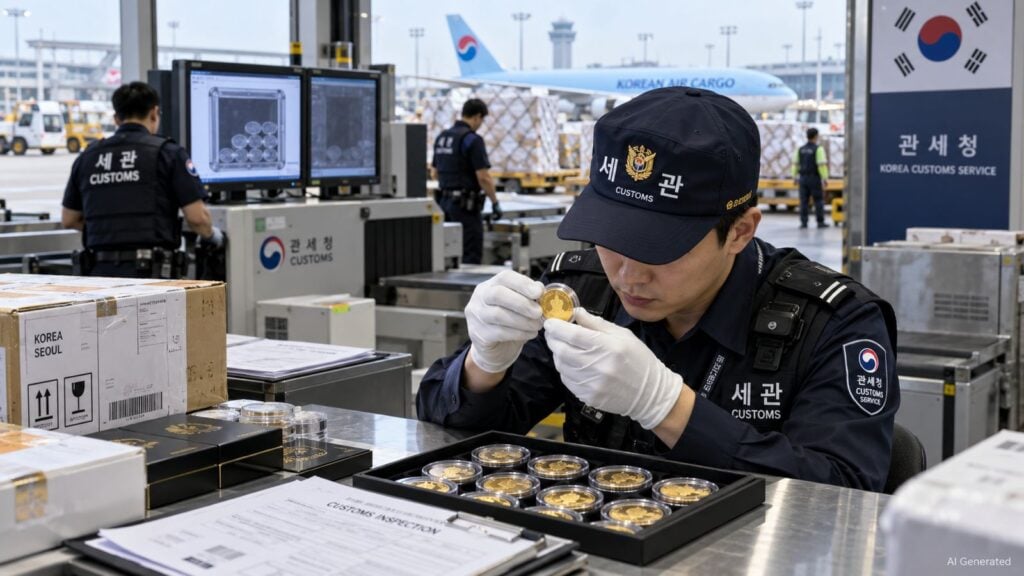
Coin shipments to South Korea are comparatively straightforward when it comes to ordinary customs duty. The tariff headings typically used for modern coins under heading 7118 are generally duty-free in South Korea. The main cost factor is therefore usually South Korean Value-Added Tax (VAT) at 10%.
For collectors of gold coins, there is an important difference compared with Taiwan: South Korea does not provide a general import VAT exemption for modern gold coins solely because they have a high gold fineness. A Maple Leaf, Libertad or Vienna Philharmonic containing 99.9% or 99.99% gold is not exempt from import VAT simply because of its fineness.
For typical modern gold and platinum coins, 10% import VAT should therefore generally be expected unless a specific exemption or an additional special consumption tax applies in the individual case.
High-value numismatic coins also involve practical import requirements. For express shipments with a goods value above USD 2,000, a regular Import Declaration is generally required. Private buyers also regularly need their Personal Customs Clearance Code (PCCC) for e-commerce imports. South Korea’s low-value threshold of USD 150 is therefore usually of little practical relevance for rare gold and platinum coins.
This overview is intended primarily for private collectors in South Korea who buy modern numismatic gold or platinum coins from a dealer in Germany and receive them by UPS, FedEx or another express carrier.
Coin shipments to South Korea: the key rules
| Topic | South Korea |
|---|---|
| 7118.10 / 7118.90 | Generally 0% customs duty for the typical coin headings |
| Gold coins | HSK 7118901000 (Harmonized System of Korea); basic customs duty 0%, but generally 10% import VAT |
| Silver coins | HSK 7118902000; basic customs duty 0% |
| Other coins | HSK 7118909000; basic customs duty 0% |
| Import VAT | Standard rate 10% |
| Gold coins with 99.9% or 99.99% gold | No general import VAT exemption based solely on gold fineness |
| Platinum coins | If correctly classified as coins, generally duty-free; normally 10% import VAT |
| Individual Consumption Tax | For certain precious-metal products, 20% on the portion of the taxable base exceeding KRW 5 million per item (5 million South Korean won), plus Education Tax equal to 30% of the Individual Consumption Tax |
| Customs value | Generally the transaction value plus, among other things, international freight and insurance, in practice broadly CIF-oriented (Cost, Insurance and Freight) |
| Low-value threshold | For personal imports from Germany, generally USD 150 |
| Express shipments | Up to USD 150, possibly List Import Declaration; over USD 150 up to USD 2,000, simplified import declaration; over USD 2,000, regular import declaration |
| PCCC | Personal Customs Clearance Code, important for private e-commerce imports |
| UPS Disbursement Fee | 2.5% of import duties and taxes advanced by UPS, minimum KRW 21,600 per shipment |
Modern coins under heading 7118 are generally duty-free
The current South Korean customs tariff classifies coins under heading 7118. The basic duty rates for the typical coin categories are listed as “Free”, meaning 0%.
The Korean HSK tariff subdivision, HSK meaning Harmonized System of Korea, includes among others the following codes:
- 7118100000: coins other than gold coins, not being legal tender
- 7118901000: gold coins
- 7118902000: silver coins
- 7118909000: other coins
For a typical modern legal-tender gold coin such as a Krugerrand, Maple Leaf, Libertad or American Gold Eagle, no ordinary import duty therefore generally applies when it is correctly classified under heading 7118.
The Free Trade Agreement between the European Union and South Korea is normally not decisive for this point because the regular basic customs duty for the relevant coin headings is already 0%.
Numismatic collectors’ pieces under heading 9705
The South Korean customs tariff also provides a 0% duty rate for heading 9705, covering collections and collectors’ pieces of, among other things, numismatic interest. The Korea Customs Service (KCS) also notes in its classification guidance on banknotes, coins and old money that genuine old collectible money may fall under Chapter 97 depending on its objective characteristics.
For modern coins, however, this heading cannot be derived from collector value alone. Proof quality, PF70, PR70, Top Pop status, a low mintage or certification by NGC or PCGS does not automatically turn a modern coin into a collectors’ piece under heading 9705. The customs classification of the specific item remains decisive.
For most modern gold and platinum coins sold by Wasserthal RareCoin.Store, heading 7118 is therefore the natural starting point for classification.
Import VAT: 10%
South Korea’s Value-Added Tax Act sets the standard VAT rate at 10%. For imported goods, the tax is not calculated only on the purchase price.
Under Article 29 of the Value-Added Tax Act, the taxable base for import VAT consists of the customs value plus customs duty and, where applicable, other domestic excise taxes and charges.
For an ordinary gold or platinum coin that is correctly classified under heading 7118 with 0% customs duty and is not subject to Individual Consumption Tax or another special excise tax, the practical calculation can therefore be simplified as follows:
Import VAT = customs value × 10%
A coin with a customs value of, for example, EUR 10,000 would therefore generally generate around EUR 1,000 in import VAT before any private clearance or advancement fees charged by the courier are taken into account.
If Individual Consumption Tax applies in addition, that tax and the Education Tax levied on it are also included in the taxable base for import VAT.
Gold coins: no general VAT exemption based on fineness
For gold coins, it is particularly important not to confuse South Korean rules with those of other Asian countries. The South Korean Value-Added Tax Act contains no general import VAT exemption for gold coins based solely on a fineness of 99.9% or 99.99%.
The following modern gold coins, for example, are therefore not exempt from import VAT merely because of their high gold content:
- Canadian Gold Maple Leaf
- Mexican Gold Libertad
- Vienna Philharmonic
- Australian Kangaroo and other modern Australian gold coins
The same is even more clearly true of characteristics such as Proof, PF70, PR70, Top Pop or a very low mintage. None of these characteristics creates a VAT exemption on its own.
For comparison, our overview of customs and import taxes for coin shipments to Japan explains the Japanese treatment of gold and platinum coins and Japanese Consumption Tax.
What about South Korea’s special tax regime for gold bullion?
South Korea does have a special tax regime for so-called gold bullion traded through the Gold Spot Market of the Korea Exchange. The scope of this regime is, however, narrowly defined.
Under the Special Tax Treatment Control Act and its Enforcement Decree, it concerns raw-form gold such as gold bars or gold blocks with a purity of at least 99.99%, as well as certain authorised market participants and transactions through the Korean gold market.
This is not a general tax exemption for numismatic gold coins. A 99.99% Maple Leaf does not become tax-favoured gold bullion under this special regime merely because it has the same fineness.
Platinum coins: also generally subject to 10% import VAT
There is likewise no general South Korean import VAT exemption for platinum coins. If a platinum coin is correctly classified as a coin under heading 7118, ordinary customs duty is generally 0%, but the 10% import VAT normally remains payable.
For collectors, this means in practice that a modern gold coin and a modern platinum coin with the same customs value can generally bear the same import VAT burden in South Korea.
Individual Consumption Tax on medals and other precious-metal products
In addition to import VAT, certain high-value precious-metal products in South Korea may be subject to Individual Consumption Tax.
Under the Korean Individual Consumption Tax Act, the tax amounts to 20% on the portion of the taxable base exceeding KRW 5 million per item. KRW means South Korean won. An additional Education Tax equal to 30% of the Individual Consumption Tax is then levied.
For imported goods, the starting point for this calculation is generally the customs value plus any customs duty that may apply. The Individual Consumption Tax and the Education Tax are then included in the taxable base for import VAT.
The distinction is important for numismatic items. A 2018 ruling by the Korean tax administration treated a Nobel Prize gold medal as a taxable precious-metal product. In particular, it did not qualify for the exception for items specially produced for national commemorative events.
The same ruling also refers to an older administrative position concerning legal-tender US Olympic commemorative coins, under which those coins were not subject to the former Special Consumption Tax.
In practical terms, coins, medals and rounds must therefore not simply be treated in the same way for tax purposes. For medals, privately issued pieces, rounds and other high-value precious-metal items without a clear monetary character, it should be checked before import whether South Korea treats them as taxable precious-metal products.
Government-issued coins with legal-tender status may be treated differently. However, the available administrative guidance does not support a general exemption from Individual Consumption Tax for every foreign modern gold coin.
How is the customs value calculated?
In South Korea, the customs value is generally based on the transaction value, meaning the price actually paid or payable, with the legally required additions.
The Korea Customs Service expressly identifies, among other things, freight and insurance premiums as costs that may have to be added to the price paid when determining the customs value.
In practice, the starting point therefore broadly corresponds to a CIF approach. CIF stands for Cost, Insurance and Freight:
Customs value ≈ goods value + international freight + insurance to South Korea
For fully insured high-value coin shipments, the coin price alone should therefore not be used when estimating import VAT.
USD 150: the low-value threshold for personal imports
For express shipments, goods for personal use may under certain conditions benefit from simplified or duty-free treatment up to USD 150. According to the KCS, the higher USD 200 threshold applies only to goods from the United States and is therefore not relevant to a shipment from Germany.
Importantly, if the applicable USD 150 threshold is exceeded, customs duty and VAT are generally calculated on the basis of the full customs value. There is no automatic tax-free USD 150 allowance that is simply deducted from a more valuable coin.
For modern numismatic gold and platinum coins sold by Wasserthal RareCoin.Store, this threshold is almost always exceeded in practice.
Express shipments: regular import declaration above USD 2,000
The Korea Customs Service distinguishes between several clearance procedures for express shipments:
- up to USD 150: under certain conditions, List Import Declaration for goods for personal use or commercial samples
- over USD 150 up to USD 2,000: Simplified Import Declaration may generally be available
- over USD 2,000: General Import Declaration is required
Certain excluded or permit-controlled goods must be declared under the regular procedure regardless of value.
Because high-value rare gold coins regularly cost more than USD 2,000, typical RareCoin.Store shipments to South Korea will in practice generally require a regular Import Declaration.
Personal Customs Clearance Code: PCCC
A practical difference compared with many other destination countries is South Korea’s Personal Customs Clearance Code (PCCC).
The Korea Customs Service uses this personal customs-clearance code for private imports instead of the Korean Resident Registration Number. For foreign persons importing e-commerce goods, the KCS likewise requires a PCCC. According to the published guidance, a Foreign Registration Number or passport number cannot simply be used as a substitute.
Before a private coin order is shipped, the buyer should therefore ensure that a valid PCCC is available and can be correctly provided to the courier for import clearance.
What information should appear on the commercial invoice?
For a high-value coin, a precise commercial invoice is particularly important. It should include at least:
- exact description of the coin
- country of issue
- year
- face value and currency
- precious metal
- fineness
- quantity
- actual purchase price
- country of origin
- shipping and, where separately stated, insurance costs
For a coin certified by NGC or PCGS, the certification number and grade can also help identify the item clearly. They do not replace either the goods description or the correct customs classification.
North Korean coins are a special case
Coins of North Korean origin should not be treated like ordinary foreign collector coins. South Korea’s Inter-Korean Exchange and Cooperation Act governs the movement of goods between North and South Korea and expressly defines such movement in a way that means transit through a third country does not remove the North Korean origin.
Under Article 13 of that Act, bringing covered goods into South Korea generally requires approval from the South Korean Ministry of Unification unless a specific exception applies.
A North Korean coin that is already located in Germany therefore does not become ordinary German-origin goods merely because it is shipped from Germany. German and European sanctions rules applicable to Wasserthal RareCoin.Store must also be observed independently.
Counterfeit currency is prohibited
The Korea Customs Service expressly lists counterfeit, altered or copied currencies, bonds and securities among the prohibited import items under Article 234 of the Customs Act.
This does not affect genuine numismatic collector coins merely because they are coins. Replicas, fantasy pieces or questionable imitations may, however, require a different legal assessment.
If you take the coin to South Korea yourself
Different rules apply to travellers than to commercial shipments sent by UPS or FedEx. The general traveller duty-free allowance is currently USD 800 for the total value of taxable goods.
If this threshold is exceeded, the relevant goods generally have to be declared. A rare gold coin worth several thousand euros will therefore normally exceed the traveller allowance.
UPS: Disbursement Fee
In addition to government taxes, private fees charged by the courier may arise. UPS Korea currently lists a Disbursement Fee of 2.5% of the import duties and taxes advanced by UPS, subject to a minimum of KRW 21,600 per shipment.
This fee is not a South Korean tax. It is a private service fee charged by UPS for advancing government charges. Other couriers may apply their own clearance, advancement or storage fees.
If you order from Wasserthal RareCoin.Store
Wasserthal RareCoin.Store ships modern numismatic gold and platinum coins internationally with full insurance and clear, traceable commercial and shipping documentation.
For a shipment to South Korea, the following points are particularly important:
- correct customs classification of the coin
- the general 10% import VAT
- possible additional Individual Consumption Tax for certain precious-metal products
- regular import declaration for high-value express shipments
- the private recipient’s Personal Customs Clearance Code
For typical modern gold and platinum coins under heading 7118, ordinary import duty is generally 0%. The buyer should, however, expect South Korean import VAT to be levied on the relevant customs value. High gold fineness, Proof quality or NGC/PCGS grading does not by itself create a tax exemption.
For deliveries outside the European Union, the buyer is responsible for import taxes, clearance charges and other fees arising in the destination country. Our current terms are available under Payment and shipping.
Frequently asked questions about coin shipments to South Korea
What is the import duty on gold coins in South Korea?
Gold coins under heading 7118 are generally duty-free in the South Korean customs tariff. The basic duty rate for HSK 7118901000 is 0%. Correct classification of the specific coin remains decisive.
What is the import VAT rate?
The general South Korean VAT rate is 10%. For a typical duty-free coin under heading 7118, import VAT effectively corresponds to 10% of the relevant customs value if no additional Individual Consumption Tax or other special excise tax applies.
If such an additional tax does apply, it and the related charges are included in the taxable base for import VAT.
Are 99.99% gold coins exempt from import VAT?
No, not merely because of their fineness. South Korea does not provide a general import VAT exemption for modern gold coins containing 99.9% or 99.99% gold. The special regime for high-purity gold on the Korean Gold Spot Market concerns narrowly defined gold bullion and specific market participants, not numismatic gold coins in general.
Is a Krugerrand tax-free?
For ordinary customs duty, generally yes if it is correctly classified as a gold coin under heading 7118: the basic duty rate is 0%. The Krugerrand is not generally exempt from import VAT, however, so 10% import VAT should normally be expected.
Whether Individual Consumption Tax applies must be considered separately. The available Korean administrative guidance does not justify a general statement that every foreign gold coin is automatically exempt from this tax solely because it has legal-tender status.
What applies to Maple Leaf, Libertad or Vienna Philharmonic coins?
These gold coins can also be duty-free when correctly classified under heading 7118. Their high gold fineness does not automatically produce a VAT exemption, so 10% import VAT should generally be taken into account.
Any potentially relevant Individual Consumption Tax must be examined separately from import VAT and ordinary customs duty.
What applies to gold medals, privately issued pieces or rounds?
For high-value precious-metal products without a clear monetary character, Individual Consumption Tax may apply in addition to import VAT. It amounts to 20% of the portion of the taxable base exceeding KRW 5 million per item. An additional Education Tax equal to 30% of the Individual Consumption Tax is also levied.
For medals, rounds and privately issued pieces, the tax classification should therefore be checked before import.
How are platinum coins treated?
If correctly classified as coins under heading 7118, they are generally free of ordinary customs duty. There is, however, no general VAT exemption for platinum coins, so 10% import VAT should normally be expected.
What is the USD 150 threshold?
For personal imports sent by express carrier, duty-free treatment may apply under certain conditions up to USD 150. Once the threshold is exceeded, charges are generally calculated on the full relevant customs value. The special USD 200 threshold for goods from the United States does not apply to shipments from Germany.
What happens if a coin is worth more than USD 2,000?
For express shipments with a goods value above USD 2,000, the Korea Customs Service generally requires a General Import Declaration. This applies to a large share of high-value numismatic gold and platinum coins.
Does a private buyer need a PCCC?
For private e-commerce imports, the Personal Customs Clearance Code is highly important in South Korea. The buyer should have a PCCC before shipment and be able to provide it to the courier for import clearance.
Does PF70 or Top Pop status turn a coin into a collectors’ piece under heading 9705?
No. Grading, Proof quality, Top Pop status, low mintage or high market value are numismatically relevant, but they do not automatically determine the customs heading. The objective characteristics of the specific coin and the Korean customs classification remain decisive.
Can a North Korean coin be shipped from Germany to South Korea?
This should not be treated as an ordinary coin shipment. South Korea has special rules for goods of North Korean origin, including approval requirements under the Inter-Korean Exchange and Cooperation Act. Shipment via Germany does not remove the North Korean origin. German and European sanctions rules must also be checked.
Transparency note
Wasserthal RareCoin.Store is a professional dealer in modern numismatic gold and platinum coins and ships coins to international customers. We therefore have a commercial interest in the topics covered on this page.
The information on customs duty, import VAT, customs value, clearance procedures and import rules is researched independently of the sale of individual products and is based on official sources. This overview also applies to coins purchased from other dealers.
Disclaimer
This information is provided for general guidance only and does not replace individual customs, tax or legal advice.
Tariff classification, customs value, VAT exemptions, Individual Consumption Tax, import procedures and special approval requirements depend on the specific coin and the actual transaction. The South Korean rules in force at the time of import and the decisions of the competent authorities are binding.
About the author
Author: Dirk Wasserthal
Dirk Wasserthal is Managing Director of TriaPrima GmbH, the company operating Wasserthal RareCoin.Store. His focus is on modern numismatic gold and platinum coins as well as high-quality certified collector coins.
Wasserthal RareCoin.Store has already supplied collectors in 40 countries. TriaPrima GmbH is an Authorized Dealer with PCGS and NGC. The company is also a member of the American Numismatic Association (ANA) and the Berufsverband des Deutschen Münzenfachhandels.
Sources and data status
This overview is based primarily on primary sources from the Korea Customs Service (KCS), the Korean National Law Information Center and current fee information from UPS Korea.
- National Law Information Center: Korean Customs Tariff Schedule, in particular heading 7118 with a 0% basic duty rate for the listed coin categories and heading 9705 for numismatic collectors’ pieces.
- Korea Customs Service: Korea Customs Service, English website, current customs and import information.
- Korea Customs Service: Clearance procedures for express cargo, USD 150 threshold, List Import Declaration, Simplified Import Declaration and General Import Declaration.
- Korea Customs Service: Issuance of Personal Customs Clearance Code, PCCC rules for private imports and foreign e-commerce buyers.
- Korea Customs Service: Guide to Customs Valuation, transaction value and additions including freight and insurance premiums.
- National Law Information Center: Value-Added Tax Act, in particular Article 29 on the import VAT base and Article 30 on the general VAT rate of 10%.
- National Law Information Center: Individual Consumption Tax Act, Article 1, taxable goods and tax rates.
- National Law Information Center: Enforcement Decree of the Individual Consumption Tax Act, in particular the KRW 5 million threshold for the relevant high-value products.
- National Law Information Center: Education Tax Act, in particular Article 5 providing for Education Tax equal to 30% of Individual Consumption Tax.
- National Tax Service / documented tax ruling: 서면-2018-소비-1863 of 24 October 2018, tax treatment of a Nobel Prize gold medal and reference to the treatment of legal-tender Olympic commemorative coins.
- National Law Information Center: Special Tax Treatment Control Act, Article 126-7, special regime for gold bullion on the Gold Spot Market.
- National Law Information Center / LBOX: Enforcement Decree, Article 121-7, definition of qualifying gold bullion.
- Korea Customs Service: Prohibited items for import, including counterfeit, altered or copied currencies and securities.
- National Law Information Center: Inter-Korean Exchange and Cooperation Act, definition of movement of goods including transit through a third country.
- National Law Information Center: Inter-Korean Exchange and Cooperation Act, Article 13, approval requirement for bringing covered goods into South Korea.
- Korea Customs Service: Customs Clearance Guide for Passengers, general traveller duty-free allowance of USD 800.
- European Commission: Consolidated list of persons, groups and entities subject to EU financial sanctions.
- UPS Korea: Shipping Costs and Rates, Disbursement Fee of 2.5% of import duties and taxes advanced, minimum KRW 21,600 per shipment.
Content and sources last reviewed: 6 October 2026