
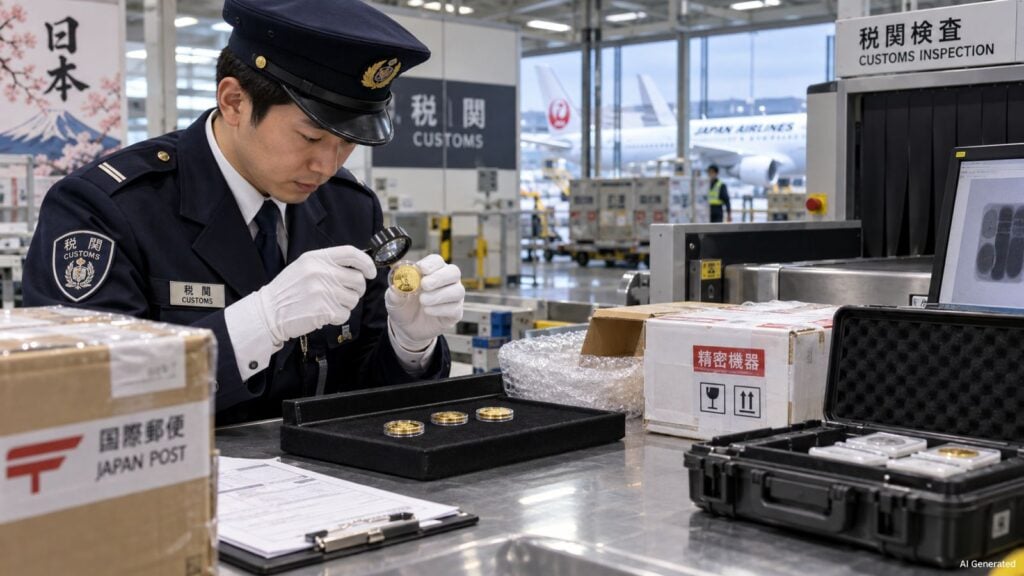
Customs and import taxes for coin shipments to Japan are, at first glance, simpler than in some other countries. Modern gold and platinum coins are generally duty-free under the Japanese customs tariff. For private collectors, however, that is not the end of the matter, because Japanese Consumption Tax may still apply on import.
For collectors, the key point is that 0% customs duty in Japan does not automatically mean 0% tax. A Krugerrand, a Gold Maple Leaf, a Platinum Maple Leaf or a rare PF70 gold coin may fall under heading 7118 for customs purposes and therefore carry 0% import duty. Whether Consumption Tax is also payable must be considered separately. Japan also expressly distinguishes between means of payment and coins imported as collectors’ items or goods for sale.
This overview is intended for private collectors in Japan who buy modern numismatic gold or platinum coins from a dealer in Germany and receive them by courier.
Coin shipments to Japan: the main rules
| Topic | Japan |
|---|---|
| Gold coins under 7118.90-010 | 0% import duty |
| Other coins under 7118.90-090 | 0% import duty; a typical starting point, among others, for modern platinum coins that are legal tender |
| Numismatic collectors’ pieces under 9705.31 / 9705.39 | 0% import duty |
| Consumption Tax | Standard rate of 10% in total: 7.8% national Consumption Tax plus 2.2% Local Consumption Tax |
| Collectors’ items and goods for sale | The tax exemption for means of payment does not apply to coins treated as collectors’ items or goods for sale |
| Low-value threshold | If the total customs value is no more than JPY 10,000 (Japanese yen), import duty and Consumption Tax are generally exempt |
| Personal use | If the import is recognized as being for personal use, the customs value is currently generally assessed at 60% of the foreign retail price |
| Change from 1 April 2028 | The special 60% rule will be abolished; at the same time, the Consumption Tax treatment of small cross-border online purchases will change |
Japan levies Consumption Tax on imported goods
Japan Customs and the National Tax Agency (NTA) generally treat imported goods as taxable. The standard rate is 10% in total. Of this, 7.8% is national Consumption Tax and 2.2% is Local Consumption Tax.
For dutiable goods, Consumption Tax is not calculated only on the value of the goods. The basis is generally the customs value plus import duty and any other applicable domestic excise taxes. For modern gold and platinum coins under heading 7118, however, import duty is 0%, so in practice the determination of the customs value is particularly important.
Means of payment or collector coin? This matters for rare coins
Under Japanese Consumption Tax law, transfers of means of payment such as banknotes and coins may generally be non-taxable. At first glance, that may sound interesting to coin collectors, but it does not automatically apply to numismatic goods sold commercially.
The National Tax Agency expressly states that means of payment are not exempt from tax when they are treated as collectors’ items or goods for sale. For modern numismatic coins purchased from a specialist dealer, normal import taxation is therefore the relevant starting point.
A rare Proof issue, a PF70 or MS70 coin, or a Top Pop coin is not purchased for its face value. Its price is determined by the gold or platinum value, mintage, condition, certification, rarity and collector demand.
Gold coins under 7118.90-010: 0% import duty
The current Japanese customs tariff expressly lists Gold coin under 7118.90-010. The import duty is 0%.
Japan does not use a special minimum fineness requirement for this tariff line. A Gold Krugerrand is therefore not treated differently solely because it contains 91.67% gold than a high-fineness Gold Maple Leaf or Gold Libertad. The decisive point is the correct classification as a gold coin.
The distinction between customs duty and Consumption Tax remains important. 0% import duty does not automatically mean 0% import tax. A gold coin imported as a collectors’ item or goods for sale may still be subject to Japanese Consumption Tax.
Platinum coins: also generally duty-free
Unlike gold coins, platinum coins do not have their own subheading under heading 7118. Modern platinum coins that are legal tender typically fall under 7118.90-090 “Other”. The Japanese customs tariff also shows an import duty of 0% for this line.
Gold and platinum therefore differ less in Japan than, for example, in Malaysia. For both metals, the practical focus is not the customs duty rate but the Consumption Tax and the correct customs value.
Proof, PF70 and Top Pop: legal tender generally remains under 7118
Japan Customs publishes its own tariff classification explanatory notes, which are based on the Explanatory Notes of the World Customs Organization (WCO). For heading 7118, these notes clarify that coins that are legal tender in the country of issue fall under 7118. This also applies when they are offered individually or as sets in presentation cases.
For typical modern series such as the Krugerrand, Maple Leaf, Libertad or American Eagle, 7118 therefore remains the starting point. A Proof finish, a PF70, PR70 or MS70 grade, a low mintage or Top Pop status does not move a legal-tender coin into Chapter 97 solely because of its collector value.
When does heading 9705 come into play?
Chapter 97 includes 9705.31 and 9705.39 for collectors’ pieces of numismatic interest. These tariff lines are also duty-free in Japan.
The Japanese tariff explanatory notes draw a clear distinction. Coins that are still legal tender in the country of issue remain under 7118, even if they are sold in presentation cases. Heading 9705 concerns in particular coins that are no longer legal tender and are genuinely classifiable as collectors’ pieces of numismatic interest.
For our focus on modern numismatics, this means that Krugerrand, Maple Leaf, Libertad and American Eagle generally remain under 7118. PF70, Top Pop status or a high collector premium does not automatically change that classification.
7118 or 9705: both are duty-free, but classification still matters
| Tariff line | Description | Import duty |
|---|---|---|
| 7118.10-000 | Coin (other than gold coin), not being legal tender | Free |
| 7118.90-010 | Gold coin | Free |
| 7118.90-090 | Other | Free |
| 9705.31-000 | Numismatic collectors’ pieces more than 100 years old | Free |
| 9705.39-000 | Other numismatic collectors’ pieces | Free |
The fact that all of these tariff lines are duty-free does not make classification unnecessary. The correct tariff line belongs in the customs declaration and may also be important for tax treatment and later documentation.
How is the customs value determined for a private collector?
Japan has a special rule for genuine private imports. If goods are imported by a private individual for their own personal use and Japan Customs accepts that status, the customs value is currently generally assessed at 60% of the foreign retail price.
For other imports, normal customs valuation generally applies on the basis of the transaction value plus, among other things, transport and insurance costs up to importation into Japan.
For a collector coin ordered by a private buyer for their own collection, this 60% rule may therefore be relevant. If the import is accepted as being for personal use and, as with coins under heading 7118, no import duty applies, the Consumption Tax works out at approximately 6% of the foreign retail price: 10% tax on a customs value of 60%. Japan Customs decides whether the requirements are met in each individual case.
The 60% rule ends on 1 April 2028
Japan has already decided to abolish this special rule for personal imports. The change takes effect on 1 April 2028.
Until then, the current rule remains applicable. From April 2028, the special valuation at 60% of the foreign retail price will be abolished. Consumption Tax will then be calculated on the basis of the customs value determined under the regular rules. For collectors who buy coins directly from foreign dealers, this is an important change.
JPY 10,000: the current low-value exemption
If the total customs value of an import is no more than JPY 10,000, the goods are currently generally exempt from import duty and Consumption Tax. Japan Customs lists certain goods for which this exemption does not apply; typical coin shipments are not among the main exceptions listed there.
The total customs value per declaration is decisive. For postal shipments, the total value of all goods in one parcel counts. If shipments are split only to stay below the threshold, they may be combined when they are sent by the same sender at the same time to the same recipient.
For high-value modern gold and platinum coins, this threshold naturally rarely plays a role in practice. It may still be relevant for smaller numismatic items.
The low-value rule will also change from April 2028
Japan is also reforming the Consumption Tax treatment of small cross-border online purchases. From 1 April 2028, certain goods sold online with a value of up to JPY 10,000 will no longer remain free of Consumption Tax solely because of the current low-value exemption.
Instead, for the relevant cross-border online sales, tax responsibility will shift more strongly to foreign sellers or platforms. For coin collectors, this is mainly relevant to small online orders. High-value gold and platinum coins are usually well above this threshold anyway.
How is Consumption Tax calculated?
The Japanese standard rate consists of 7.8% national Consumption Tax and 2.2% Local Consumption Tax. Together they amount to 10%.
On import, the importer is generally liable for the tax, meaning the person who takes possession of the goods after customs clearance. This does not apply only to businesses. A private individual may also owe Consumption Tax on import.
The tax base generally consists of the customs value plus import duty and any other applicable excise taxes. Because modern coins under heading 7118 are duty-free in Japan, no additional customs duty amount enters this calculation for typical coin shipments.
Simplified tariff rates up to JPY 200,000 are rarely relevant to coins
Japan has simplified tariff rates for many imports with a total customs value of up to JPY 200,000. These simplified rates do not apply, however, to goods that are already duty-free under the normal customs tariff.
For modern coins under heading 7118, this rule therefore normally has no practical significance. The regular customs tariff already provides a 0% rate.
Customs declaration and courier clearance
An Import Declaration must generally be submitted for imported goods. The declaration includes, among other things, the importer, description of the goods, quantity, value, origin and place of shipment. Since 12 October 2025, all imports must also state the domestic destination and the type of shipment. For mail-order goods, the name of the electronic platform used must also be provided.
For express shipments, the courier or its customs agent normally handles the technical customs clearance on behalf of the recipient. A complete commercial invoice, a clear description of the goods, the actual purchase price, origin and the correct tariff classification are therefore particularly important.
UPS and FedEx: private clearance fees
In addition to government Consumption Tax, private fees charged by the shipping provider may arise.
Since 20 September 2026, UPS Japan has charged a Disbursement Fee on imports of 2.5% of the duties and taxes advanced by UPS, with a minimum of JPY 1,920 per shipment.
FedEx Japan also charges Advancement, Disbursement or Duty Handling fees when FedEx advances duties and taxes for the recipient during customs clearance. The relevant fees were adjusted on 3 August 2026.
These amounts are not Japanese taxes or customs duties, but private service fees charged by the respective courier.
If you order from Wasserthal RareCoin.Store
Wasserthal RareCoin.Store ships modern numismatic gold and platinum coins to Japan fully insured and with clear commercial and shipping documentation. Japan is one of our regular international shipping destinations.
For deliveries outside the European Union, the buyer is responsible for any import charges, taxes and other fees incurred in the destination country. Wasserthal RareCoin.Store does not calculate these amounts itself. Our current shipping terms can be found under Payment and shipping.
If you are also interested in Japanese numismatics, our article Japanese Gold Commemorative Coins: Motifs and Value provides further background on this collecting area.
Frequently asked questions about coin shipments to Japan
Are gold coins duty-free when imported into Japan?
Yes. Gold coins under 7118.90-010 are listed as “Free” in the current Japanese customs tariff. This means 0% import duty.
Does Japanese Consumption Tax still apply?
For collectors’ items and goods for sale, generally yes, unless a specific exemption applies. The fact that a coin is legal tender or falls under a duty-free tariff line does not automatically mean that it is exempt from Consumption Tax.
Are Krugerrand, Maple Leaf and Libertad treated differently?
Not for import duty, provided they are correctly classified as gold coins under 7118.90-010. The tariff line is duty-free and contains no special minimum fineness requirement.
How are platinum coins treated?
Modern platinum coins that are legal tender typically fall under 7118.90-090 “Other”. This tariff line is also duty-free. Consumption Tax may nevertheless apply.
Can a PF70 or Top Pop coin fall under 9705 because of its collector value?
Not for that reason alone. Japan Customs makes clear that coins that are legal tender in the country of issue remain under 7118, including when presented in cases. Proof status, grading, low mintage or Top Pop status does not automatically change this.
When is 9705 relevant?
Primarily for coins that are no longer legal tender and are genuinely classified as collectors’ pieces of numismatic interest. The Japanese tariff lines 9705.31 and 9705.39 are also duty-free.
What does the JPY 10,000 threshold mean?
If the total customs value is no more than JPY 10,000, import duty and Consumption Tax are currently generally exempt. Multiple goods in one shipment are added together. Artificially split shipments may also be combined.
What does the 60% rule mean for private imports?
If the import is accepted as goods for personal use, Japan Customs currently generally assesses the customs value at 60% of the foreign retail price. This special rule is due to end on 1 April 2028.
Is the JPY 10,000 rule permanent?
No. Japan has adopted a reform of the Consumption Tax treatment of small cross-border online purchases for 1 April 2028. The current treatment of orders up to JPY 10,000 will change as a result.
Are UPS or FedEx fees Japanese taxes?
No. Disbursement, Advancement and Duty Handling fees are private service fees charged by the courier.
Transparency notice
Wasserthal RareCoin.Store is a specialist dealer in modern numismatic gold and platinum coins and ships coins to international customers. We therefore have a commercial interest in the topics covered on this page.
The information on customs, Consumption Tax and import rules is researched independently of the sale of individual products and is based on official sources. This overview also applies to coins purchased from other dealers.
Disclaimer
This information is provided for general guidance and does not replace individual customs, tax or legal advice.
Tariff classifications, tax rates, exemptions, customs values and clearance procedures may change and depend on the specific goods and shipment. The Japanese rules in force at the time of import and the decision of the competent Japanese authorities are authoritative.
About the author
Author: Dirk Wasserthal
Dirk Wasserthal is Managing Director of TriaPrima GmbH, the company operating Wasserthal RareCoin.Store. His focus is on modern numismatic gold and platinum coins as well as high-quality certified collector coins.
Wasserthal RareCoin.Store has already supplied collectors in 40 countries. TriaPrima GmbH is an Authorized Dealer with both PCGS and NGC. The company is also a member of the American Numismatic Association (ANA) and the German professional association of coin dealers.
Sources and review date
This overview is based primarily on primary sources from Japan Customs, the Japanese National Tax Agency and the Ministry of Finance, as well as current fee information from the shipping providers.
- Japan Customs: Japan’s Tariff Schedule 2026, Chapter 71, in particular 7118.10, 7118.90-010 and 7118.90-090.
- Japan Customs: Japan’s Tariff Schedule 2026, Chapter 97, in particular 9705.31 and 9705.39.
- Japan Customs: Tariff Classification Explanatory Notes, Chapter 71, in particular the classification of coins that are legal tender under heading 7118.
- Japan Customs: Tariff Classification Explanatory Notes, Chapter 97, in particular the distinction between 7118 and 9705.
- National Tax Agency: Consumption Tax basics, standard tax rate and taxation of imported goods.
- National Tax Agency: Consumption Tax and Local Consumption Tax rates, breakdown of the 10% standard rate.
- National Tax Agency: Imported transactions, tax base for Consumption Tax on imports.
- National Tax Agency: Consumption Tax Basic Circular, No. 6-2-3, in particular the note concerning collectors’ items and goods for sale.
- Japan Customs: Duty exemption for goods at a total customs value of 10,000 yen or less, low-value exemption and aggregation of shipments.
- Japan Customs: Simplified tariff for low-value imports, the 60% rule for personal imports and treatment up to JPY 200,000.
- Japan Customs: Customs valuation guidance, in particular customs valuation for personal imports.
- Ministry of Finance Japan: 2026 Customs Tariff Law amendment, abolition of the special 60% rule from 1 April 2028.
- Ministry of Finance Japan: Review of the small-value import tax exemption, planned Consumption Tax treatment from 1 April 2028.
- Japan Customs: Items to be described in the Import Declaration Form, in particular domestic destination, type of shipment and platform information for mail-order goods.
- UPS Japan: Shipping Costs and Rates, Disbursement Fee for Japan from 20 September 2026.
- FedEx Japan: Service News and Alerts, adjustment of clearance-related fees on 3 August 2026.
Content and sources last reviewed: 4 October 2026