
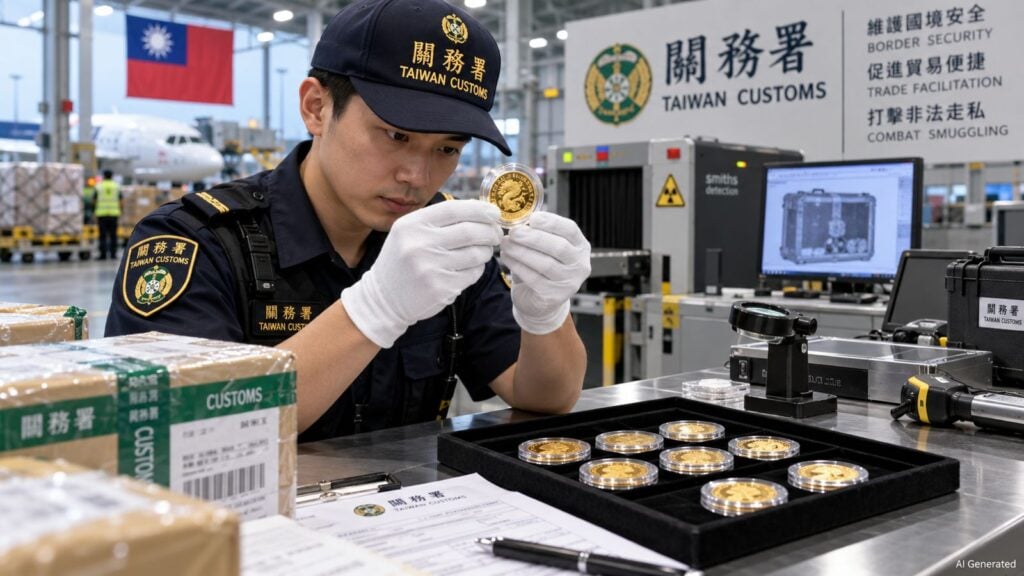
Customs duties and import taxes on coin shipments to Taiwan are comparatively straightforward at first glance: the relevant coin headings in Taiwan’s customs tariff under 7118 are generally listed with 0% customs duty. The tax treatment, however, is more interesting because gold and platinum coins are not treated in the same way.
Taiwan generally levies a Business Tax on imported goods, a tax similar to value added tax. The standard rate is currently 5%. Gold coins can benefit from an important exemption which, under the customs manual used for imports, is linked to a gold fineness of at least 99.9%. 22-karat coins such as the Krugerrand and the American Gold Eagle fall below this threshold, so 5% Business Tax should be expected. There is no corresponding exemption for platinum coins: Article 8 of the Business Tax Act refers to gold, not platinum. Platinum coins should therefore generally also be expected to incur 5% Business Tax.
For high-value collector coins, a few practical points also matter: the customs value generally includes the purchase price, freight and insurance; high-value shipments require a regular import declaration; and private or non-regular importers may require an import permit where the FOB value (Free on Board, meaning the value of the goods up to the point of export) exceeds USD 20,000.
Particular attention is also required for coins of mainland China origin. Taiwan maintains separate lists of permitted, conditionally permitted and non-permitted goods of mainland Chinese origin. Shipment from Germany does not change the origin of the coin. Our separate overviews for mainland China and Hong Kong cover their import systems separately.
Coin shipments to Taiwan: the key rules
| Topic | Taiwan |
|---|---|
| Customs duty on coins | The current coin headings under 7118 are generally listed with 0% customs duty; correct CCC classification remains decisive |
| Business Tax | Standard import rate 5%; gold coins may be exempt from Business Tax |
| Gold coins | Exempt at a gold fineness of at least 99.9% under the customs manual; the Krugerrand and American Gold Eagle at 91.67% do not meet this purity threshold |
| Platinum coins | No corresponding exemption: Article 8 of the Business Tax Act refers to gold, not platinum; generally 5% Business Tax |
| Customs value | Generally Cost, Insurance and Freight (CIF): FOB value or the relevant value of the goods plus freight and insurance |
| Trade Promotion Service Fee | 0.04% of the customs value; amounts of TWD 100 or less are not collected |
| Low-value threshold | For postal and express shipments, the low-value tax threshold is generally TWD 2,000 |
| Express shipments | Up to TWD 2,000: X2; TWD 2,001 to 50,000: X3; over TWD 50,000: X4 and the regular procedure |
| Private / non-regular importers | Non-restricted goods with an FOB value up to USD 20,000 can generally be imported without an import permit; above this threshold a permit may be required |
| Mainland China origin | Additional product-specific origin and import rules apply; not every Chinese coin is treated in the same way |
0% customs duty on the typical coin headings
Taiwan’s customs tariff uses so-called CCC codes (Commodity Classification of the Republic of China). For coins, the current classification includes the following headings:
- 7118100010 – silver coins not being legal tender
- 7118100090 – other coins, except gold coins, not being legal tender
- 7118901000 – gold coins
- 7118909010 – other silver coins, including currency
- 7118909090 – other coins, including currency
The relevant coin headings under 7118 are generally listed with 0% customs duty in Taiwan’s current customs tariff. For shipments from Germany, the first tariff column generally applies; this includes goods from members of the World Trade Organization (WTO).
This does not mean that the exact tariff classification is unimportant. It can remain relevant for import rules, origin, statistical reporting and tax treatment. A low mintage, Proof quality, high market value or grading by the Numismatic Guaranty Company (NGC) or Professional Coin Grading Service (PCGS) does not automatically determine the customs classification.
Business Tax: the key difference between gold and platinum
Taiwan refers to its value-added-type tax as Business Tax. The standard rate on taxable imported goods is currently 5%.
The taxable amount generally consists of the customs value plus customs duty and, where applicable, other excise-type charges. For ordinary collector coins without such additional charges, the basic logic can be simplified as follows:
Business Tax = (customs value + customs duty) × 5%
Because the typical coin headings under 7118 are generally duty-free, the taxable amount for a taxable platinum coin will in practice often correspond to the customs value.
Gold coins: statutory exemption from Business Tax
Article 8 Paragraph 1 Subparagraph 30 of Taiwan’s Business Tax Act lists gold bars, gold ingots, gold plates, gold coins and pure-gold jewellery among the exempt goods. Article 9 extends this exemption to imports.
For imports, Customs applies its manual for the collection of Business Tax. It lists gold bars, gold coins and other gold products made of pure gold as exempt. Pure gold is defined there as gold with a fineness of at least 99.9%.
A 1990 interpretation by Taiwan’s Ministry of Finance additionally addresses commemorative gold coins. According to that interpretation, commemorative coins made of gold and issued by governments or institutions designated by them are exempt if they are legal tender. A commemorative issue from a private mint, by contrast, was not recognised as an exempt gold coin.
What does this mean for a Krugerrand or other modern gold coins?
For gold coins with a fineness of at least 99.9%, such as the Maple Leaf, Libertad or Vienna Philharmonic, the purity requirement in the customs manual is met.
The Krugerrand and the American Gold Eagle contain 91.67% gold and therefore fall below the 99.9% threshold. Both are government-issued legal tender. Under the customs manual relevant to importation, however, they do not meet the exemption for gold coins made of pure gold. For such coins, 5% Business Tax should therefore be expected.
Proof, PF70, PR70, Top Pop status or a low mintage do not affect the exemption. The decisive factors are gold fineness and issuing status. The commercial invoice should clearly state the issuing country, face value, metal, fineness and year. An NGC or PCGS holder does not replace this information, although it can support identification of the coin.
Platinum coins: generally 5% Business Tax
There is no exemption for platinum coins comparable to the exemption for gold coins. Article 8 of the Business Tax Act lists the qualifying gold products, but not platinum. If a platinum coin is imported duty-free under the relevant coin heading, the 5% Business Tax therefore generally remains payable.
This matters for collectors: two coins with the same purchase price can receive different tax treatment when imported into Taiwan if one is made of gold and the other of platinum.
How is the customs value calculated?
For Taiwanese import taxation, the coin price alone is not decisive. The customs value or Duty-Paid Value (DPV) is generally based on the transaction value and includes, in particular, costs up to the place of importation.
Taiwan Customs describes the practical basic formula as:
Customs value = FOB value + freight + insurance
The customs value therefore broadly corresponds to a CIF value. For a fully insured international coin shipment, freight and insurance can consequently form part of the taxable amount in addition to the purchase price.
Trade Promotion Service Fee: an additional 0.04%
In addition to customs duty and Business Tax, Taiwan levies a Trade Promotion Service Fee. For imported goods, it is currently 0.04% of the customs value.
Importantly, a customs duty rate of 0% does not automatically mean that this fee is also waived. The official list of exemptions expressly distinguishes between goods that are duty-free because of a special statutory customs exemption and goods whose ordinary tariff rate is simply 0%.
If the calculated Trade Promotion Service Fee is TWD 100 or less, it is not collected. For high-value numismatic coins, however, this de minimis amount can quickly be exceeded.
TWD 2,000: the low-value threshold
For imported postal items, the current low-value tax threshold is TWD 2,000. If the customs value exceeds this amount, customs duty and other charges collected by Customs may become payable.
For express consignments, Taiwan uses the following categories:
- X2: low-value, non-dutiable consignments with a DPV up to TWD 2,000
- X3: low-value dutiable consignments with a DPV from TWD 2,001 to TWD 50,000
- X4: high-value consignments with a DPV over TWD 50,000
X1 to X3 can generally be declared under a simplified procedure provided none of the statutory exclusion grounds applies. X4 consignments are handled under the regular import procedure.
For the typical value of modern rare gold or platinum coins at Wasserthal RareCoin.Store, the TWD 2,000 threshold is practically of little relevance. The TWD 50,000 threshold is also frequently exceeded by high-value collector coins.
Private buyers: the USD 20,000 threshold matters
A second threshold is considerably more important for private collectors. According to current information from Taiwan Customs, persons who do not regularly engage in importation may generally import non-restricted goods by sea, air or post without an import permit if the FOB value does not exceed USD 20,000 or the equivalent amount.
Above this FOB value, such a non-regular importer may require an import permit from the competent Taiwanese trade authority. Additional product-specific import requirements remain unaffected.
For rare gold coins, this is not a theoretical threshold. A single high-value numismatic coin or a shipment containing several coins can easily exceed an FOB value of USD 20,000. Before shipping, it should therefore be clarified whether the recipient can complete the required import procedure.
Special case: coins of mainland China origin
Taiwan maintains separate import lists for goods of mainland China origin. What matters is the origin of the goods, not merely the country from which the parcel is shipped.
The lists published as of 5 October 2026 show a mixed picture for coins. Certain headings are conditionally permitted, certain commemorative coins have expressly been opened for import, while other headings are not permitted for import.
Examples from the current lists:
- Gold coin, not being legal tender under 7118.90.10.00-4EX <1> is conditionally permitted and subject to a special import rule.
- Commemorative gold coin under 7118.90.10.00-4EX <2> has expressly been opened for goods of mainland China origin.
- Other coin (including currency) under 7118.90.90.90-8 appears on the current list of mainland China goods not permitted for import.
It would therefore be incorrect to make the blanket statement that “Chinese coins may not be sent to Taiwan”. It would be equally incorrect to say that all Chinese coins can be imported without difficulty. The specific CCC heading and the current mainland China rule must be checked.
A Chinese coin that is already located in Germany and is sold from Germany to Taiwan does not become a product of German origin merely because of that shipping route.
If you take the coin to Taiwan yourself
Separate rules apply to travellers and must not be confused with the rules for UPS, FedEx or postal shipments.
According to a current notice from Taipei Customs, travellers must declare, among other things, the following values on entry or exit:
- Gold: total value exceeding USD 20,000
- Diamonds, gemstones and platinum: total value exceeding TWD 500,000 if not intended for personal use
For gold, Customs determines the value for this traveller rule using the selling price of a one-kilogram gold bar quoted by the Bank of Taiwan on the date of travel, rather than the individual purchase price.
These thresholds are purely travel-related or anti-money-laundering control rules. They do not replace the ordinary import, tax or permit requirements for commercial coin shipments.
Anti-money laundering and sanctions
Taiwan maintains its own system for countering terrorist financing and implementing relevant United Nations Security Council resolutions. Under the Counter-Terrorism Financing Act, persons and organisations are designated on sanctions lists in particular where they have been designated under relevant United Nations (UN) resolutions concerning terrorist financing or proliferation.
Transactions, payments, transfers or other dispositions in favour of listed persons or organisations are generally prohibited unless a permitted exception or authorisation applies.
In addition, Taiwan prohibits the import of goods from North Korea under the published import rule Regulation Code 114.
For Wasserthal RareCoin.Store, applicable German and European sanctions rules also apply independently. Before a shipment is made, the buyer, payment sender, beneficial owner, banks, origin of the goods and actual delivery destination may therefore be relevant.
Courier service and possible additional charges
In addition to government import charges, fees charged by the carrier may arise. These can include customs-clearance charges, disbursement fees, additional documentation, storage or special customs inspections.
For imports into Taiwan, UPS has listed a Disbursement Fee since 20 September 2026 of 2.5% of the import duties and taxes advanced by UPS. The minimum charge is TWD 470 and the maximum is TWD 2,500 per shipment.
This fee is not a Taiwanese import tax but a service charge levied by UPS. Whether it applies and, if so, in what amount depends on which government charges UPS advances for the particular shipment.
If you order from Wasserthal RareCoin.Store
Wasserthal RareCoin.Store ships modern numismatic gold and platinum coins internationally with full insurance and clear, traceable commercial and shipping documentation.
For a shipment to Taiwan, four points are particularly important: correct CCC classification, the Business Tax treatment of the specific coin, the origin of the goods and, for private or non-regular importers, the USD 20,000 threshold for an import permit.
For gold coins, the commercial invoice should clearly state the issuing country, face value, metal, fineness and year. For the import exemption under the customs manual, a gold fineness of at least 99.9% is particularly relevant. For 22-karat coins such as the Krugerrand and American Gold Eagle, as well as for platinum coins, 5% Business Tax should generally be expected unless another exemption applies in the particular case.
For deliveries outside the European Union, the buyer is responsible for import charges, declaration costs and other fees arising in the destination country. Our current terms are available under Payment and shipping.
Frequently asked questions about coin shipments to Taiwan
What is the customs duty on gold coins in Taiwan?
The current Taiwanese coin heading for gold coins under 7118 is generally listed with 0% customs duty. The specific coin must nevertheless be correctly classified under Taiwan’s CCC system.
Is 5% Business Tax charged on gold coins?
That depends in particular on the gold fineness. For imports, the customs manual exempts gold coins made of pure gold, defined as a gold fineness of at least 99.9%. The Maple Leaf, Libertad and Vienna Philharmonic meet this purity threshold. The Krugerrand and American Gold Eagle contain 91.67% gold and do not meet it, so 5% Business Tax should be expected for those coins.
Does a gold coin need to contain at least 99.9% gold to be tax-exempt?
For the import exemption under the customs manual, yes. The manual exempts gold coins made of pure gold and defines pure gold as a gold fineness of at least 99.9%. There is also an older Ministry of Finance interpretation concerning government-issued commemorative gold coins that are legal tender. For practical import clearance, however, a tax exemption should not be assumed for coins below 99.9% gold.
How are platinum coins taxed?
There is no general Business Tax exemption for platinum coins comparable to the exemption for gold coins. If the coin is classified duty-free under 7118, 5% Business Tax should therefore generally be expected on the relevant taxable amount.
Does the tax calculation use only the purchase price of the coin?
No. The customs value generally also includes freight and insurance up to the place of importation. Taiwan Customs describes the basic formula as FOB value plus freight plus insurance.
What is the TWD 2,000 threshold?
It is the low-value threshold for certain postal and express shipments. For high-value numismatic gold and platinum coins, it is usually of little practical relevance because the value of the goods is well above this amount.
What happens if the value exceeds TWD 50,000?
Express consignments with a Duty-Paid Value above TWD 50,000 are classified as X4 high-value consignments and are generally processed under the regular import procedure rather than the simplified express declaration.
Can a private collector import a coin worth more than USD 20,000?
In principle, yes, but the permit threshold for persons who do not regularly import goods must be considered. For non-restricted goods imported by sea, air or post, the exemption from an import permit generally applies only up to an FOB value of USD 20,000. Above this threshold, the required import permit should be clarified before shipment.
Can coins from China be sent to Taiwan?
That depends on the specific coin and its CCC heading. Taiwan maintains separate lists for goods of mainland China origin. Certain commemorative gold coins have been opened for import, while other coin headings are permitted only under conditions or are not permitted for import. Shipment from Germany does not change the origin of the goods.
Is an NGC- or PCGS-certified coin automatically treated as a numismatic collector’s item for customs purposes?
No. Grading, Top Pop status, Proof quality, a low mintage or a high market value are numismatically important, but they do not automatically determine the customs classification. The objective characteristics of the coin and Taiwan’s customs classification remain decisive.
Transparency note
Wasserthal RareCoin.Store is a professional dealer in modern numismatic gold and platinum coins and ships coins to international customers. We therefore have a commercial interest in the topics covered on this page.
The information on customs duties, Business Tax, import permits, origin, sanctions and import rules is researched independently of the sale of individual products and is based on official sources. This overview also applies to coins purchased from other dealers.
Disclaimer
This information is provided for general guidance only and does not replace individual customs, tax or legal advice.
The CCC heading assigned to a particular coin, whether a gold coin qualifies for the Business Tax exemption, whether an import permit is required and which origin or sanctions rules apply depend on the specific goods and the actual transaction. The Taiwanese rules in force at the time of import and the decisions of the competent authorities are binding.
About the author
Author: Dirk Wasserthal
Dirk Wasserthal is Managing Director of TriaPrima GmbH, the company operating Wasserthal RareCoin.Store. His focus is on modern numismatic gold and platinum coins as well as high-quality certified collector coins.
Wasserthal RareCoin.Store has already supplied collectors in 40 countries. TriaPrima GmbH is an Authorized Dealer with PCGS and NGC. The company is also a member of the American Numismatic Association (ANA) and the Berufsverband des Deutschen Münzenfachhandels.
Sources and data status
This overview is based primarily on primary sources from Taiwan Customs, the Ministry of Finance, the International Trade Administration and the Ministry of Justice.
- Ministry of Finance, R.O.C.: Customs Import Tariff, current customs tariff, last amended on 28 January 2026, including the general tariff rules.
- Customs-Port-Trade Single Window: Tariff Database, current CCC codes and tariff lookup.
- Customs-Port-Trade Single Window: Current commodity code descriptions, including the current coin headings 7118100010, 7118901000, 7118909010 and 7118909090.
- Ministry of Finance, R.O.C.: Value-Added and Non-Value-Added Business Tax Act, in particular Articles 8, 9, 10 and 20 on the Business Tax exemption for gold coins and the taxation of imported goods.
- Ministry of Finance, R.O.C.: 海關代徵營業稅稽徵作業手冊 (Manual for the Collection of Business Tax by Customs), Section 貳 一 (四): gold coins made of pure gold are exempt; pure gold is defined as a gold fineness of at least 99.9%.
- Ministry of Finance, R.O.C.: Interpretation concerning commemorative gold coins that are legal tender, distinguishing government-issued legal tender from private commemorative issues.
- Ministry of Finance, R.O.C.: Directions for the Collection of Business Tax on Imported Goods by Customs, Business Tax, taxable amount and rules for gold products.
- Taiwan Customs Administration: Taxes and fees levied on imported goods, 5% Business Tax, 0.04% Trade Promotion Service Fee and the CIF calculation of customs value; published 13 July 2026.
- Taiwan Customs Administration: Mail items valued at less than NT$2,000, current low-value threshold for postal items; published 8 July 2026.
- Taiwan Customs Administration: Categorizations of express consignments, X2, X3 and X4 thresholds; published 8 July 2026.
- Taiwan Customs Administration: Simplified Declaration, conditions and exclusions for simplified express declarations.
- Taiwan Customs Administration: Imports without an import permit, USD 20,000 threshold for non-regular importers; published 9 July 2026.
- Ministry of Economic Affairs: Foreign Trade Act, statutory basis of the Trade Promotion Service Fee and customs value as the basis of assessment.
- Ministry of Economic Affairs: Exemptions from the Trade Promotion Service Fee, including the TWD 100 de minimis threshold.
- International Trade Administration: List of conditionally permitted goods of mainland China origin, status 5 October 2026.
- International Trade Administration: List of goods of mainland China origin not permitted for import, status 5 October 2026.
- International Trade Administration: Opening of certain commemorative gold coins of mainland China origin, announcement dated 15 August 2013.
- Taipei Customs: Passengers Carrying Cash, Gold, or Other Valuables Must Declare Them to Customs, current traveller thresholds for gold and platinum; published 15 July 2026.
- Ministry of Justice: Counter-Terrorism Financing Act, sanctions lists and restrictions on transactions and dispositions.
- Ministry of Justice: Current sanctions lists.
- International Trade Administration: Classification of Commodities and Regulations, Regulation Code 114: prohibition on imports of goods from North Korea.
- European Commission: Consolidated list of persons, groups and entities subject to EU financial sanctions, European financial sanctions that must be observed independently of Taiwan’s import rules.
- UPS Taiwan: Shipping Costs and Rates, Disbursement Fee for imports into Taiwan since 20 September 2026.
Content and sources last reviewed: 5 October 2026