
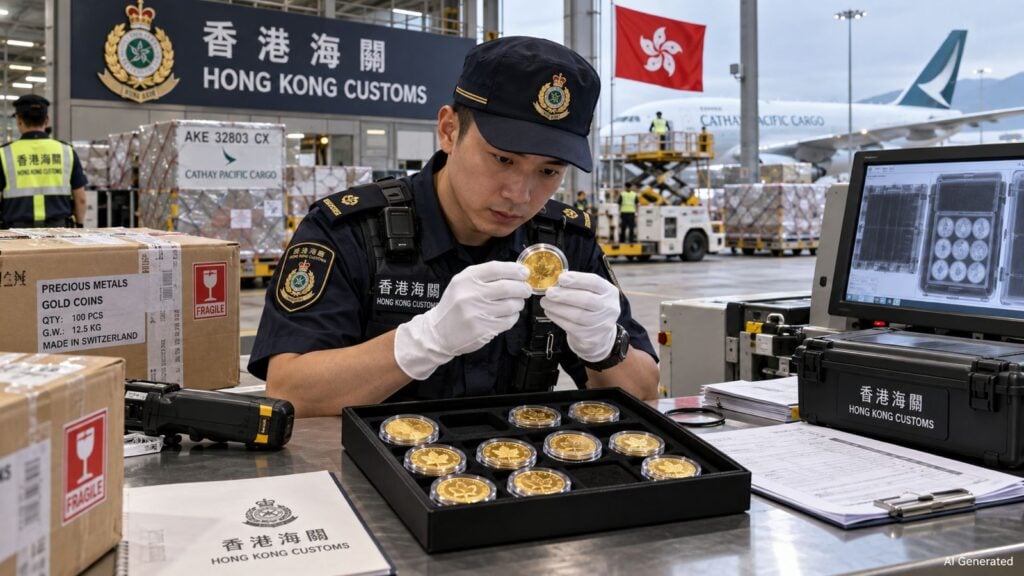
Customs duties and import taxes on coin shipments to Hong Kong are unusually straightforward compared with mainland China. Hong Kong is a separate customs territory and a free port. There is no general customs tariff on ordinary imports or exports. Nor is there a value added tax (VAT) or general sales tax.
For gold and platinum coins, this means that, in principle, neither general import duty nor Import VAT is charged when they enter Hong Kong. Excise duties are imposed only on four groups of goods: liquor, tobacco, certain hydrocarbon oils and methyl alcohol. Gold and platinum coins are not among them.
That does not mean there are no formalities at all. Depending on the coin, an Import Declaration may be required, while special exemptions apply to legal tender. Anti-money-laundering rules, requirements for precious-metals dealers, sanctions and the acceptance rules of the chosen carrier may also be relevant.
Mainland China is deliberately not combined with Hong Kong on this page. The licensing rules of the People’s Bank of China (PBOC) for gold coins that apply there do not automatically apply to Hong Kong. Hong Kong is a separate customs territory.
Coin shipments to Hong Kong: the key rules
| Topic | Hong Kong |
|---|---|
| General import duty | 0%; Hong Kong does not levy a general customs tariff on imports or exports |
| VAT / Sales Tax | No VAT and no general sales tax |
| Excise duties | Only on liquor, tobacco, certain hydrocarbon oils and methyl alcohol; gold and platinum coins are not included |
| Gold and platinum coins | No general precious-metals import tax; general customs and import charges are essentially 0 |
| Import Declaration | Generally required within 14 days after import unless a statutory exemption applies |
| Legal tender | Banknotes and coins that have been issued into circulation and are legal tender in any country are exempt from the Import / Export Declaration requirement |
| Online purchases | Goods bought online from abroad are also generally subject to the Declaration requirement unless they fall within an exempt category |
| Declaration Charge | For declarable non-food items, from HKD 0.20; maximum HKD 200 per Declaration |
| Precious-metals dealers (DPMS) | Dealers in Precious Metals and Stones (DPMS) may face registration and anti-money-laundering / counter-terrorist-financing (AML/CFT) obligations for transactions totalling HKD 120,000 or more |
| CBNI rule | A coin that is legal tender can qualify as a Currency and Bearer Negotiable Instrument (CBNI); the large-quantity threshold is more than HKD 120,000 under the CBNI valuation rules |
Hong Kong is a free port: 0% general customs duty
The Hong Kong Customs and Excise Department expressly describes the Hong Kong Special Administrative Region (HKSAR) as a free port. Hong Kong does not levy a general customs tariff on imports or exports. There are also no general tariff quotas or import surcharges.
This is a fundamental difference from many other destination countries. Whether a modern gold or platinum coin is classified under an HS heading (Harmonized System) such as 7118, or as a genuine numismatic collectors’ piece under 9705, does not determine whether Hong Kong charges, for example, 0%, 5% or 10% import duty. The general import-duty rate is 0% regardless.
Classification may still matter if an Import Declaration is required. Hong Kong uses eight-digit Hong Kong Harmonized System Codes (HKHS) for these declarations.
No Import VAT and no general sales tax
Hong Kong does not levy VAT on imported goods. Nor does it have a general sales tax or Goods and Services Tax (GST).
For a modern gold or platinum coin, there is therefore no typical combination seen in many other countries of 0% customs duty followed by, for example, 5%, 13%, 19% or 20% Import VAT. These general import taxes do not apply to an ordinary import into Hong Kong.
Excise duties apply only to four expressly listed groups of goods: liquor, tobacco, certain hydrocarbon oils and methyl alcohol. Coins and precious metals are not among these dutiable commodities.
Gold and platinum coins: no general import permit like in mainland China
The Hong Kong customs authority’s overview of prohibited and controlled goods includes, among other things, dangerous drugs, pharmaceutical products, rough diamonds, certain food products, radio transmitting apparatus, and nuclear and chemical weapons. Gold and platinum coins are not listed.
This is an important difference from mainland China. The People’s Bank of China (PBOC) special rule governing the import and export of gold coins there does not automatically apply to Hong Kong.
That does not mean every conceivable coin shipment is permitted regardless of origin, recipient or beneficial owner. Sanctions and other product-specific laws can still restrict a transaction in individual cases.
Import Declaration: generally within 14 days
Hong Kong distinguishes between the customs clearance of a shipment itself and the statistical Import / Export Declaration. Under the Import and Export (Registration) Regulations, any person who imports goods into Hong Kong, or exports or re-exports goods from Hong Kong, must generally lodge a complete and accurate declaration within 14 days, unless the goods are expressly exempt.
Current guidance from the Census and Statistics Department expressly confirms that this rule also applies to online purchases from abroad. A coin bought from a foreign dealer is therefore not exempt from the Declaration requirement simply because the order was placed through an online shop and delivered by courier.
The Declaration is submitted electronically through service providers appointed by the government. Form 1 is generally used for imports of ordinary non-food items.
Important exemption: legal tender
There is a particularly interesting exemption for coin collectors. Under the Import and Export (Registration) Regulations, banknotes and coins that have been issued into circulation and are legal tender in any country are among the goods for which no Import / Export Declaration has to be lodged.
This can be highly relevant to modern gold and platinum coins. It should not, however, be assumed that every numismatic issue automatically qualifies. The characteristics of the particular coin matter, especially its legal-tender status and the exact requirements of the Hong Kong exemption.
For Proof issues, special editions or older collector coins, the applicability of the exemption should therefore be clarified in cases of doubt with the recipient, the courier or the Hong Kong Census and Statistics Department.
Other exemptions from the Declaration requirement
In addition to legal tender, Hong Kong lists other exempted articles. These include personal baggage that can be shown not to be intended for trade or business, personal gifts for which the recipient makes no payment, and postal packets containing goods worth less than HKD 4,000.
These exemptions should not be mixed together. A commercially sold coin, for example, is not a personal gift. Likewise, a UPS or FedEx shipment is not automatically a “postal packet” within the meaning of the Post Office Ordinance.
Declaration Charge: small, but not always zero
If an Import Declaration is required, Hong Kong charges a small Declaration Charge. For non-food items, the current charge is HKD 0.20 for the first HKD 46,000 of value and then HKD 0.125 for each additional HKD 1,000 or part thereof. The total is capped at HKD 200 per Declaration.
This is not an import tax on the coin. It is an administrative charge for the Import / Export Declaration.
There is a special rule for high-fineness gold bars: gold bars with a fineness of at least 995.0 may still be declarable, but they are exempt from the Declaration Charge. This specific rule for gold bars should not simply be extended to gold coins.
7118 or 9705: in Hong Kong mainly a declaration issue
For declarable goods, the correct eight-digit HKHS code must be used. The first six digits of the Hong Kong Harmonized System correspond to the international Harmonized System (HS).
For coins, the familiar HS areas 7118 and, for genuine numismatic collectors’ pieces, potentially 9705 may be relevant. The 2026 Hong Kong classification includes, among others, 97053100 and 97053900 for numismatic collectors’ pieces.
A low mintage, Proof quality, a high market value or grading by Numismatic Guaranty Company (NGC) or Professional Coin Grading Service (PCGS) does not automatically mean that a modern coin belongs under 9705. If a Declaration is required, the specific HKHS code should be checked against the current Hong Kong classification.
Precious-metals dealers and the HKD 120,000 threshold
Since 1 April 2023, Hong Kong Customs has operated a dedicated regime for Dealers in Precious Metals and Stones (DPMS). It covers, among other things, gold and platinum in both manufactured and unmanufactured form.
A person carrying on a precious-metals or precious-stones business in Hong Kong and conducting transactions totalling at least HKD 120,000 may be required to register. Category A generally applies to non-cash transactions at or above that threshold; Category B applies to dealers that also conduct relevant cash transactions. Category B is subject to additional Anti-Money Laundering and Counter-Terrorist Financing obligations (AML/CFT).
For Wasserthal RareCoin.Store, the distinction matters: an ordinary online order placed by a Hong Kong customer with a German company does not automatically require Wasserthal RareCoin.Store to register as a local precious-metals dealer in Hong Kong. The DPMS regime is tied to carrying on the precious-metals business, or conducting relevant transactions, in Hong Kong.
Separate rules apply to dealers that are not based in Hong Kong but actually carry on business activities there, for example at a trade fair. Such Non-Hong Kong Dealers may be exempt from registration under certain conditions, but cash transactions of HKD 120,000 or more conducted in Hong Kong must generally be reported within one day or before the dealer leaves Hong Kong.
Legal tender and the CBNI rule
Hong Kong also has a system for controlling the cross-boundary movement of large quantities of cash and bearer negotiable instruments. CBNI stands for Currency and Bearer Negotiable Instruments.
Under the definition used by Hong Kong Customs, a coin is a CBNI if it is legal tender in Hong Kong or in another country. The customs authority also states expressly that a gold coin which is not legal tender anywhere is not a CBNI.
CBNIs with a total value of more than HKD 120,000 are treated as a “large quantity”. For commemorative banknotes and old banknotes, Hong Kong Customs expressly uses nominal value rather than collector or material value. The published FAQ does not state the same valuation rule expressly for coins. If the HKD 120,000 threshold could become relevant to a coin shipment, the valuation should therefore be clarified with Hong Kong Customs or the appointed carrier.
If CBNIs are transported as cargo in one consignment with a value of more than HKD 120,000, an additional electronic advance declaration may be required. This advance declaration does not apply to postal packets within the meaning of the Post Office Ordinance. The CBNI system is also separate from the ordinary Import / Export Declaration.
Anti-money laundering
Hong Kong regulates precious-metals and precious-stones dealers under the Anti-Money Laundering and Counter-Terrorist Financing Ordinance (Cap. 615). Gold and platinum are expressly covered as precious metals.
For local dealers, transactions of HKD 120,000 or more can trigger registration, customer-due-diligence and, where applicable, reporting obligations. Separate rules apply to dealers not based in Hong Kong when they actually conduct business activities or cash transactions in Hong Kong.
For an ordinary international dealer shipment, banks, payment service providers or the recipient may also request additional information on the buyer, payment sender, beneficial owner or source of funds under their own compliance obligations.
Sanctions and embargoes
Hong Kong implements sanctions imposed by the United Nations Security Council through the United Nations Sanctions Ordinance (Cap. 537) and the country-specific Regulations made under it. The Commerce and Economic Development Bureau publishes current sanctions lists and guidance.
For the precious-metals trade, the sanctions regime concerning North Korea is relevant, among others. The United Nations Sanctions (Democratic People’s Republic of Korea) Regulation prohibits, among other things, the procurement of gold from North Korea or from persons connected with North Korea without the relevant licence.
For a coin shipment, it is therefore not only the product and customs classification that matter. The buyer, payment sender, beneficial owner, banks, origin and actual delivery destination may also be relevant to sanctions screening.
For Wasserthal RareCoin.Store, applicable German and European sanctions also apply independently of Hong Kong import rules. A delivery that would in principle be permissible under Hong Kong customs law must therefore not be carried out if an applicable German or European sanctions rule prohibits it.
Courier service and possible additional charges
Even though Hong Kong does not levy general import duty or Import VAT, an international shipment can still incur charges. These may include carrier fees for special customs clearance, additional documentation, physical customs inspections, storage or subsequent amendments.
These charges are not Hong Kong import taxes. Whether they arise depends on the courier company, the particular service used and the actual clearance work required.
UPS, for example, has listed a Disbursement Fee for Hong Kong since 20 September 2026 of 2.5% of duties, taxes or other government charges advanced by UPS, with a minimum of HKD 62 per shipment. For an ordinary gold or platinum coin without such government import charges, this fee should not arise merely because of the coin’s value. Other service or clearance fees may still apply independently.
If you order from Wasserthal RareCoin.Store
Wasserthal RareCoin.Store ships modern numismatic gold and platinum coins internationally with full insurance and clear, traceable commercial and transport documentation.
For Hong Kong, the tax position is comparatively straightforward: gold and platinum coins are generally subject to neither general import duty nor Import VAT. The more important question is whether the specific coin requires an Import Declaration or falls within an exemption, for example because of its status as legal tender.
Where a shipment is declarable, the recipient or appointed courier should ensure that the Import Declaration is submitted with the correct HKHS code within the statutory deadline.
For deliveries outside the European Union, the buyer is responsible for import charges, declaration costs and other fees arising in the destination country. Our current terms are available under Payment and shipping.
Frequently asked questions about coin shipments to Hong Kong
What is the import duty on gold coins in Hong Kong?
Hong Kong does not levy a general customs tariff on imports. An ordinary gold coin is therefore generally not subject to import duty.
Is Import VAT charged on gold or platinum coins?
No. Hong Kong has no general VAT or sales tax. Gold and platinum coins are also not among the four groups of dutiable commodities.
Does China’s PBOC licensing requirement for gold coins also apply in Hong Kong?
Not automatically. Hong Kong is a separate customs territory with its own import system. The PBOC special rule for gold coins that applies in mainland China cannot simply be transferred to Hong Kong.
Does every coin shipment to Hong Kong have to be declared?
No. An Import Declaration is generally required within 14 days unless a statutory exemption applies. Exempted articles include certain banknotes and coins that are legal tender.
Is legal tender exempt from the Import Declaration requirement?
Hong Kong’s rules expressly list banknotes and coins that have been issued into circulation and are legal tender in any country as exempted articles. For a particular collector coin, it should be checked whether all requirements of this exemption are met.
Does the exemption automatically apply to Proof and Top Pop coins?
Not because of Proof, grading or Top Pop status. What matters is not the numismatic quality but whether the specific coin satisfies the statutory conditions for the exemption. In cases of doubt, the classification should be clarified before or immediately after import with the courier or the competent Hong Kong authority.
How much does an Import Declaration cost?
For declarable non-food items, the government Declaration Charge is HKD 0.20 for the first HKD 46,000 of value plus HKD 0.125 for each additional HKD 1,000 or part thereof. The charge is capped at HKD 200 per Declaration.
Does the HKD 120,000 threshold apply to a private buyer?
There are several different HKD 120,000 rules and they should not be confused. The DPMS regime primarily concerns dealers in precious metals and stones. Separately, the CBNI regime concerns large quantities of currency and bearer negotiable instruments. An ordinary private order does not automatically trigger both regimes merely because of its purchase price.
Is a gold coin a CBNI?
If it is legal tender in Hong Kong or another country, it can fall within the CBNI definition. Hong Kong Customs expressly states that a gold coin which is not legal tender is not a CBNI. How a particular coin should be valued for the HKD 120,000 threshold should be clarified directly with Hong Kong Customs or the carrier where relevant; the published FAQ expressly refers to nominal value for commemorative and old banknotes, but not in the same terms for coins.
Does Wasserthal RareCoin.Store need Hong Kong DPMS registration for online sales to Hong Kong?
An ordinary cross-border online order placed with a dealer based in Germany does not automatically lead to local DPMS registration in Hong Kong. The regime relates to carrying on a precious-metals and precious-stones business and relevant transactions in Hong Kong. Separate rules for Non-Hong Kong Dealers apply to actual business activities in Hong Kong, for example at a trade fair.
Does Hong Kong fall under the China customs rules in this article series?
No. Hong Kong is a separate customs territory. Mainland China and Hong Kong are therefore deliberately covered separately in this article series.
Transparency note
Wasserthal RareCoin.Store is a professional dealer in modern numismatic gold and platinum coins and ships coins to international customers. We therefore have a commercial interest in the topics covered on this page.
The information on customs duties, taxes, declarations, anti-money-laundering requirements and import rules is researched independently of the sale of individual products and is based on official sources. This overview also applies to coins purchased from other dealers.
Disclaimer
This information is provided for general guidance only and does not replace individual customs, tax or legal advice.
Whether a particular coin is exempt from the Import Declaration, which HKHS code must be used if necessary, and which additional compliance or sanctions rules apply depends on the specific product and the actual transaction. The Hong Kong rules in force at the time of import and the decisions of the competent authorities are binding.
About the author
Author: Dirk Wasserthal
Dirk Wasserthal is Managing Director of TriaPrima GmbH, the company operating Wasserthal RareCoin.Store. His focus is on modern numismatic gold and platinum coins as well as high-quality certified collector coins.
Wasserthal RareCoin.Store has already supplied collectors in 40 countries. TriaPrima GmbH is an Authorized Dealer with PCGS and NGC. The company is also a member of the American Numismatic Association (ANA) and the Berufsverband des Deutschen Münzenfachhandels.
Sources and data status
This overview is based primarily on primary sources from the Hong Kong Customs and Excise Department, Census and Statistics Department, Trade and Industry Department and Commerce and Economic Development Bureau.
- Hong Kong Customs and Excise Department: Cargo Clearance, Hong Kong as a free port, no general customs tariff, no VAT or Goods and Services Tax (GST), and an overview of customs controls.
- Hong Kong Customs and Excise Department: Dutiable Commodities, excise duties on liquor, tobacco, certain hydrocarbon oils and methyl alcohol.
- Hong Kong Customs and Excise Department: Import and Export Declaration, 14-day deadline, forms, Declaration Charges and the HKD 200 maximum charge.
- Hong Kong Census and Statistics Department: Import/Export Declaration, current 2026 guidance including online purchases and HKHS classification.
- Hong Kong Census and Statistics Department: Exempted Articles, in particular legal tender, personal baggage, personal gifts and certain postal packets.
- Hong Kong Census and Statistics Department: Types of Import/Export Declarations, Form 1 and goods exempt from the Declaration Charge, including certain high-fineness gold bars.
- Hong Kong Census and Statistics Department: Search Commodity Codes, eight-digit HKHS codes for the 2026 edition.
- Hong Kong Customs and Excise Department: Prohibited Articles, overview of prohibited and controlled goods.
- Hong Kong Customs and Excise Department: Supervision of Dealers in Precious Metals and Stones, DPMS regime, HKD 120,000 threshold and Category A / Category B.
- Hong Kong Customs and Excise Department: Dealers in Precious Metals and Stones Registration Regime – FAQs, definitions, transaction threshold and rules for Non-Hong Kong Dealers.
- Hong Kong Customs and Excise Department: Currency and Bearer Negotiable Instruments, definition of CBNI, legal tender, gold coins and the HKD 120,000 threshold.
- Commerce and Economic Development Bureau: United Nations Security Council Sanctions, current sanctions lists and reporting guidance; last updated 28 August 2026.
- Trade and Industry Department: United Nations Sanctions (Democratic People’s Republic of Korea) (Amendment) Regulation 2018, including restrictions on procuring gold from North Korea.
- European Commission: Consolidated list of persons, groups and entities subject to EU financial sanctions, European financial sanctions that must be observed independently of Hong Kong import rules.
- UPS Hong Kong SAR: Shipping Costs and Rates, Disbursement Fee for Hong Kong since 20 September 2026.
Content and sources last reviewed: 5 October 2026