
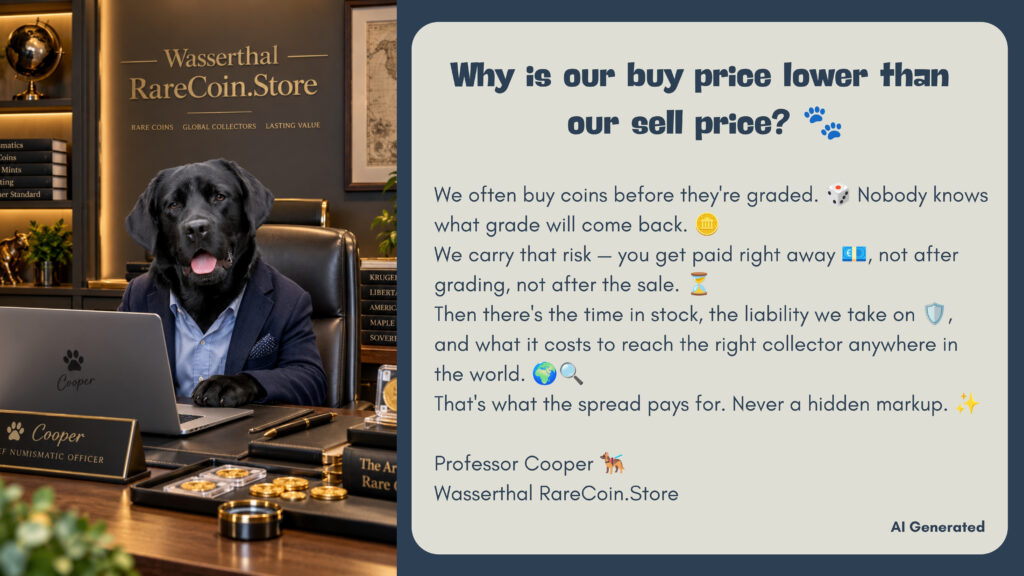
Hello Collectors Club, Professor Cooper here. 🐾
There are questions that make me raise my head, even when I’m lying very comfortably.
This is part of it. It’s about the purchase price, it comes regularly, it comes by email, and it almost always comes with a slightly negative undertone:
“You sell this coin at a certain price. Why are you offering me significantly less for the same coin?”
That’s a fair question. It deserves an honest answer.
And the reason isn’t “because of operating costs.” That may be true, but it explains about as much as “because that’s just the way it is.”
I’m lying under the desk during these processes and I witness everything. That’s why I’m explaining it to you.
It’s not the same coin.
That sounds like a sleight of hand at first. Physically, it’s of course the same coin.
Economically, these are two different things.
What a collector sells is a single item. Often its origin is unclear, its authenticity is often not independently verified, and its condition is not assessed. And the buyer who will eventually want it has not yet been found.
What a retailer sells is a different product. It’s inspected. It’s documented. It’s traceable because it’s been described and categorized. And it comes with a contact person in case something doesn’t match the agreed-upon description.
Between these two states lies work and risk.
The point that cannot be seen from the outside
Now comes the part that I consider the most important. And that hardly anyone says.
We frequently purchase coins that are not yet certified. We then send these coins in for evaluation ourselves.
And then we wait.
I’m waiting too, by the way. I notice immediately when a package is returned, because it gets very quiet in the office for a moment.
Because nobody knows in advance what degree of conservation will return.
You know how it is in my world. You can prepare a dog for a show as well as you like. The final verdict is only decided by the judge. Anyone who claims otherwise has never been in the ring.
It’s the same with coins.
In the best-case scenario, a coin with a very high grade is returned. Then the purchase was a success, and there’s a brief moment of great joy in the office.
Sometimes, however, it returns with a lower grade than the surface suggested. And sometimes it returns with a detail grade because a problem has become visible that no one had previously noticed.
The difference between these results can be significant. With modern gold coins, there can be a considerable price difference between the highest grade and the one immediately below it, even though the difference is barely perceptible to the naked eye. I explained why this is the case in my article “Is PF70 really worth it, or is the premium over PF69 often too high?”
Buying an ungraded coin doesn’t mean buying a known outcome. It means buying an open question.
Furthermore, the appraisal costs money and time, regardless of the outcome. Even a coin that returns a disappointing result has already gone through the entire process.
That’s precisely why a purchase offer can’t be as high as the eventual selling price, even in the best-case scenario. It has to cover both outcomes: the good and the less good. 🐾
What you get in return
And now the part that often gets overlooked.
You will receive your money after the coin has been received and examined – and not only when it is returned certified or when a buyer has been found.
From the moment of purchase, the outcome of the valuation transfers to us. If the valuation is better than expected, that’s our good fortune. If it’s worse, that’s our problem. Your agreed purchase price remains unchanged in either case.
That is the real exchange: security today for opportunity and risk tomorrow.
Time is the next factor.
A collector’s item typically doesn’t sell the day after it’s purchased.
I’m the wrong witness for that, though. I’m fifteen months old. There are coins in our collection that were already here before I was born – and I’ve seen quite a few packages come and go.
For very special pieces, it can take months until the right collector appears. Sometimes longer. Until then, the capital is tied up in the coin and is unavailable for other purchases.
During this time, the market can also fluctuate. The price of gold can fall. Interest in a series can wane. Both of these factors affect anyone who owns the coin.
Testing, documentation and responsibility
A lot happens between the purchase and sale that is not reflected in the price.
And then the dealer guarantees that the delivered coin corresponds to the agreed description: authenticity, certification, year of issue, and stated characteristics. If something is wrong, he is the one who takes responsibility. Wasserthal RareCoin.Store is a member of the Professional Association of German Coin Dealers .
The coin is examined. It is sent in or cataloged. It is photographed and described in such a way that a collector can find it later.
Part of the selling price is precisely this security. It’s one reason why buyers may be willing to pay more than for an anonymous offer without any guarantees.
The buyer base decides – and it is international.
And now the part that will benefit you as a collector.
The difference between the buying and selling price is not always the same. It depends on how many people want the item and how easy it is to reach them.
For a well-known, standardized investment coin, the potential buyer pool is huge and located right on your doorstep. The price is directly linked to the gold price. The coin can usually be resold quickly. The profit margin can therefore be quite narrow.
The situation is different with a very specific, certified rarity. The right collector often doesn’t live in the same country. They might live in South Africa, Mexico, Singapore, or the United States.
That’s precisely why we sell worldwide. This isn’t about expanding our business, but rather the prerequisite for such a piece to fetch a reasonable price. A Krugerrand Proof from an early year won’t find its buyer by waiting longer, but by offering it where the collectors are.
This reach comes at a price.
A certified gold coin doesn’t travel like an ordinary parcel. It’s shipped insured, and the insurance premium is based on the value of the goods. With a coin, weight is negligible, but value is very important. This can be substantial for some countries. In addition, there are customs clearance and export documentation, which vary in complexity depending on the destination country. The customer only bears a portion of these costs. The rest is part of the overall expenses that the business must cover.
The second part of this reach is the visibility itself.
I’m a Labrador. I know how to find something that isn’t lying around in plain sight: you need a scent trail. Without a trail, you’ll walk right past it, no matter how good your nose is.
The same applies to a coin. A piece doesn’t find its buyer by waiting, but by the right collector finding it in the first place. Someone has to lay that trail: through description, classification, images, international presence, and years of work to ensure that certain coins are even discovered. It doesn’t happen by itself; it requires constant maintenance, and it costs money. 🐾
And it works both ways. Because in the same way that a buyer in Singapore finds a specific coin, a seller in Belgium or Canada also finds the right contact person for their piece.
Most likely, that’s exactly how you ended up here. You weren’t looking for a coin dealer, but for your coin – a specific year, variant, or condition. And you’ve found someone who can identify and classify precisely those pieces.
This is no coincidence, but the result of the same work that also reaches the buyer.
For you as the seller, this is the other side of the same coin: The size of the offer you receive depends on being able to reach a buyer worldwide. Without this reach, the profit margin would likely not be smaller, but the offer itself would be lower. Regardless, you will be paid after receipt and inspection – not only when the coin is sold.
And there’s another point to consider: the rarer the item, the easier it is to sell. If you already know you want to resell it later, you should factor that in.
What you can do
Some things are indeed in your hands. I’m listing them; after all, that’s what being a professor is for.
Keep the documents. Certificates, original packaging, proof of purchase. Anything that verifies the origin can facilitate classification and influence the offer.
Do not open the slab. A certified coin in its undamaged holder can be immediately identified and its certification verified. Once the coin is removed, this security is lost.
Don’t separate sets without a reason. Whether a set as a whole or in individual pieces is the better approach depends on the specific case – I’ve seen that in Should you leave a complete proof set together or have individual coins graded? 3 expert tips As described. In any case, do not separate a set haphazardly, because it cannot be undone.
Sell where the buyer base is. If you offer a specialized collector’s item to a dealer who primarily deals in investment coins, you might receive an offer based on the metal itself. This isn’t due to unfair practices, but simply because the dealer doesn’t have a suitable market for the item.
Get several quotes. That’s perfectly normal, and nobody should hold it against you.
Cooper’s summary
The difference between the buying and selling price is not an arbitrary markup. It is the price for six things:
- The open result of the grading of ungraded coins
- The time it takes to find the right buyer
- The market risk during this period
- The responsibility for verification and correct description
- The effort required to reach buyers and sellers worldwide in the first place
- A commercial margin, because without it the retailer wouldn’t exist.
Anyone selling a coin pays the first five points and receives their money after receipt and verification. Anyone buying a coin takes possession of it – and can only recoup all of this through a later sale, if a buyer is actually found.
Feel free to ask about the spread. For standardized investment coins, it’s usually easy to understand. For collector’s items, it depends on the individual piece, its quality, its demand, and the market where it can be offered.
A salesperson who doesn’t like hearing that question is already telling you something. I also tend to pin my ears back when someone asks. That’s a reliable sign for me.
Until the next collector’s question.
Professor Cooper ⭐
Do you have more questions? Me too. I’ve already answered over 35 of them: Collector questions about gold coins – explained with Cooper 🐾
Name: Professor Cooper
Role: Chief Numismatic Officer, Wasserthal RareCoin.Store
Author box:
Cooper is a Labrador and lies under the desk whenever something happens in the office. As Professor Cooper, he answers the questions collectors actually ask in the series “Collector’s Questions with Cooper” – about grading, rarity, condition, and pricing.
The technical basis comes from the daily work of Wasserthal RareCoin.Store, an authorized NGC and PCGS dealer specializing in certified gold coins and top pop rarities.
Editorial and technical review: Larissa Wasserthal