
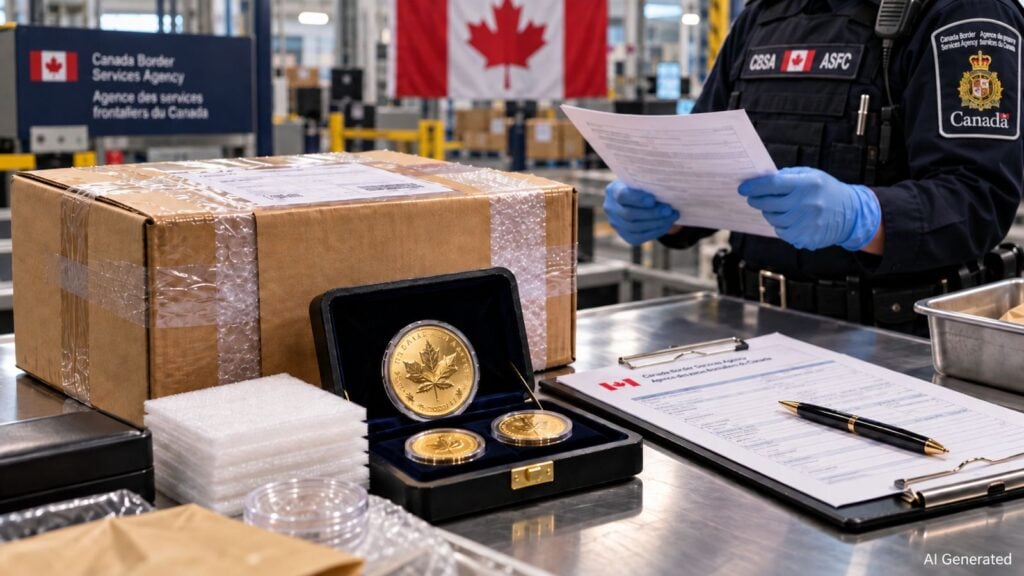
Customs duties and import taxes on coin shipments to Canada cannot be summed up in a single figure. For a properly classified gold coin, the ordinary Canadian customs duty is generally zero. Goods and Services Tax (GST) or Harmonized Sales Tax (HST), a provincial sales tax and clearance fees may nevertheless arise on importation. The outcome depends on the particular coin, its fineness and classification, the purchase price and the recipient’s province.
This guide covers gold coins shipped by a dealer in Germany to a private collector in Canada. It also applies to purchases from other dealers. Bringing coins into Canada in a traveller’s baggage involves a different procedure.
What charges can arise on coin shipments to Canada?
| Charge | What collectors should know |
|---|---|
| Ordinary Canadian customs duty | Nil for coins properly classified under the gold coin or numismatic collectors’ item provisions discussed below. The parcel still has to clear customs. |
| GST/HST on importation | Certain government-issued gold coins with a fineness of at least 99.5% may qualify for the precious metal exception. A 22-karat coin does not meet this fineness requirement. |
| Provincial sales tax | Check the destination province separately. British Columbia has a specific rule for coins sold above the market value of their gold content. Manitoba, Saskatchewan and Quebec use different tests. |
| Courier charges | The carrier’s processing and brokerage fees are distinct from government duties and taxes. |
Ordinary duty on gold coins and collectors’ items
The Canadian Customs Tariff of the Canada Border Services Agency (CBSA), Chapter 71, lists gold coins under 7118.90.00, statistical suffix 10, with an ordinary rate of Free. For numismatic collectors’ items properly classified there, Chapter 97 lists 9705.39.00 for items not over 100 years old and 9705.31.00 for older items. Their ordinary rates are also Free.
A Proof finish, a high purchase price or NGC or PCGS certification does not, by itself, determine the tariff classification. The actual item matters. A medal, a coin mounted in jewellery or another gold article may be treated differently.
Why the shipping country and the origin of the goods differ
For the orders covered here, Germany is the shipping country. An American Gold Eagle bought there was nonetheless struck in the United States. The origin of the goods may matter for additional duties even when a parcel leaves Germany. The United States Surtax Order (2026) has applied since September 8, 2026 to selected goods of US origin. Depending on the listed tariff item, the surtax is 15%, 25% or 50%. The CBSA explains its application to imports.
The coin classifications discussed here, 7118.90.00, 9705.31.00 and 9705.39.00, appear neither in that order’s product schedules nor in the Department of Finance’s current list of US products subject to counter-tariffs. A coin properly classified under one of these items is therefore not subject to this surtax on the basis of the rules checked on September 26, 2026. Its actual classification and the rules in force on its import date still need to be checked for the shipment.
When does GST/HST apply to an imported gold coin?
The Canada Revenue Agency (CRA) explains in paragraphs 29 and 30 of GST/HST Memorandum 17.1 that a gold coin must have a fineness of at least 99.5% to be treated as a “precious metal” under these rules. For a coin, paragraph 30 also requires it to have been issued by a government authority and to be usable as currency. The import rule in paragraph 38 and the Non-Taxable Imported Goods (GST/HST) Regulations exempt qualifying precious metals from GST/HST on importation. Merely describing an item as a “gold coin” on the invoice does not establish that it qualifies.
According to the Royal Canadian Mint, an ordinary Gold Maple Leaf is 99.99% gold, so it meets the fineness requirement. The American Gold Eagle Proof and the Krugerrand, by contrast, are each approximately 91.67% gold. Both contain a specified amount of fine gold, but the entire coin does not reach Canada’s 99.5% threshold. A buyer should expect GST/HST on such an import unless another exception applies to the particular case.
Modern collector issues must be assessed as finished products. The Royal Canadian Mint notes that inserts, gemstones or moving parts can reduce a coin’s overall fineness below the tax threshold. Even for a rare 999 fine issue, check the issuing authority, currency status, actual fineness and any additions. More background on the mint is available in our Royal Canadian Mint overview.
What about a collector premium? Paragraphs 29, 30 and 38 of the CRA memorandum identify form, fineness, government issue and use as currency as relevant conditions for the import exception. They do not identify a purchase price above the metal value as a separate ground for exclusion. The Royal Canadian Mint also focuses on the overall fineness of its collector coins for federal tax treatment. Accordingly, a collector premium alone does not automatically make an otherwise qualifying gold coin subject to GST/HST on importation. British Columbia’s provincial tax follows a different rule.
Rates by destination province
For a taxable import, the applicable GST/HST rate depends on the destination. The CBSA’s overview lists, for example, 13% HST in Ontario, 14% in Nova Scotia, 15% in New Brunswick, Newfoundland and Labrador, and Prince Edward Island, and 5% GST in Alberta. In provinces without HST, a separate provincial tax may also need to be considered.
British Columbia’s separate provincial sales tax
In British Columbia, the 7% Provincial Sales Tax (PST) must be considered separately. Under section 54 of the provincial exemption regulation, a gold coin is exempt from PST only if its purchase price does not exceed the market value of the gold it contains. The province explains with respect to collector coins that a numismatic premium can therefore lead to tax. The Royal Canadian Mint’s current FAQ likewise refers to the market value of the metal for British Columbia, not the coin’s face value.
A rare Gold Maple Leaf may thus be exempt from GST/HST on importation yet still be subject to PST because of its collector price. Compare the actual price paid with the relevant market value of the gold content. The province’s PST bulletin on goods brought into British Columbia also explains that, if PST owing was not collected by the seller or on importation, the recipient must self-assess and pay it to the province.
Manitoba, Saskatchewan and Quebec
Manitoba: The official RST 043 bulletin, revised in July 2026, exempts gold coins that qualify as bullion of at least 99.5% purity from the 7% Retail Sales Tax (RST) regardless of face value, price or premium. Other coins sold above face value are generally taxable. This is different from British Columbia’s rule. Manitoba Finance confirms the general RST rate.
Saskatchewan: Under the official PST-32 bulletin, qualifying precious metal coins may be exempt from PST as financial instruments. The province treats other collector coins sold above face value as taxable. The status of the particular coin is therefore decisive.
Quebec: Revenu Québec indicates that taxable goods imported from abroad are generally subject to 5% GST and 9.975% Quebec Sales Tax (QST). It also notes exceptions for non-taxable goods. The status of the particular coin should be established before making a blanket tax calculation.
Purchase price, low-value thresholds and customs clearance
For a purchased collector coin, the price actually paid or payable is the starting point for Canadian customs valuation, subject to the adjustments required by law. The CBSA’s Customs Valuation Handbook explains this. A rare Proof coin’s face value or its gold value alone does not replace the price paid, and the same applies to a rare top-pop coin. The customs value must be stated in Canadian dollars (CAD). A clear commercial invoice should identify the precise coin, its fineness, weight and price, and its certification number where applicable.
The frequently quoted courier thresholds of CAD 40 for taxes and CAD 150 for customs duty apply, subject to their conditions, only to shipments from the United States or Mexico. For a courier shipment from Germany, the general low-value remission threshold is CAD 20 under the CBSA memorandum on courier imports. Above that threshold, the coin’s actual duty and tax treatment still determines whether any amount is payable. The CAD 60 gift exemption does not help with a dealer purchase: the CBSA excludes packages sent by a business.
A courier may handle clearance and any payment due on the recipient’s behalf and charge its own fees. The CBSA expressly distinguishes private courier charges from government duties and taxes. For certain private courier shipments, the CBSA also notes that recipients may declare and pay directly at a CBSA office; higher-value shipments may follow different procedures. Ask the carrier in advance about the process and its fees. If charges have been assessed incorrectly, the CBSA’s correction procedures may be relevant.
Are there import restrictions to check?
A zero customs duty rate does not remove the need to check import restrictions. Under section 3.11 of Canada’s Special Economic Measures (Russia) Regulations, it is prohibited to import, purchase or acquire goods listed in Schedule 9 from Russia or from a person in Russia. The list includes unworked and semi-manufactured gold and certain jewellery, among other goods, but does not list coins of heading 7118. A Russian-minted gold coin shipped by a dealer in Germany is therefore not caught by this particular prohibition on gold goods solely because of its country of minting. Its actual classification, the parties involved and any other applicable sanctions must still be checked for the shipment.
Three typical purchases, three different questions
| Purchase from Germany, delivery in Canada | Key question |
|---|---|
| Ordinary Gold Maple Leaf, 99.99% gold | Ordinary duty is nil if classified correctly; it meets the fineness requirement for the federal precious metal exception. Check the destination province and courier fees too. |
| American Gold Eagle Proof or Krugerrand, 91.67% gold | Ordinary coin duty is generally nil; it fails the 99.5% fineness requirement for the GST/HST exception. Check the destination rate and clearance fees. |
| Rare, high-fineness collector coin shipped to British Columbia | Assess federal GST/HST and provincial PST separately. A price above the market value of the gold content may trigger PST. |
Frequently asked questions
Are gold coins tax-free when imported into Canada?
The ordinary customs duty rate for the coin classifications cited above is zero. The GST/HST exception for imported precious metals has its own conditions. Provincial taxes and courier charges must be assessed separately. There is no blanket tax exemption for all gold coins.
Is a Krugerrand exempt from GST/HST because it contains an ounce of fine gold?
The ounce describes the quantity of fine gold it contains. The coin itself is an alloy of about 91.67% gold and does not meet Canada’s 99.5% fineness threshold. Its tax status on importation must be assessed for the entire coin.
Does the CAD 150 threshold apply when I buy from a German dealer?
The CAD 150 courier rule concerns qualifying shipments from the United States or Mexico. A courier shipment from Germany generally has the CAD 20 threshold. That does not change any specific GST/HST exception available for a qualifying gold coin.
Could I owe PST in British Columbia if no GST/HST was charged on importation?
Yes. The section 54 exemption depends on the purchase price relative to the market value of the gold content. If PST owing was not collected, the provincial bulletin requires self-assessment.
Ordering from Wasserthal RareCoin.Store
Wasserthal RareCoin.Store ships only gold products outside the EU. Under our payment and shipping terms, the buyer bears import duties, taxes and other fees incurred in the recipient country. This guide helps you assess potential charges before ordering. The Canadian rules described here also apply to a gold coin bought from another dealer in Germany.
Transparency note
Wasserthal RareCoin.Store deals in rare gold coins, including coins from series mentioned here, and has a commercial interest in this market. This guide also applies to purchases from other dealers and does not recommend any particular coin. Official sources are linked directly in the text.
Disclaimer
This article provides general information for collectors and is not individual customs, tax or legal advice. Your shipment’s treatment depends on the classification, origin, characteristics and purchase price of the particular coin, the destination province and the rules in force on the import date. The relevant Canadian authorities decide import matters; the respective provincial authority can advise on its own tax. We cannot guarantee that this information remains complete and up to date.
About the author
Author: Dirk Wasserthal
Dirk Wasserthal is managing director of TriaPrima GmbH, the company behind Wasserthal RareCoin.Store. He specialises in modern numismatic gold coins, including certified collectors’ items. Wasserthal RareCoin.Store has delivered to collectors in 40 countries. TriaPrima GmbH is an authorised PCGS dealer and is listed in NGC’s dealer locator. It belongs to the German professional coin dealers’ association and the American Numismatic Association.
Sources and scope
The main official sources used for this guide are:
- Customs and special measures: CBSA Customs Tariff 2026, Chapter 71, Chapter 97, Canada Gazette, SOR/2026-186, United States Surtax Order (2026), text of the order, CBSA Customs Notice 26-23, and the current list of US products subject to counter-tariffs.
- GST/HST and coin characteristics: CRA Memorandum 17.1, Non-Taxable Imported Goods (GST/HST) Regulations, Royal Canadian Mint FAQ on numismatic coins and provincial taxes, Gold Maple Leaf, US Mint on the Gold Eagle Proof, and South African Mint on the Krugerrand.
- Rates and provincial law: CBSA on provincial taxes, British Columbia PST exemption regulation, section 54, official interpretation for collector coins, and Bulletin PST 310, Manitoba Bulletin RST 043 and RST rate, Saskatchewan Bulletin PST-32, and Revenu Québec on imports.
- Value and clearance: CBSA Customs Valuation Handbook, Memorandum D8-2-16 on courier thresholds, CBSA gift rules, and CBSA on private courier shipments and fees.
- Restrictions: Special Economic Measures (Russia) Regulations, section 3.11 and Schedule 9, and Global Affairs Canada on sanctions against Russia.
Content and sources last checked: September 26, 2026