Quality Check 2026: This expert article on the importance of certificates and original packaging (OGP) was updated on April 10, 2026, to reflect current standards for market value premiums and protection against counterfeiting.
In modern numismatics, the coin itself no longer alone determines its market value. A key factor is the so-called slab – the sealed holder certified by independent grading companies such as NGC (Numismatic Guaranty Corporation) or PCGS (Professional Coin Grading Service) . While the gold price (spot price) determines the value of pure investment coins, the documented condition, authenticity, and market standardization play a crucial role for collector coins.
A certified slab ensures transparency, comparability, and international tradability. Combined with the original packaging (OGP) and a certificate of authenticity (COA) , it creates an objectively assessable collector’s item that clearly distinguishes itself from “raw” coins lacking market standards. This is precisely the difference between a random purchase and a sound long-term collector’s or investment decision.
This guide explains why NGC and PCGS grading , slabs, and original packaging are far more than accessories – and why they now play a crucial role in determining the value, liquidity, and security of collector coins.
1) Why many “certificates of authenticity” barely move the market
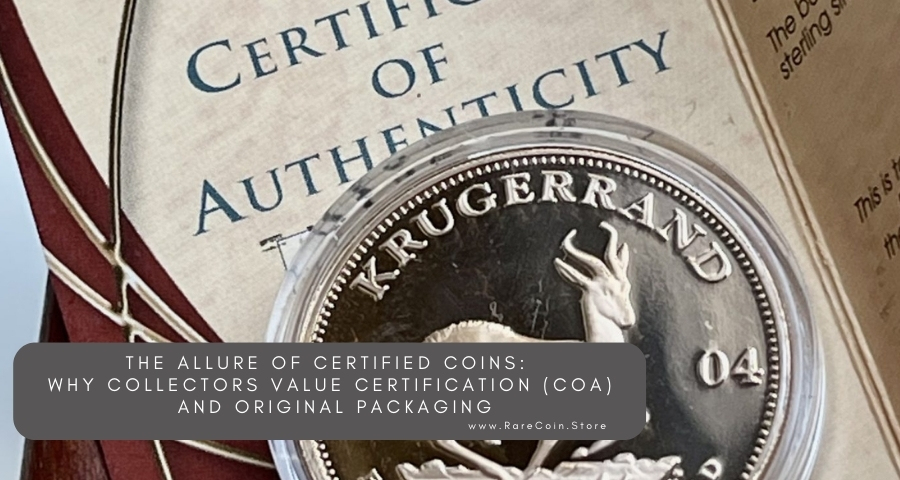
A common mistake made by beginners is to overestimate manufacturer-issued Certificates of Authenticity (COA). A COA primarily documents issue and origin, but it neither replaces a market-wide accepted condition assessment nor does it automatically improve tradability.
The crucial difference: COA vs. Third-Party Grading (TPG)
A Certificate of Authenticity (COA) from the Austrian Mint or the Royal Mint can be useful for documentation purposes. However, true international market standardization typically only arises through third-party grading, especially through NGC or PCGS .
A pro rule of thumb: A COA provides context, an NGC/PCGS slab enables comparability. In the long run, the combination of both is often the best solution.
2) How standardization affects prices
Why do collectors sometimes pay significantly more for a certified coin in MS70 or PF70 than for a visually similar blank?
Standardized condition description
NGC and PCGS use established grading systems, creating a common language. A dealer in New York can classify a coin from Berlin much more easily if its condition is clearly documented.
The liquidity effect
Uncertified coins often require re-appraisal upon resale. This is time-consuming and frequently leads to disputes. A certified coin significantly reduces this friction, making it faster and easier to trade in many markets. This increased tradability often stabilizes prices, and for top-grade coins, it can even drive prices up.
3) Risk minimization: Protection against manipulation and misunderstandings
Counterfeits and altered pieces are a problem in various segments, especially where high premiums are paid. A recognized slab is not a panacea, but it significantly reduces the risk because:
-
Authenticity and condition were assessed by an independent body.
-
the holder is sealed to prevent tampering
-
The market generally knows and accepts the classification.
At the same time, the slab protects against typical everyday damage caused by handling, such as fingerprints or micro-scratches, which is particularly relevant for proof surfaces.
4) Psychology: Why “complete” sells better
Coin collecting is not just analysis, but also psychology. Many collectors strive for completeness. A coin in its original packaging (OGP) with a matching COA appears “complete,” while missing packaging or documentation is often perceived as a flaw.
Furthermore, OGP provides context. This provenance component increases the attractiveness because it provides a story, especially when buyers are choosing between several copies.
5) When is grading really worthwhile?
Not every coin needs to be graded. The crucial question is whether grading improves tradability and market value more than it costs.
Practical scheme:
-
Modern bullion coins (Krugerrand, Maple Leaf): Grading is usually only worthwhile for exceptionally high grades or for special labels/editions, provided there is market demand for them.
-
Limited commemorative and collector’s editions: Grading is often useful because the print run, condition, and demand can differ significantly.
-
Historical gold coins: Grading can be particularly relevant here, as small differences between AU and MS can have a significant impact on price.
6) Common pitfalls despite certification
There are also pitfalls in the certified market:
-
Unknown grading companies: International market acceptance is crucial, therefore NGC and PCGS are usually the reference.
-
Damaged slabs: Scratches, cracks or clouding detract from the presentation and can deter buyers.
-
Stock photo trap: Even with slabs, you should see the actual piece, as the color and surface effect vary.
Conclusion: Standardization creates clarity
The market for high-quality collector coins thrives on comparability, security, and trust. Certification and OGP (Official Gazette Permit) are no guarantee of value appreciation, but in many segments they are a key factor for tradability and price structure. Those who clearly distinguish between the logic of grading, condition, and provenance make significantly better decisions, both as collectors and when reselling later.
FAQ
Does a coin lose value when I take it out of the slab?
Generally yes, often significantly, because the classification and protective function are lost. Afterwards, it is considered “raw” again and would have to be resubmitted.
Is MS69 automatically worse than MS70?
No. MS69 is often more attractively priced and can offer a very good balance between quality and premium. MS70, on the other hand, is often much more strongly influenced by collector psychology and scarcity.
What if the COA is missing?
In modern editions, this can weaken the OGP character. However, a recognized grading system can compensate for some of the missing documentation, because the condition and authenticity are still standardized to the market.
In short:
Certified coins offer a clear advantage over uncertified pieces. The slab documents authenticity and condition according to international standards, reduces the risk of counterfeiting, and increases tradability. Combined with the original packaging and Certificate of Authenticity (COA), this creates a complete, marketable collector’s item that allows for long-term planning by both collectors and resellers.
Perhaps also interesting:
The growing popularity of modern numismatic gold coins among collectors worldwide
Buying NGC PF70 / PCGS PR70 certified rare coins online: A quick guide
About the author: Larissa Wasserthal
In a market built on trust, complete documentation is paramount. As editor for RareCoin.Store, Larissa Wasserthal specializes in explaining the importance of proof of authenticity and the preservation of original accessories for collectors. Her focus is on demonstrating the connection between physical integrity, certified provenance, and long-term value appreciation. Her goal is to raise collectors’ awareness of the details that distinguish a simple gold coin from a top-tier, marketable investment piece.