
Understanding coin terminology is key to a better grasp of numismatics. Anyone who collects rare coins, evaluates gold coins, or studies historical mintings will quickly encounter terms like rarity, condition, mintage, collector value, minting quality, and certification. It is especially helpful for beginners to clearly define these terms.
This short guide explains basic coin terminology from the world of coin collecting. It covers not only the pure material value of a coin, but also its historical significance, market availability, demand, condition, and numismatic classification.
Updated in May 2026: This article has been refined in terms of content and supplemented with information on coin terms, rare coins, valuable coins, coin collecting, numismatics, preservation and collector value.
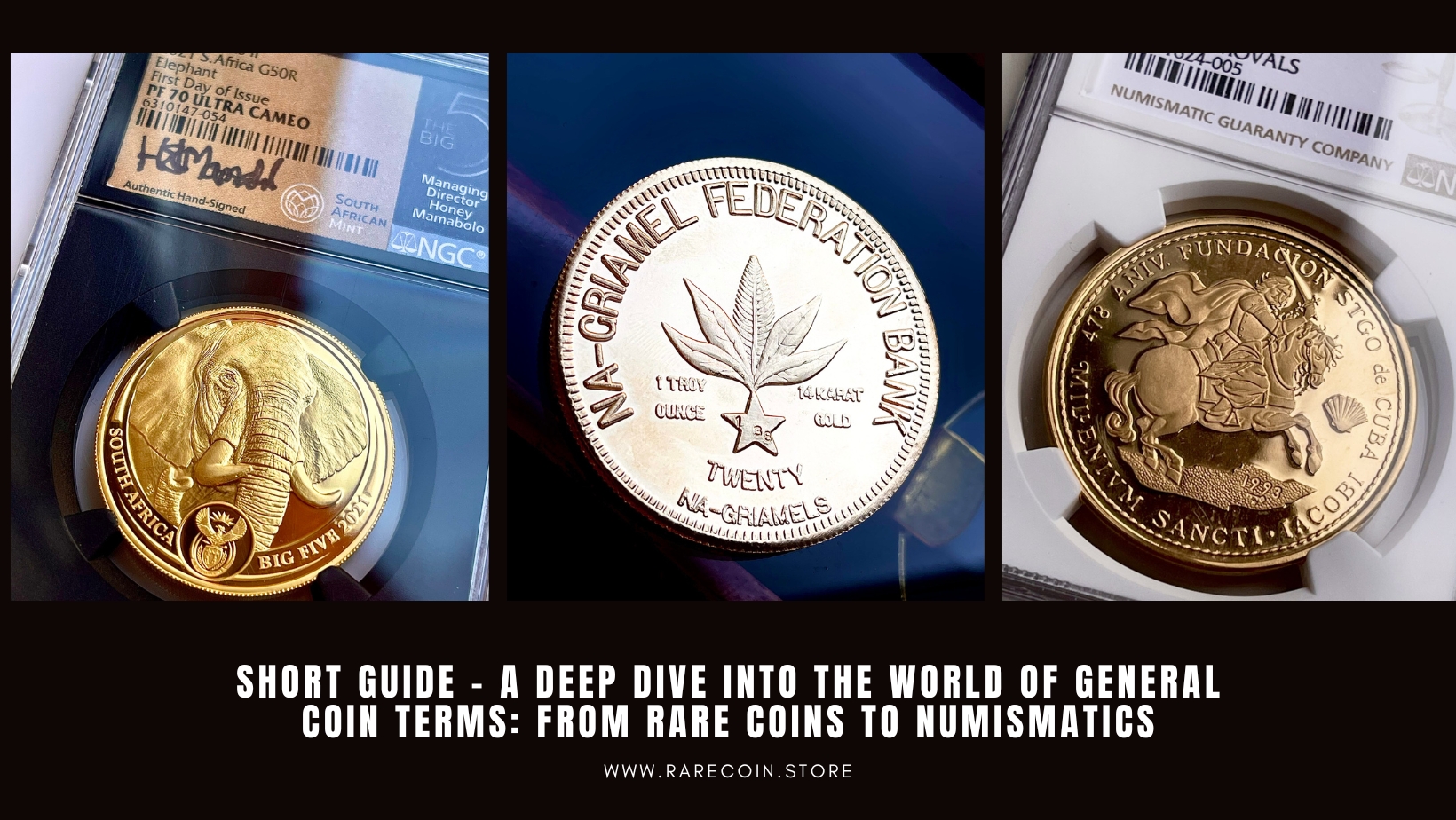
A few examples of very rare coins:
Na-Griamel – 1976 – 20 Na-Griamels – President Moly – Federation Medal (stamp unknown – extremely rare)
South Africa Big Five 2021 – Elephant – Series II – 1 oz Gold PP – NGC PF70 Ultra Cameo – ( SA Mint , embossing autographed – 102)
Important coin terms explained simply
Precious Coins : While all rare coins hold a special place in the hearts of collectors, not all are necessarily valuable in terms of monetary value. Precious coins are those that fetch high prices in the market due to their historical significance, metal composition, demand and of course their rarity. Their value can range from a few dollars to millions, with some pieces breaking records at auction, such as the 1794 Flowing Hair Silver Dollar, which is the most expensive silver coin in the world. Or a much cheaper and much sought after example: Krugerrand 1997 Sabi-Sabi 1oz gold coin
Coin collecting : The fascinating world of coin collecting is hidden behind the individual pieces. What often starts as a childhood hobby can develop into a lifelong passion or even a lucrative investment. It’s a journey through history, geography and art, with each coin telling a story about its era, country and the people who used it. Collectors can specialize in different niches – from ancient coins to specific geographical regions or time periods.
Numismatics : Beyond simply collecting coins, numismatics is the scientific study of all types of currency, including coins, paper money, and medals. A numismatist not only collects, but also researches the provenance, design and historical context of these pieces. It is an interdisciplinary field that combines history, archeology and even metallurgy. Numismatics can be used to explore the development of trade, design trends and socio-political changes over time. Although these general coin terms may seem simple at first glance, they open the door to a world of history and art, and passion.
Whether you are interested in the allure of rare coins, the investment potential of valuable coins, or the academic appeal of numismatics, there is no denying the enduring charm of this age-old hobby. Dive in and maybe discover a passion you never knew existed.
Why coin terminology is important for collectors
Understanding numismatic terminology allows for better classification of coins. Rarity, condition, mintage, design, origin, and demand often influence collector value more than it initially appears. Therefore, it’s worthwhile to know the most important basics of numismatics before buying, selling, or appraising rare coins.
Examples from the world of modern gold coins
At RareCoin.Store you will find a selection of modern gold coins from various collecting areas. Many of these pieces demonstrate why coin terms such as rarity, condition, mintage, proof quality, certification, and collector value are important in practice.
Frequently asked questions about coin terms
What are coin terms?
Coin terms are technical terms from numismatics and coin collecting. They help to better classify coins according to origin, condition, mintage, rarity, material, minting quality, and collector value.
What does “rare coin” mean?
A rare coin is one that was minted in small quantities, rarely appears on the market today, or is difficult to find due to special characteristics. However, rarity alone does not automatically imply high value.
What is the difference between rare and valuable coins?
Rare coins are not automatically valuable. Their value also depends on demand, condition, historical significance, material, certification, and market availability.
What does numismatics mean?
Numismatics is the scientific and collecting study of coins, medals, paper money, and related forms of money. It combines history, art, economics, and materials science.
Why is preservation important for coins?
Condition significantly influences a coin’s value to collectors. Scratches, cleaning marks, abrasions, stains, or damage can considerably reduce a coin’s value.
If you would like to delve deeper into specific terms, you will find further explanations of important numismatic terms in our coin glossary . There, key concepts relating to coins, minting quality, condition, rarity, certification, and collector value are presented in a concise and easy-to-understand manner.
About the author
Larissa Wasserthal, at RareCoin.Store, focuses on modern numismatic gold coins, certified collectibles, and the clear explanation of fundamental coin terminology. In her articles, she explains why terms like rarity, condition, mintage, minting quality, certification, and collector value are important for coin collectors. She combines numismatic research with clear language for discerning collectors.


