
Chilean gold coins are among the most interesting modern collector coins of South America. They combine precious metal, national history, South American symbolism, and modern minting techniques. Many issues were minted as commemorative or collector coins and depict historical events, cultural themes, or national motifs of Chile.
Chilean gold coins are particularly exciting for collectors because they appear much less frequently on the international market than classic investment coins like the Krugerrand, Maple Leaf, or American Eagle. Therefore, their valuation depends not only on gold content and weight, but also on face value, year of issue, mintage, condition, minting quality, certification, and provenance.
Unlike pure bullion coins, Chilean gold coins are usually more closely linked to the context of modern South American numismatics. They document history, national identity, and cultural motifs. Therefore, they can be much more than just physical gold for collectors.
Updated in May 2026: This article has been refined in terms of content and supplemented with information on Chilean gold coins, peso denominations, historical motifs, minting quality, mintage, certification, condition and collector value.
Some interesting facts about Chile and its gold coins
Chile lies on the west coast of South America and stretches along an exceptionally long north-south axis between the Pacific Ocean and the Andes Mountains. The country is officially the Republic of Chile, its capital is Santiago de Chile, its official language is Spanish, and its currency is the Chilean peso. It is precisely this combination of geographical diversity, national history, and its own currency that makes Chile numismatically interesting.
Historically, Chile is particularly shaped by its long process of independence from Spain. On September 18, 1810, the first governing junta marked a decisive step towards autonomy. The formal declaration of independence followed in 1818. Therefore, September 18th continues to play a central role in Chile’s national identity.
Chile’s national symbols include the colors red, white, and blue; the national flower, the copihue; the Andean condor as the national bird; and the huemul as the national animal. Such national symbols are also relevant for collectors because coin designs often reflect a country’s history, nature, coat of arms, prominent figures, or cultural identity.
Chilean gold coins are particularly interesting due to their historical motifs, peso denominations, national anniversaries, and the connection between South American history and modern numismatics. Unlike classic investment coins, many Chilean gold coins represent not only their intrinsic precious metal value but also their historical significance, rarity, minting quality, and collector value.
What are traditional Chilean dishes?
Pebre: A tasty and spicy sauce prepared with tomatoes, onions, garlic, olive oil, herbs and peppers.
Empanada: A popular delicacy made of fried bread dough and filled with different ingredients, such as cheese and olives, cheese and ham, meat and hard-boiled egg and many more.
Sopaipilla: A common treat consisting of fried pastries occasionally decorated with sugar, marshmallows or chancaca, a sweet syrup made from sugar cane.
Dulce de Leche: is a creamy caramel confection.
What is the national drink of Chile?
The official national drink of Chile is none other than Pisco, a beloved and cherished beverage that holds a special place in Chilean culture.
Pisco is a type of brandy made from fermented grape juice, specifically distilled from certain grape varieties grown in the wine regions of Chile.
With a long history dating back to Spanish colonial times, Pisco has become deeply ingrained in the social fabric of Chile. It is often enjoyed as an aperitif or in a variety of traditional cocktails, such as the iconic Pisco Sour, which combines Pisco with lemon or lime juice, sugar, and egg white to create a delicious and refreshing concoction.
The production of Pisco in Chile is carefully regulated to guarantee its quality and authenticity. The grapes used for the production are carefully selected and the distillation process follows specific guidelines to preserve the unique flavors and characteristics of the spirit.
The result is a smooth and aromatic drink that reflects the essence of the Chilean winemaking tradition.
Besides its taste, pisco also has a symbolic meaning for Chileans. It represents a link to the country’s historical roots and serves as a sign of pride in national identity. On festive occasions and gatherings, pisco is often shared with friends and family, further strengthening the bonds of camaraderie and celebration.
In recent years, pisco has gained international recognition and popularity, finding its way onto the shelves of bars and restaurants around the world. Anyone visiting Chile should definitely try this iconic drink and be convinced of its rich flavor and cultural significance.
Chile’s official national drink, pisco, exemplifies the country’s passion for its rich heritage and its commitment to preserving and sharing its unique traditions with the world. Whether enjoyed in a traditional cocktail or neat, pisco gives a sense of Chile’s vibrant culture and the warmth of its people.
Chile’s wine production
Chile has rightly established itself as one of the world’s leading nations in wine production. Its impressive position as one of the leading countries in this industry is due to a combination of advantageous climatic conditions, diverse landscapes and the know-how of its winemakers.
What animals are common in Chile?
Chile’s diverse landscapes are home to a range of animals, including guanacos, vicuñas, alpacas, armadillos, foxes, opossums, pudu (a type of deer) and Patagonian pumas. The North Andean huemul (in English it is called South Andean deer) or taruca is recognized as Chile’s national animal.
The tallest building in South America
The Gran Torre Santiago (Spanish for “Great Santiago Tower”) is a towering 62-story building in Santiago, Chile. It is the tallest building in South America and the second tallest building in Latin America.
What languages are spoken in Chile?
While Spanish is the official language in Chile, English is taught in schools as part of the curriculum. In addition, in the southern regions of Chile there is a minority that speaks languages such as Indio, Italian, Mapuche and German.
Chile and precious metals
Chile is the largest copper producer in the world and has impressive mineral resources such as gold, silver, iron, coal and lithium. The spotlight, however, is on copper, as Chile claims the title of leading exporter and supplier of this valuable metal on the international stage.
Chile gold coins – motifs, face value and collector value:
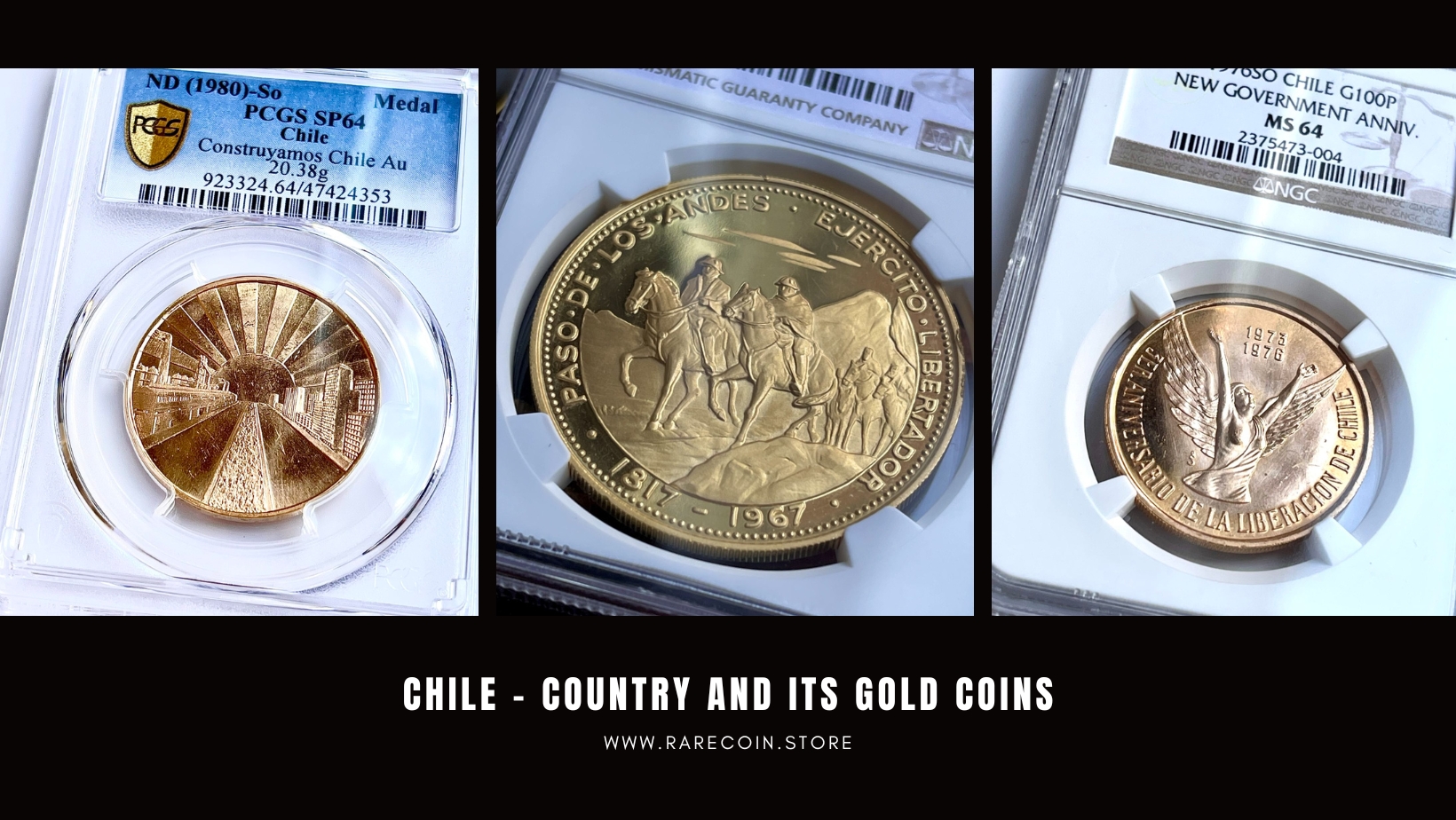
Chile – 1980 – Gold Medal – Construyamos Santiago de Chile – PCGS SP64
This stunning gold medal features a vibrant cityscape illuminated by a brilliant sun. It embodies the concepts of progress, unity and collective effort in the pursuit of a stronger Chile. Meticulous craftsmanship and careful attention to every element make this piece a true masterpiece.
The gold medal “Construyamos Chile 1980” is of immense historical importance and symbolizes a crucial period in Chile’s development. It is a testament to the tireless efforts and determination of the Chilean people in shaping the destiny of their country.
Chile – 1976 – 100 Pesos – Anniversary of the new government – NGC MS64
The obverse of this charming coin proudly displays the Chilean national coat of arms above the date and denomination. The lettering “REPUBLICA DE CHILE” symbolizes the identity of the nation, while “100 PESOS” indicates the monetary value. The date “1976” not only represents the issue of the coin, but also commemorates the third anniversary of the liberation of Chile.
On the reverse side, a figure with wings and raised arms takes center stage, symbolizing the spirit of liberation and triumph. Above the figure, the two dates “1973” and “1976” recall the historical journey from oppression to freedom. The inscription “3ER ANIVERSARIO DE LA LIBERACION DE CHILE” celebrates the third anniversary of Chile’s liberation and expresses national pride.
This exceptional coin, produced with extreme precision at the prestigious Casa de Moneda de Chile in Santiago, is of remarkable historical and cultural importance. With a limited edition of only 2900 pieces, this coin is an extremely rare and appreciated treasure.
Chile – San Martin Passage – 200 Pesos – 1968 – NGC PF64 Ultra Cameo
This particular gold coin comes from Chile and carries a face value of 200 pesos. It was minted in 1968 as a special commemorative issue to honor two important events. On the one hand, it honors the 150th anniversary of the Anniversary of the founding of the company. Anniversary of the founding of the company. On the other hand, it commemorates the important procession of Saint Martin through the Andes, which eventually led to the liberation of Chile from Spanish rule.
The gold coin has been officially certified by the NGC (Numismatic Guaranty Corporation), a renowned grading body. It has received an impressive PF64 Ultra Cameo rating, which highlights its exceptional quality and flawless appearance.
Frequently asked questions about Chilean gold coins
What are Chilean gold coins?
Chilean gold coins are modern or historical gold coins with a connection to Chile. Many issues were minted as commemorative or collector coins and depict historical, cultural, or national motifs.
Are Chilean gold coins investment coins or collector coins?
Many Chilean gold coins are more collector’s items than classic investment coins. While they do contain gold, their value also depends on the design, mintage, condition, minting quality, certification, and market availability.
What motifs are typical for Chilean gold coins?
Typical motifs relate to Chilean history, national identity, historical events, coats of arms, personalities, or cultural symbols.
Why are Chilean gold coins rare on the market?
Chile is not a typical mass-issuing country for internationally circulated bullion coins . Many gold issues therefore only appear occasionally in the market or at auctions.
Is NGC or PCGS certification worthwhile for Chilean gold coins?
For rare modern or historical gold coins, certification by NGC or PCGS can be helpful. It documents the authenticity, condition, and identity of the specific coin and facilitates international comparison.
About the author
Larissa Wasserthal, at RareCoin.Store, focuses on modern numismatic gold coins, certified collectibles, and the clear explanation of complex numismatic topics. In her articles, she explains why Chilean gold coins and other modern South American gold coins are of interest to collectors and what role history, design, minting quality, condition, mintage, certification, and collector value play. She combines numismatic research with clear language for discerning collectors.


