
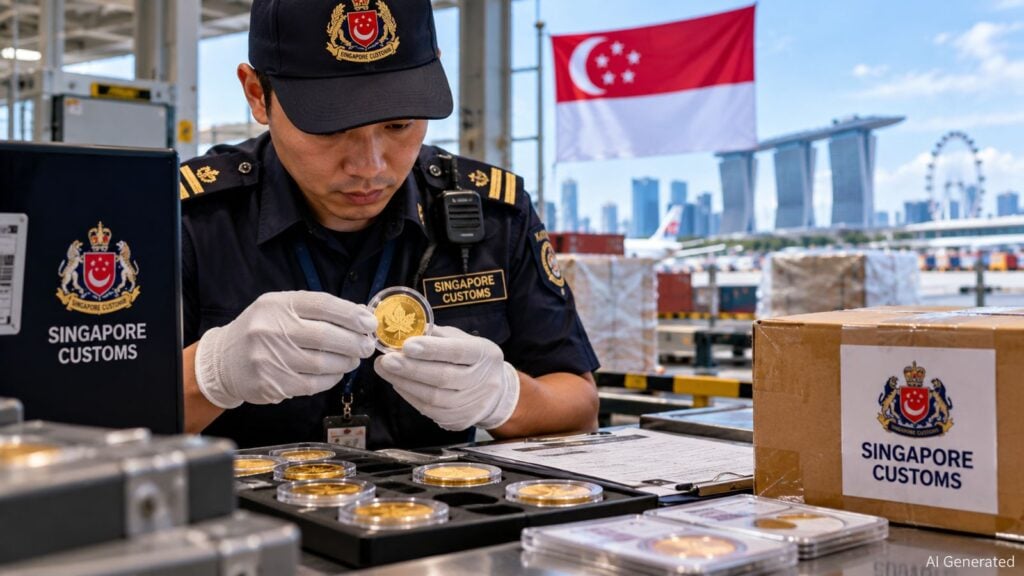
Customs and import taxes for coin shipments to Singapore depend less on classic customs duty than on Goods and Services Tax (GST). Coins are not among the few categories of goods on which Singapore levies Customs Duty or Excise Duty. However, the current GST rate of 9% may generally apply on import.
For collectors of modern gold and platinum coins, the key exception is for so-called Investment Precious Metals (IPM). Qualifying investment gold and platinum coins can be fully exempt from GST. Proof issues, numismatic collector coins and collector versions, however, are expressly excluded from this exemption, even if the corresponding bullion series is generally included on the IPM list.
This overview is intended for private collectors in Singapore who buy modern numismatic gold or platinum coins from a dealer in Germany and receive them by courier.
Coin shipments to Singapore: the main rules
| Topic | Singapore |
|---|---|
| Customs Duty / Excise Duty | Generally none for gold and platinum coins; coins are not among the categories subject to customs or excise duty |
| GST | Standard rate of 9% unless an exemption applies |
| Qualifying Investment Precious Metals (IPM) | Exempt from GST on import |
| Proof, numismatic and collector versions | No IPM exemption; generally subject to GST |
| Gold IPM | At least 99.5% gold, legal tender in the country of origin, and included on the prescribed IPM list |
| Platinum IPM | At least 99% platinum, legal tender in the country of origin, and included on the prescribed IPM list |
| S$400 threshold | For non-dutiable, non-controlled consignments imported by air or post, import GST may be relieved where the CIF value does not exceed S$400; the OVR system may nevertheless result in GST being charged at the point of sale |
| Courier clearance above S$400 | For taxable courier imports, an In-Payment Permit is generally required; the courier or customs agent usually handles this |
Singapore does not levy classic import duty on coins
Singapore Customs limits dutiable or excisable goods essentially to four groups: intoxicating liquors, tobacco products, motor vehicles, and petroleum products and biodiesel blends. Gold and platinum coins are not included.
For typical coin shipments from Germany, there is therefore no Customs Duty and no Excise Duty. This does not automatically make the import tax-free. The decisive issue is then GST.
GST in Singapore: currently 9%
Goods and Services Tax (GST) is Singapore’s general consumption tax. The current standard rate is 9%.
For taxable imports, GST is generally calculated on the customs value. Singapore Customs and the Inland Revenue Authority of Singapore (IRAS) use the Cost, Insurance and Freight value (CIF), meaning the value of the goods plus transport and insurance to Singapore. Customs duties and certain incidental charges are added where applicable. Because coins are not dutiable, the tax base for a typical coin shipment essentially consists of the relevant value of the goods including transport and insurance.
The key exception: Investment Precious Metals (IPM)
Singapore exempts the import and local supply of qualifying Investment Precious Metals (IPM) from GST. Certain gold, silver and platinum coins can qualify.
For coins, a high precious-metal content alone is not enough. According to IRAS, a qualifying IPM coin must:
- have a fineness of at least 99.5% for gold or at least 99% for platinum,
- be or have been legal tender in its country of origin, and
- belong to one of the specifically prescribed coins or coin series.
A coin that is not on the prescribed list cannot qualify as IPM solely because of its fineness or bullion character.
Particularly important for modern numismatics: Proof and collector coins are excluded
For our area, the distinction is unusually clear. IRAS expressly excludes Proof, numismatic and collector versions of prescribed coins from the IPM exemption. The reason is that their market price is determined substantially by rarity, finishing and beauty, rather than only by precious-metal content.
This means, for example, that a standard bullion Gold Maple Leaf may qualify as IPM, while a Proof or explicitly numismatic collector version of the same series may be taxable. The same principle applies to other coin series included on the IPM list.
For a large proportion of the modern numismatic gold coins we deal with, the normal GST rate of 9% is therefore the practical starting point. This differs, for example, from Malaysia, where the exemption for gold coins is linked to tariff line 7118.90.10 and Proof issues are not excluded solely because of their finish.
Which gold coins can qualify as IPM?
The current IRAS list includes, among others, the following gold coins and series:
- American Buffalo
- Australian Kangaroo / Nugget
- Australian Lunar
- Austrian Philharmonic
- Canada Maple Leaf
- China Panda
- Malaysia Kijang Emas
- Mexico Libertad
- Singapore Lion
- United Kingdom Britannia (older 22-carat issues do not meet the required 99.5% fineness)
- Canada Call of the Wild
- United Kingdom Lunar
- Queen’s Beasts and Royal Tudor Beasts
- Australia RAM Kangaroo
- Australia Dragon Rectangular
- United Kingdom Royal Arms
- United Kingdom Myths and Legends
Here too, the list refers to qualifying investment versions. Proof, numismatic and collector versions are expressly not IPM.
Krugerrand, American Gold Eagle and Centenario: not gold IPM
The Gold Krugerrand contains 91.67% gold and therefore does not meet the 99.5% fineness required for gold IPM. It is also not included on the prescribed gold-coin list. A Gold Krugerrand is therefore not exempt from GST as IPM in Singapore.
The same basic issue applies to the American Gold Eagle, which also contains 91.67% gold, and to the Mexican 50 Pesos Centenario, which contains 90% gold. These coins likewise do not meet the minimum fineness requirement for gold IPM.
In the EU and the United Kingdom, the Gold Krugerrand can be treated as investment gold. Singapore, by contrast, applies its own, considerably narrower criteria for the IPM exemption.
Libertad and Maple Leaf: bullion can be tax-exempt, Proof cannot
The Gold Libertad and the Gold Maple Leaf are included on the prescribed gold-IPM list and, in their standard bullion versions, also meet the required fineness.
This does not mean that every Libertad or Maple Leaf issue is GST-exempt. A Proof, numismatic or collector version is expressly excluded from the IPM exemption.
Especially with rare Libertad Proofs, Reverse Proofs, low mintages or certified collector issues, the exact version being imported therefore has to be checked. The series name alone is not enough for the exemption.
Natura, Big Five and other modern collector series
A very high gold fineness does not automatically make a coin IPM either. Series that are not on the prescribed gold-coin list do not receive the exemption merely because they contain 99.9% or 99.99% gold.
This is relevant, for example, to many modern South African collector issues. Gold issues from Natura or Big Five are not GST-exempt solely because of their high gold content. In the case of the Big Five series, it is notable that IRAS expressly includes the South Africa Big Five series on the list of qualifying platinum coins. Proof, numismatic and collector versions remain excluded from the IPM exemption there as well.
Platinum coins: a separate IPM list
For platinum, IRAS requires a fineness of at least 99%, legal-tender status and inclusion on the prescribed list.
The current list of qualifying platinum coins includes, among others:
- American Platinum Eagle
- Australia Koala
- Australia Platypus
- Canada Platinum Maple Leaf
- Austria Philharmonic
- United Kingdom Britannia
- United Kingdom Lunar
- Queen’s Beasts
- Australia Kangaroo
- Australia Lunar
- United Kingdom Royal Arms
- South Africa Big Five
- United Kingdom Royal Tudor Beasts
For platinum as well, the GST exemption applies only to qualifying IPM versions, not automatically to every collector issue from a listed series.
NGC or PCGS grading: not the actual tax test
The published IPM criteria do not depend solely on certification or on a particular grading grade. What matters is whether the specific coin meets the requirements for a qualifying IPM version.
A PF70 coin is usually a Proof issue and is therefore already excluded from the IPM exemption because of its version. For a standard bullion coin certified in an NGC or PCGS holder, however, the specific issue must be checked against the IPM criteria. The holder itself does not determine the GST exemption.
HS codes for qualifying IPM coins
Singapore Customs specifies, among others, the following Harmonised System codes (HS codes) for IPM coins:
| IPM | HS code |
|---|---|
| Gold coin | 71189010 |
| Platinum coin | 71181090 or 71189090 |
The HS code alone does not establish a GST exemption. The specific coin must still meet the IRAS IPM criteria.
S$400: import relief and Low Value Goods are not the same thing
Singapore uses a threshold of S$400 (400 Singapore dollars) in two related but distinct areas.
1. GST relief on import
Non-dutiable and non-controlled goods imported by air or post with a total CIF value not exceeding S$400 may qualify for GST relief on import.
CIF means Cost, Insurance and Freight. Transport and insurance therefore count towards this threshold. If the total CIF value exceeds S$400, GST is generally charged on the full taxable value of a non-exempt import.
For high-value gold and platinum coins, this import threshold is usually of little practical importance because their value is normally well above it.
2. Low Value Goods and Overseas Vendor Registration
Since 2023, Singapore has also operated a separate system for Low Value Goods (LVG) and Overseas Vendor Registration (OVR). A Low Value Good has a sales value not exceeding S$400, is located outside Singapore at the point of sale and is delivered to Singapore by air or post.
If the overseas seller is registered for Singapore GST, the seller charges GST at the point of sale on such B2C transactions. If the seller is not registered and the CIF value of the consignment does not exceed S$400, import relief may apply. If the CIF value exceeds S$400, GST is collected on import.
Qualifying IPM are already exempt from GST and therefore do not fall within the normal LVG mechanism for taxable Low Value Goods.
When must an overseas dealer register for GST?
The OVR system does not automatically apply merely because an overseas dealer makes individual sales to Singapore. According to IRAS, registration is generally required where the business has a global annual turnover exceeding S$1 million and at the same time makes more than S$100,000 per year in B2C supplies of remote services and/or Low Value Goods to Singapore.
Only where the relevant conditions are met and the supplier is GST-registered is GST on Low Value Goods collected under the OVR system at the point of sale.
Customs clearance for courier deliveries
For non-dutiable and non-controlled courier goods imported by air with a CIF value of up to S$400, an individual Import Permit is generally not required. For taxable courier imports above S$400, an In-Payment Permit is generally required.
With UPS, FedEx and other express services, the technical customs declaration is usually handled by the courier or its Declaring Agent. A complete commercial invoice, a clear description of the goods, the actual value, transport and insurance costs, and the correct tax treatment of the coin are therefore particularly important.
Special clearance for Investment Precious Metals
Qualifying IPM are exempt from GST but may still be subject to special permit requirements. Singapore Customs specifies an In-Non Payment (GST Relief) Permit for IPM coins imported by air where the value exceeds S$400. No permit is required for air consignments up to S$400. No Customs Permit is required for IPM imported by parcel post either.
The GST Relief Permit includes, among other things, the relevant HS code, the coin description and a product code such as GOLDCOIN or PLATINUMCOIN. A taxable collector coin must not simply be declared as IPM. IRAS expressly warns that falsely declaring taxable imports as GST-exempt IPM can result in penalties.
UPS and FedEx: private clearance fees
In addition to government GST, private courier fees may arise where the service provider advances tax on behalf of the recipient or performs additional customs-clearance services.
According to the current UPS Singapore Rate and Service Guide, the Disbursement Fee on imports is 5.9% of the duties and taxes advanced by UPS, subject to a minimum of S$25 and a maximum of S$100 per shipment.
FedEx Singapore currently charges an Advancement or Disbursement Fee of 5% of the duties and taxes advanced, subject to a minimum of S$24 per shipment. The relevant clearance-service fees were adjusted on 20 July 2026.
These amounts are not Singapore taxes or customs duties, but private service fees charged by the respective shipping provider.
If you order from Wasserthal RareCoin.Store
Wasserthal RareCoin.Store ships modern numismatic gold and platinum coins to Singapore fully insured and with clear commercial and shipping documentation. Singapore is one of our regular international shipping destinations.
For deliveries outside the European Union, the buyer is responsible for any import charges, taxes and other fees incurred in the destination country. Wasserthal RareCoin.Store does not calculate these amounts itself. Our current shipping terms can be found under Payment and shipping.
Further numismatic background can be found in our article Singapore Gold Coins: Rare Issues and the Collector Market.
Frequently asked questions about coin shipments to Singapore
Are gold coins subject to import duty in Singapore?
Gold coins are not among Singapore’s dutiable categories of goods. Typical gold coins are therefore not subject to Customs Duty or Excise Duty. GST must be considered separately.
What is the GST rate in Singapore?
The current standard rate is 9%. Qualifying Investment Precious Metals are exempt from GST.
Is every Gold Maple Leaf GST-exempt?
No. The qualifying bullion version of the Canada Maple Leaf is on the IPM list. Proof, numismatic and collector versions, however, are expressly excluded from the IPM exemption under the IRAS rules.
Is a Gold Libertad GST-exempt?
The Mexico Libertad is one of the prescribed gold-IPM series and can qualify for the exemption in a qualifying bullion version. A Proof, numismatic or collector version is not GST-exempt as IPM.
Is a Gold Krugerrand GST-exempt in Singapore?
No. The Gold Krugerrand has a fineness of 91.67%, below the 99.5% required for gold IPM. It is also not included on the prescribed gold-IPM list.
What about an American Gold Eagle?
The American Gold Eagle also has a fineness of 91.67% and therefore does not meet the minimum fineness for gold IPM. The American Buffalo, with 99.99% gold, is included on the prescribed gold-IPM list.
Are Proof and PF70 coins GST-exempt if the series is on the IPM list?
Proof versions are expressly excluded. A PF70 coin is typically a Proof issue and therefore does not fall under the IPM exemption. The specific version of the coin is decisive, not merely the series name or the grading.
What applies to platinum coins?
Certain platinum coins can be exempt from GST as IPM if they contain at least 99% platinum, are or were legal tender, and appear on the prescribed list. These include, among others, Canada Maple Leaf, American Eagle and South Africa Big Five in qualifying versions.
What does the S$400 threshold mean?
For non-dutiable and non-controlled goods imported by air or post, GST relief on import may apply where the total CIF value does not exceed S$400. Where the purchase is made from an OVR-registered overseas seller, however, GST on Low Value Goods may already be collected at the point of sale.
Do shipping and insurance count towards the S$400 threshold?
Yes for the import-relief threshold. The relevant amount is the CIF value, meaning Cost, Insurance and Freight. For the LVG sales value used by an OVR seller, however, transport and insurance are not included in the value of the goods.
Are UPS or FedEx fees Singapore taxes?
No. Disbursement and Advancement fees are private service fees charged by the courier and are separate from government GST.
Transparency notice
Wasserthal RareCoin.Store is a specialist dealer in modern numismatic gold and platinum coins and ships coins to international customers. We therefore have a commercial interest in the topics covered on this page.
The information on customs, GST and import rules is researched independently of the sale of individual products and is based on official sources. This overview also applies to coins purchased from other dealers.
Disclaimer
This information is provided for general guidance and does not replace individual customs, tax or legal advice.
Tax rates, IPM lists, tariff classifications, exemptions, customs values and clearance procedures may change and depend on the specific coin and shipment. The rules of Singapore in force at the time of import and the decision of the competent authorities are authoritative.
About the author
Author: Dirk Wasserthal
Dirk Wasserthal is Managing Director of TriaPrima GmbH, the company operating Wasserthal RareCoin.Store. His focus is on modern numismatic gold and platinum coins as well as high-quality certified collector coins.
Wasserthal RareCoin.Store has already supplied collectors in 40 countries. TriaPrima GmbH is an Authorized Dealer with both PCGS and NGC. The company is also a member of the American Numismatic Association (ANA) and the German professional association of coin dealers.
Sources and review date
This overview is based primarily on primary sources from Singapore Customs and the Inland Revenue Authority of Singapore (IRAS), as well as current fee information from UPS and FedEx.
- Singapore Customs: Duties and Dutiable Goods Overview, overview of dutiable and excisable goods.
- IRAS: Current GST Rates, current standard GST rate of 9%.
- Singapore Customs: Goods and Services Tax, calculation of GST on imports.
- IRAS: Supplies Exempt from GST – Investment Precious Metals, IPM criteria and GST exemption.
- IRAS: GST: Guide on Exemption of Investment Precious Metals (IPM), prescribed gold and platinum coins and exclusion of Proof, numismatic and collector versions.
- Singapore Customs: Importing Investment Precious Metals, HS codes and permit requirements for IPM.
- Singapore Customs: Courier / Postal Procedures, S$400 threshold, GST and permit requirements.
- Singapore Customs: GST on Low-Value Goods, GST on Low Value Goods and treatment by overseas sellers.
- IRAS: Overseas businesses supplying remote services and low-value goods to Singapore, requirements for Overseas Vendor Registration.
- UPS Singapore: Shipping Costs and Rates and 2026 Rate and Service Guide, current Disbursement Fee for Singapore.
- FedEx Singapore: Service News and Alerts and Surcharge and Other Information, clearance-service fees from 20 July 2026.
Content and sources last reviewed: 4 October 2026