
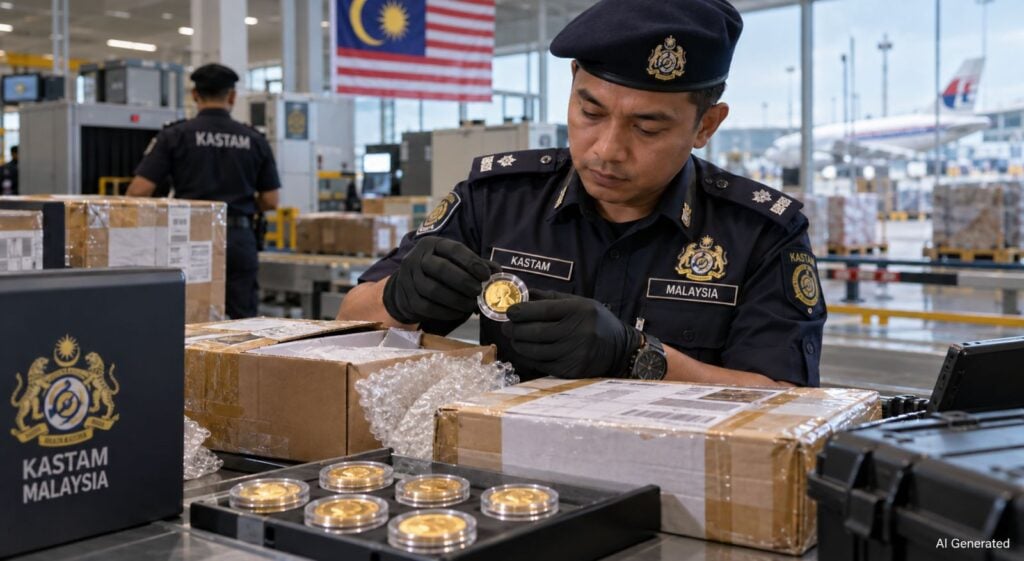
Customs and import taxes for coin shipments to Malaysia depend above all on the correct tariff classification. A Gold Krugerrand, a Platinum Maple Leaf and a rare certified Proof gold coin can all be in the same parcel to Kuala Lumpur but still be treated differently for customs purposes.
The position is particularly favourable for gold coins. The current Malaysian customs tariff lists gold coins, whether or not legal tender, under 7118.90.10 with 0% import duty. The same tariff line is expressly exempt from regular Sales Tax. Platinum coins fall under different tariff lines and are therefore subject to different charges.
This overview is intended for private collectors in Malaysia who buy modern numismatic gold or platinum coins from a dealer in Germany and receive them by courier. It covers regular imports into the Malaysian customs territory. Different rules may apply in special and free zones, including Labuan, Langkawi, Tioman and Pangkor.
Coin shipments to Malaysia: the key rules
| Topic | Malaysia |
|---|---|
| Gold coin under 7118.90.10 | 0% import duty; exempt from regular Sales Tax |
| Platinum coin under 7118.90.90 | 5% import duty; generally 10% Sales Tax unless another exemption applies |
| Modern legal-tender collector coin | Generally heading 7118; Proof, PF70, PR70, MS70 or Top Pop do not automatically change this |
| Regular Sales Tax rate | 10% for taxable goods unless an exemption or special rule applies |
| Sales Tax basis on import | Customs value + any import duty + any excise duty |
| De minimis threshold | Up to RM 500 (500 Malaysian ringgit) per consignment on a CIF basis (Cost, Insurance and Freight) for qualifying air-courier or postal shipments; import duty and Sales Tax on import may be exempt |
| Low Value Goods (LVG) | Goods sold online at a selling price of up to RM 500; separate 10% system for sellers required to register |
| Standard customs declaration | Generally Customs Form No. 1 (K1), unless simplified immediate release applies |
Malaysia uses Sales Tax, not GST
Malaysia taxes imported goods under the Sales and Service Tax (SST). For coins, the relevant component is Sales Tax. It is not a European-style value-added tax and it is also not the Australian Goods and Services Tax (GST).
Since 1 July 2025, the Sales Tax (Rate of Sales Tax) Order 2025 has generally imposed a rate of 10% on taxable goods, unless an exemption or another special treatment applies. A 2026 amendment concerns only Chapter 89 of the customs tariff, covering ships and floating structures. The gold-coin tariff line 7118.90.10 remained unchanged.
Gold coins under 7118.90.10: 0% duty and exempt from Sales Tax
The current Customs Duties Order 2025, in force since 1 November 2025, lists tariff line 7118.90.10 00 as “Gold coin, whether or not legal tender”. The general import duty rate is 0%.
Even more important for collectors is the Sales Tax treatment. The Sales Tax (Goods Exempted from Sales Tax) Order 2025 expressly lists the same tariff line, 7118.90.10 00, as exempt from Sales Tax.
This makes Malaysia quite different from countries that apply minimum fineness requirements to gold coins or use a special definition of investment gold. The wording of Malaysian tariff line 7118.90.10 does not specify a minimum fineness. A Gold Krugerrand with 91.67% gold content or an American Gold Eagle is therefore not excluded from this gold-coin tariff line merely because of its alloy. The same generally applies to high-fineness series such as the Gold Libertador Gold Maple Leaf, provided the specific item is in fact classified under 7118.90.10.
Proof, PF70 and Top Pop: legal tender remains under 7118
Paragraph 4(2) of the Malaysian Customs Duties Order 2025 requires tariff classification to be read together with the explanatory notes and other materials of the World Customs Organization (WCO). Under the WCO Explanatory Notes to heading 7118, coins that are legal tender in the country of issue belong in this heading. This also applies to individual coins or coin sets in presentation cases.
For typical modern legal-tender series such as the Krugerrand, Maple Leaf, Libertad or American Eagle, 7118 is therefore the starting point. A Proof finish, a PF70, PR70 or MS70 grade, a low mintage or Top Pop status does not move such a coin into Chapter 97 merely because of its collector value.
Heading 9705 remains relevant for genuine numismatic collectors’ pieces, particularly where coins are no longer legal tender and are to be classified as collectors’ pieces of numismatic interest. This does not mean that every old or demonetised coin automatically falls under 9705; the specific classification under the HS rules and WCO Explanatory Notes remains decisive.
For the modern gold coins we typically handle, this distinction is favourable. If the coin is legal tender and is classified as a gold coin under 7118.90.10, the customs and Sales Tax treatment provided for that tariff line also applies to Proof, PF70 or Top Pop pieces.
Platinum coins: 7118.90.90 is a different starting point
Heading 7118 does not contain a separate subheading for platinum coins as it does for gold coins. If a modern platinum coin is classified under 7118.90.90 00 “Other”, the general import duty under the Customs Duties Order 2025 is 5%.
This tariff line is not covered by the special Sales Tax exemption for gold coins under 7118.90.10. Unless another exemption applies, the regular Sales Tax rate of 10% applies to taxable goods.
For platinum too, a coin that is legal tender in the country of issue generally falls under heading 7118. A Proof finish or a high grading grade does not automatically alter that classification. The final tariff classification rests with the Malaysian customs authorities.
7118 or 9705: which heading applies to collector coins?
| Tariff line | Description | Treatment |
|---|---|---|
| 7118.90.10 00 | Gold coin, whether or not legal tender | 0% import duty; central tariff line for modern gold coins |
| 7118.90.20 00 | Silver coin, being legal tender | 5% import duty |
| 7118.90.90 00 | Other | 5% import duty; possible starting point for other legal-tender coins such as platinum |
| 9705.31 / 9705.39 | Collectors’ pieces of numismatic interest | Not the starting point for modern coins that are legal tender in the country of issue |
For modern legal-tender coins, heading 7118 is therefore the relevant starting point. Krugerrand, Maple Leaf, Libertad and American Eagle remain there in principle even as Proof, PF70 or Top Pop pieces. Heading 9705, by contrast, covers numismatic collectors’ pieces that actually meet the requirements of that collectors’ heading, particularly coins that are no longer legal tender.
“Rare”, “Proof”, “Top Pop” or “certified” is not a separate customs tariff classification. In unusual borderline cases, obtaining a prior classification ruling from Royal Malaysian Customs may be advisable.
How is Sales Tax calculated on a taxable import?
Under the Sales Tax Act 2018, the value of taxable imported goods is based on the customs value plus any import duty and any excise duty payable.
The customs value is generally based on the transaction value of the goods sold for export to Malaysia. Under the Malaysian Customs (Rules of Valuation) Regulations, international transport, insurance, loading and handling costs up to importation into Malaysia are among the amounts added where they are not already included in the price.
For a taxable platinum coin classified under 7118.90.90, this means that the 5% import duty is calculated on the customs value; the Sales Tax base then also includes that import duty. The actual amount always depends on the specific shipment and the customs valuation.
RM 500: de minimis and Low Value Goods are two different rules
The RM 500 threshold appears in two different parts of the Malaysian system. The two rules are easy to confuse, but they serve different purposes.
1. De minimis rule on import
For consignments with a CIF value of no more than RM 500 per consignment imported through qualifying air-courier or postal services, a de minimis rule continues to apply. The official MyLVG materials refer to Item 94, Part I of the Customs Duties (Exemption) Order 2017 and Item 24, Schedule A of the Sales Tax (Persons Exempted from Payment of Tax) Order 2018. Such consignments may be exempt from import duty and Sales Tax on import if the other conditions are met.
CIF means Cost, Insurance and Freight. Unlike the LVG selling-price threshold, insurance and transport therefore count towards the relevant value for the de minimis test.
The rule does not apply generally to every type of import. Royal Malaysian Customs expressly states that the de minimis exemption is tied to air-courier or postal shipments. It does not apply, for example, to imports by road.
2. Low Value Goods in online sales
The separate Low Value Goods (LVG) system applies to goods from abroad that are sold online at a selling price of no more than RM 500 and delivered to Malaysia. Since 1 January 2024, the LVG Sales Tax rate has been 10%.
A Malaysian or foreign seller must register for this system if the total sales value of its LVG brought into Malaysia exceeds RM 500,000 within a 12-month period. For the LVG threshold, the selling price of the goods is counted without tax, duty, transport, insurance or other incidental charges.
A product can therefore have a selling price of no more than RM 500 and still fail the de minimis threshold if transport and insurance push its CIF value above RM 500. Royal Malaysian Customs expressly describes this situation in its LVG FAQ.
Several coins in one consignment
For the de minimis rule, the CIF value of the entire consignment is relevant. If several goods are shipped together and the CIF value therefore exceeds RM 500, the consignment no longer qualifies for de minimis treatment.
This is different from the LVG definition, which is based on the selling price of the individual Low Value Goods sold online. If LVG Sales Tax was correctly charged at the point of sale and the LVG registration number is stated in the customs declaration, the official FAQ indicates that double Sales Tax on import should be avoided.
Customs declaration: K1 and courier clearance
For regular imports, Malaysia uses Customs Form No. 1 (K1). Royal Malaysian Customs provides for simplified immediate release via the Electronic Pre-Alert Manifest (ePAM) for qualifying air-courier shipments with a CIF value of up to RM 500. Outside that immediate-release process, release of the goods generally takes place through K1.
For express shipments, the courier or its customs agent will in practice normally handle the technical customs clearance on behalf of the recipient. A complete commercial invoice, precise goods description, value, origin and appropriate tariff classification are therefore particularly important.
UPS and FedEx: private clearance fees
In addition to government import duty and Sales Tax, private fees charged by the carrier may arise.
Since 20 September 2026, UPS Malaysia charges a Disbursement Fee on import shipments of 2.5% of the duties and taxes advanced by UPS, subject to a minimum of RM 62.60 per shipment. The fee applies when UPS advances government charges on behalf of the party liable to pay them.
FedEx Malaysia likewise refers to Advancement, Disbursement and Duty Handling fees when FedEx advances duties and taxes during customs clearance. The relevant fees were adjusted on 20 July 2026.
These amounts are not Malaysian import taxes or customs duties, but service fees charged by the respective courier.
If you order from Wasserthal RareCoin.Store
Wasserthal RareCoin.Store ships modern numismatic gold and platinum coins to Malaysia fully insured and with clear commercial and shipping documentation. Malaysia is one of our regular international shipping destinations. Depending on the shipment and logistical availability, established express carriers such as UPS or FedEx are used in particular.
For deliveries outside the European Union, the buyer is responsible for import charges, customs duties, taxes and other fees arising in the destination country. Wasserthal RareCoin.Store does not calculate these amounts itself. Our current shipping terms can be found under Payment and Shipping.
Collectors can also find further practical guidance in our article Buying Gold Coins Online in Malaysia: What Collectors Really Look For.
Frequently asked questions about coin shipments to Malaysia
Are gold coins duty-free when imported into Malaysia?
Gold coins classified under 7118.90.10 00 have a general import duty rate of 0% under the current Customs Duties Order 2025. The tariff line expressly reads “Gold coin, whether or not legal tender”.
Is Sales Tax charged on gold coins in Malaysia?
Tariff line 7118.90.10 00 is expressly exempt from Sales Tax under the Sales Tax (Goods Exempted from Sales Tax) Order 2025. If a different tariff classification applies, for example as a numismatic collectors’ piece under 9705.39, that exemption cannot automatically be carried over.
Is a Krugerrand taxable in Malaysia because it is only 91.67% gold?
Not because of its fineness alone. Unlike some other countries, Malaysia does not state a minimum fineness for 7118.90.10, but instead uses the wording “Gold coin, whether or not legal tender”. The specific tariff classification remains decisive.
How are platinum coins treated?
There is no separate platinum-coin subheading under 7118. If a platinum coin is classified under 7118.90.90 00, the general import duty is 5%. Because the special Sales Tax exemption applies only to 7118.90.10, taxable goods are generally subject to the regular 10% Sales Tax rate unless another exemption applies.
Does a modern rare legal-tender coin fall under 9705 because it is Proof or Top Pop?
No. Under the WCO Explanatory Notes, coins that are legal tender in the country of issue generally belong in heading 7118, even if sold as collectors’ pieces, in Proof or in a presentation case. A PF70, PR70, MS70 or Top Pop status does not automatically change that.
What does the RM 500 threshold mean?
There are two different RM 500 rules. The de minimis rule concerns the CIF value of a qualifying air-courier or postal consignment. The LVG system, by contrast, concerns goods sold online at a selling price of no more than RM 500. The two rules should not be treated as the same thing.
Are shipping and insurance included in the RM 500 threshold?
For the de minimis threshold, yes, because the CIF value includes Cost, Insurance and Freight. For the LVG selling-price threshold, transport, insurance, tax and other incidental charges are not included in the selling price.
Which customs declaration is used for normal courier shipments?
Customs Form No. 1 (K1) is used for regular imports. Qualifying air-courier shipments within the de minimis rule may be eligible for simplified clearance through ePAM.
Are UPS or FedEx clearance fees Malaysian taxes?
No. Disbursement, Advancement and Duty Handling fees are private service fees charged by the courier and are separate from government import duty and Sales Tax.
Transparency note
Wasserthal RareCoin.Store is a commercial specialist dealer in modern numismatic gold and platinum coins and ships coins to international customers. We therefore have a commercial interest in the subjects covered on this page.
The information on customs, Sales Tax and import rules is researched independently of the sale of individual products and is based on official sources. This overview also applies to coins purchased from other dealers.
Disclaimer
This information is provided for general guidance and does not replace individual customs, tax or legal advice.
Tariff classifications, tax rates, exemptions, customs values and clearance procedures can change and depend on the specific goods and shipment. The Malaysian rules in force at the time of import and the decision of the competent Malaysian authorities are authoritative.
About the author
Author: Dirk Wasserthal
Dirk Wasserthal is Managing Director of TriaPrima GmbH, the company operating Wasserthal RareCoin.Store. His focus is on modern numismatic gold and platinum coins as well as high-quality certified collector coins.
Wasserthal RareCoin.Store has already supplied collectors in 40 countries. TriaPrima GmbH is an Authorized Dealer with both PCGS and NGC. The company is also a member of the American Numismatic Association (ANA) and the German professional association for coin dealers.
Sources and date of review
This overview is based primarily on primary sources from the Royal Malaysian Customs Department (JKDM/RMCD), the official MySST portal and current fee information from the shipping carriers.
- Royal Malaysian Customs Department: Customs Duties Order 2025, P.U. (A) 384, in particular 7118.90.10, 7118.90.90 and 9705.39.
- MySST / Royal Malaysian Customs Department: Sales Tax (Goods Exempted from Sales Tax) Order 2025, P.U. (A) 171, in particular the exemption for 7118.90.10.
- MySST: SST Orders, including the Sales Tax (Rate of Sales Tax) Order 2025 and the 2025/2026 amendments.
- MySST / Royal Malaysian Customs Department: Sales Tax (Goods Exempted from Sales Tax) (Amendment) Order 2026, P.U. (A) 276, in force since 1 August 2026; the amendment concerns tariff lines in Chapter 89 and not 7118.90.10.
- World Customs Organization: HS Explanatory Notes; the Customs Duties Order 2025 expressly refers to the WCO Explanatory Notes as the principal reference for classification.
- MySST: FAQ Transition of Sales Tax Rate Changes 2025, in particular the regular 10% rate for non-exempt goods.
- MySST: Sales Tax Act 2018, Act 806, in particular the valuation of taxable imported goods.
- Royal Malaysian Customs Department: Customs Valuation / Customs (Rules of Valuation) Regulations 1999, in particular transaction value and transport and insurance costs.
- MyLVG / Royal Malaysian Customs Department: FAQ Sales Tax on Low Value Goods, RM 500 threshold, 10% LVG rate, registration threshold and relationship with the de minimis rule.
- MyLVG: Guide on Sales Tax on Low Value Goods, Version 2.1, in particular the definition of the de minimis rule.
- Royal Malaysian Customs Department: Electronic Pre-Alert Manifest (ePAM), immediate release and K1 customs declaration.
- Royal Malaysian Customs Department: Customs Ruling, option to obtain a binding classification ruling.
- UPS Malaysia: Shipping Costs and Rates, current Disbursement Fee for Malaysia.
- FedEx Malaysia: Service News and Alerts and information on clearance-related fees effective 20 July 2026.
Content and sources last reviewed: 4 October 2026