
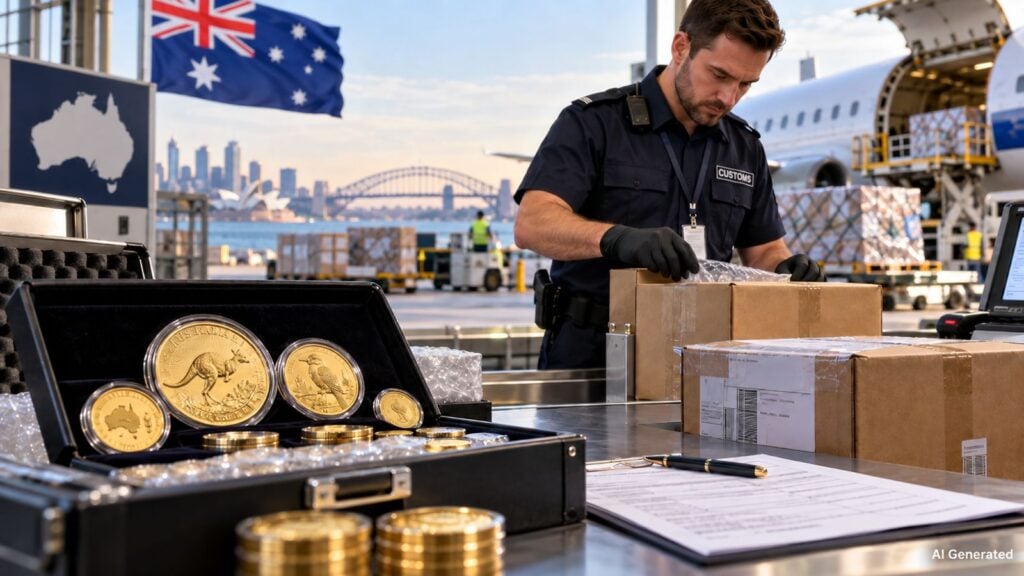
Customs and import taxes for coin shipments to Australia can vary more than collectors might expect. A Gold Krugerrand and a Gold Maple Leaf may travel together in the same parcel to Sydney, yet they do not meet the same tax requirements. Australia looks not only at the metal itself, but also at fineness and whether the coin is in investment form.
This is particularly important for modern numismatic coins. Proof issues, rare years, Top Pop coins and other collector issues may be subject to Australian Goods and Services Tax (GST) despite their high precious-metal content. This guide is intended for private collectors in Australia who buy modern gold or platinum coins from a dealer in Germany and import them by courier.
Coin Shipments to Australia at a Glance
| Topic | Australia |
|---|---|
| GST on a taxable import | 10% of the Value of Taxable Importation (VoTI) |
| Gold as “precious metal” | At least 99.5% fineness and in “investment form” |
| Platinum as “precious metal” | At least 99% fineness and in “investment form” |
| Proof and collector coins | ATO and ABF distinguish them from investment-form precious metal where collector characteristics materially influence their value |
| Customs duty | Tariff items 7118.10.00 and 7118.90.00 are listed as “Free” |
| Up to AUD 1,000 customs value | Generally no customs duty or GST at the border; GST may instead be collected at the time of sale to an Australian consumer |
| Over AUD 1,000 customs value | Import Declaration; GST is collected on import if the import is taxable |
| AUSTRAC | For certain shipments of coins that are legal tender and exceed AUD 10,000, a report may be required |
When Does a Gold Coin Qualify as Investment-Form Precious Metal?
Under the Australian GST Act, gold is “precious metal” if it is at least 99.5% fine and is also in investment form. Both requirements must be met.
The Australian Taxation Office (ATO) explains investment form in GSTR 2003/10. The key question is whether the coin is traded on the international bullion market essentially by reference to its metal value. Whether a coin is described as bullion or proof does not decide the issue.
This is where collector coins become different. If rarity, grade, minting quality, finish or other numismatic features materially influence the price, that weighs against treatment as pure investment-form precious metal.
Proof, Top Pop and Collector Value
The Australian Border Force (ABF) expressly separates Proof Coins and other collectable coins from “precious metals” for GST purposes. With these coins, value is influenced not only by weight and fineness, but also by rarity, condition and beauty.
This is consistent with the ATO approach. A Proof coin is not traded solely by reference to the gold or platinum price. The premium for finish, condition or rarity forms part of the product.
An NGC or PCGS holder does not determine the tax treatment on its own. With rare PF70, PR70 or MS70 issues, however, the documented grade can be exactly the reason why a coin trades well above its metal value. From a dealer’s perspective, this is where the Australian GST question becomes particularly relevant: where collector value clearly outweighs the pure precious-metal value. A high-grade Maple Leaf with a substantial numismatic premium is a good example.
Krugerrand and American Gold Eagle: Fineness Already Falls Short
The Gold Krugerrand is simpler to assess. The South African Mint states a gold content of 91.67%. It therefore does not meet Australia’s minimum gold fineness of 99.5%. The fact that the Krugerrand is traded worldwide as a bullion coin does not change that. You can find more information about individual years and issues in our overview of Krugerrand mintage figures.
The same issue arises with the American Gold Eagle. According to the United States Mint, it also contains 91.67% gold and therefore does not meet the Australian 99.5% threshold.
Highly refined series such as the Gold Libertad or Gold Maple Leaf can meet the fineness requirement. The specific issue then becomes decisive. A regular bullion issue may be treated differently from a rare Proof, special or Top Pop issue from the same series. See also our overviews of Libertad mintage figures and Maple Leaf mintage figures.
Platinum Coins: 99% Fineness and Investment Form
Platinum follows the same logic but with a different threshold. Platinum qualifies as “precious metal” from 99% fineness, provided it is also in investment form.
A standard platinum bullion coin can meet these requirements. With Proof or other numismatic platinum coins, the further question is whether the price is driven mainly by the platinum value or by rarity, grade and collector demand.
“GST-Free” Is Not the Same as a Non-Taxable Importation
In Australian tax law, “GST-free” is a specific legal term. For the import of qualifying investment-form precious metal, the more precise wording is non-taxable importation.
ABF explains that an import is non-taxable where the corresponding domestic supply would be GST-free or input taxed. A supply of qualifying “precious metal” is generally input taxed in Australia. The import can therefore also be treated as non-taxable.
AUD 1,000: What Happens with Low Value Imported Goods?
For goods with a customs value of up to AUD 1,000, ABF generally collects neither customs duty nor GST at the border. That does not necessarily mean the purchase is completely outside the Australian GST system.
For sales to Australian consumers, GST may already be collected at the time of purchase. The responsible party may be the overseas seller, an electronic distribution platform or, in certain cases, a redeliverer. For overseas businesses, the general GST registration threshold is AUD 75,000 of relevant Australian-connected turnover.
If the seller or platform is not registered for GST and is not required to register, Australian GST is not charged at the point of sale on a low-value supply. For a coin shipment up to AUD 1,000, GST will then generally not be collected at the border either.
If several coins are imported together and the customs value of the shipment exceeds AUD 1,000 in total, the shipment no longer falls under the low-value rules. An Import Declaration is then required, even if individual coins are each worth less than AUD 1,000.
Customs Value, Shipping and Insurance
The customs value is used for the AUD 1,000 threshold. International freight and transport insurance are not included in that customs value for the purpose of this threshold test.
For a taxable import above AUD 1,000, GST is instead calculated on the Value of Taxable Importation (VoTI). This includes the customs value, any customs duty payable and the international transport and insurance costs to the relevant place of destination in Australia.
Customs Tariff: Heading 7118 for Modern Coins
For typical modern gold and platinum coins, heading 7118 “COIN” is the starting point in the Australian customs tariff.
| Tariff Item | Official Description | Duty Rate |
|---|---|---|
| 7118.10.00 | Coin (other than gold coin), not being legal tender | Free |
| 7118.90.00 | Other | Free |
Modern gold and platinum coins correctly classified under heading 7118 therefore attract no regular customs duty. GST and government clearance charges are assessed separately.
Why Modern Legal-Tender Coins Do Not Fall Under 9705
Chapter 97 does contain a tariff heading for numismatic collectors’ pieces. However, the Australian Additional Notes to Chapter 97 expressly exclude coins that are legal tender in the country of issue from heading 9705. This also applies to coins presented in cases.
For typical modern legal-tender issues such as the Krugerrand, Maple Leaf, Libertad or American Eagle, heading 7118 is therefore the correct starting point. Coins that were not issued as legal tender may require separate tariff classification.
Import Processing Charge and Biosecurity Charge
Government clearance charges may also apply to shipments over AUD 1,000. As of 3 October 2026, ABF lists an Import Processing Charge of AUD 50 for an electronic Import Declaration where the shipment value is over AUD 1,000 and under AUD 10,000. From AUD 10,000, the charge is AUD 152.
ABF also collects a Biosecurity Cost Recovery Charge on behalf of the Department of Agriculture, Fisheries and Forestry. For a Full Import Declaration by air, the charge has been AUD 48 since 1 July 2026; for sea freight, it is AUD 71.
These are government clearance charges. They are neither customs duty nor GST.
AUSTRAC for Certain Coin Shipments over AUD 10,000
High-value coin shipments can raise one further Australian requirement. ABF may require an AUSTRAC report (Cross-Border Movement of Monetary Instruments) for shipments containing precious-metal coins classified as legal tender where the combined value of the shipment, including other physical currency or bearer negotiable instruments such as cheques or bills of exchange, exceeds AUD 10,000.
If such a report is required, different deadlines apply. For a shipment sent by post, courier or freight, the report must be lodged before dispatch. A person receiving the relevant coins from overseas must lodge the report within five business days after receipt.
ABF expressly states that an AUSTRAC declaration is not required for bullion.
UPS and FedEx: Private Courier Fees
UPS and FedEx may charge their own service fees on import, for example where the courier advances government charges on behalf of the recipient or handles customs clearance. FedEx uses terms such as Disbursement Fee or Advancement Fee; UPS lists a Disbursement Fee in its Australian Rate and Service Guide.
These courier fees are not Australian taxes or government charges.
If You Order from Wasserthal RareCoin.Store
Wasserthal RareCoin.Store ships modern numismatic gold and platinum coins to Australia fully insured and with clear commercial and shipping documentation. Depending on the shipment, delivery is handled in particular by UPS or FedEx.
For deliveries to countries outside the European Union, the buyer is responsible for customs duties, import taxes and other charges incurred in the destination country. These are not calculated by Wasserthal RareCoin.Store. Further information is available under Payment and Shipping.
For collectors in Australia, it is worth looking closely at the specific coin. A Krugerrand already fails the fineness test. With a high-fineness Maple Leaf or Libertad, the more interesting question is whether the coin is a regular bullion issue or a rare Proof, special or Top Pop issue.
Frequently Asked Questions
Do I have to pay Australian GST on a gold coin from Germany?
That depends on the coin and the value of the shipment. Gold must be at least 99.5% fine and must also meet the Australian criteria for investment form. Proof and other numismatic collector coins can therefore be taxable even when they are made of high-fineness gold.
Does a Krugerrand qualify as “precious metal” in Australia?
No. The Gold Krugerrand contains 91.67% gold and therefore does not meet Australia’s minimum fineness of 99.5%.
How are platinum coins treated?
Platinum must be at least 99% fine and must also be in investment form. With Proof and other numismatic platinum coins, the question is whether the price is driven mainly by metal value or by collector value.
What does the AUD 1,000 threshold mean?
Up to a customs value of AUD 1,000, ABF generally collects neither customs duty nor GST at the border. For sales to Australian consumers, GST may nevertheless be collected at the time of purchase if the seller or platform is registered or required to register for GST. If the customs value of the shipment exceeds AUD 1,000, an Import Declaration is required.
Are shipping and insurance included in the AUD 1,000 threshold?
No. The threshold is based on customs value. International freight and transport insurance are not added for this threshold test. For import GST on a taxable import above AUD 1,000, however, they are included in the Value of Taxable Importation.
Is Australian customs duty charged on modern gold or platinum coins?
For coins classified under 7118.10.00 or 7118.90.00, the Australian tariff rate is “Free”. GST and government clearance charges are considered separately.
Why is a modern collector coin not automatically classified under 9705?
Australia’s Additional Notes to Chapter 97 expressly exclude coins that are legal tender in the country of issue from heading 9705. Heading 7118 is therefore the starting point for typical modern legal-tender coins.
Can AUSTRAC become relevant for a coin shipment over AUD 10,000?
Yes. ABF may require an AUSTRAC report for certain shipments of precious-metal coins classified as legal tender. If a report is required, it must be lodged before dispatch by the sender, or within five business days after receipt by the recipient. According to ABF, an AUSTRAC declaration is not required for bullion.
Are UPS or FedEx fees Australian taxes?
No. They are private service charges levied by the courier.
Transparency Note
Wasserthal RareCoin.Store is a commercial dealer in modern numismatic gold and platinum coins and ships coins to international customers. The company therefore has a commercial interest in the subjects covered on this page.
The information on customs, GST and import rules is researched independently of the sale of individual products and is based on official sources. This guide applies equally to coins purchased from other dealers.
Disclaimer
This information is intended as general guidance and does not constitute individual customs, tax or legal advice.
GST rules, duty rates, fees, tariff classifications and clearance procedures can change. The rules in force at the time of import, the specific coin and the decision of the competent Australian authorities are decisive.
About the Author
Author: Dirk Wasserthal
Dirk Wasserthal is Managing Director of TriaPrima GmbH, the company operating Wasserthal RareCoin.Store. He specialises in modern numismatic gold and platinum coins as well as high-quality certified collector coins.
Wasserthal RareCoin.Store has already delivered coins to collectors in 40 countries. TriaPrima GmbH is an Authorized Dealer with both PCGS and NGC. It is also a member of the American Numismatic Association (ANA) and the German Professional Association of Coin Dealers.
Sources and Scope
This guide uses official Australian primary sources, official information from the mints mentioned and official information from UPS and FedEx regarding possible courier fees.
- Australian Government, Federal Register of Legislation: A New Tax System (Goods and Services Tax) Act 1999, in particular the definition of “precious metal” and the rules on non-taxable importations.
- Australian Taxation Office: GSTR 2003/10, What is ‘precious metal’ for the purposes of GST?, in particular investment form, bullion coins, Proof Coins and collector coins.
- Australian Taxation Office: LCR 2018/1, GST on low value imported goods, in particular Low Value Imported Goods and GST on sales to Australian consumers.
- Australian Taxation Office: Foreign residents doing business in Australia, GST registration threshold for overseas businesses.
- Australian Border Force: Importing precious metals, coins, jewellery and currency, fineness thresholds, collector coins and AUSTRAC.
- Australian Border Force: GST and other taxes when importing, GST and calculation of the Value of Taxable Importation.
- Australian Border Force: Import declarations, Import Declaration above AUD 1,000, Self-Assessed Clearance for air and sea freight up to AUD 1,000 and treatment of goods up to AUD 1,000 at the border.
- Australian Border Force: Current Tariff, Chapter 71, tariff items 7118.10.00 and 7118.90.00.
- Australian Border Force: Current Tariff, Chapter 97, Additional Notes on the exclusion from heading 9705.
- Australian Border Force: Import Processing Charges, Import Processing Charge and Biosecurity Cost Recovery Charge.
- South African Mint: Krugerrand, official product specifications showing 91.67% gold content.
- United States Mint: Bullion Coin Programs, composition of the American Gold Eagle with 91.67% gold.
- FedEx Australia: Disbursement Fee / Advancement Fee / Duty Handling Fee, private service fees where FedEx advances duties and taxes.
- UPS Australia: 2026 UPS Rate and Service Guide Australia, Disbursement Fee where UPS advances duties and taxes.
Content and sources last reviewed: 3 October 2026