
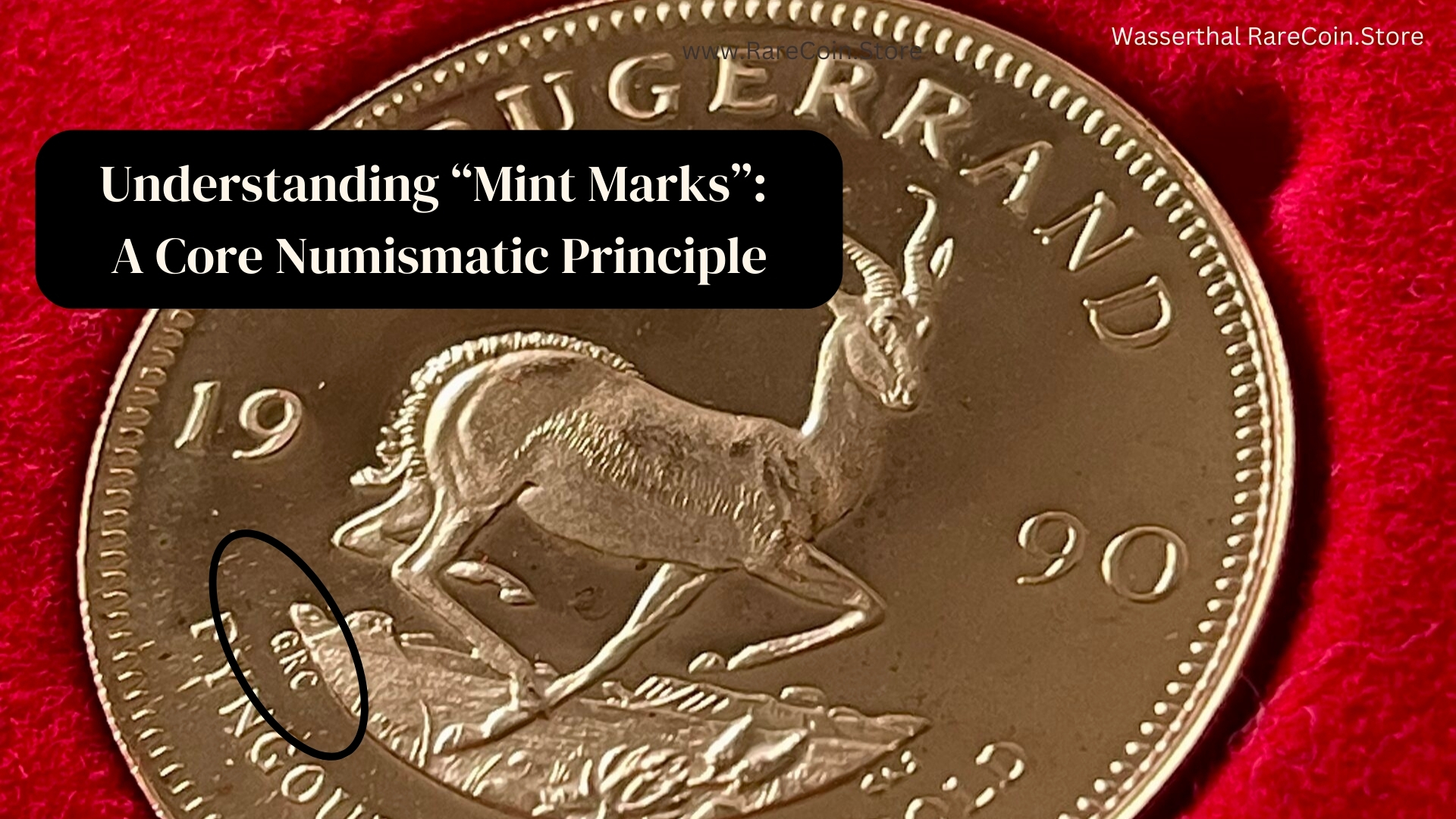
Mint marks, often referred to internationally as mint symbols, are among the most important small details on coins. They indicate in which mint a coin was produced and can therefore be crucial for identification, historical classification, and collector value.
Especially with modern gold coins, proof issues and rare collector variants, mint marks, privy marks or special minting marks can make the difference between an ordinary issue and a numismatically particularly interesting variant.
In numismatics, it’s often the small details that make the difference. A mint mark is precisely such a detail: a tiny marking on the coin that tells collectors and experts where a piece was minted and sometimes even why it is rarer or more sought after today.
1) Clearly identify origin
A mint mark is usually a letter, abbreviation, or symbol that identifies the issuing mint . This often allows a coin to be clearly attributed to a specific mint, even if the design is otherwise identical.
2) Historically important for control and traceability
Especially in earlier times, mint marks had a practical function: if there were deviations in weight, alloy, or minting quality , authorities and those responsible could use the mint mark to trace where the coin was produced. This made a kind of “quality control” possible long before modern production protocols existed.
3) Influence on rarity and collector value
This point is particularly crucial for collectors: mint marks can significantly influence a coin’s value . Depending on the year and mint, the mintage can vary considerably. Some mints produced significantly fewer coins in certain years, making coins with that specific mint mark much harder to find today.
4) Historical and numismatic classification
Furthermore, mint marks provide important information about coinage history: they show which mints were active , how production sites changed, and which mints played a special role in certain periods.
Example: GRC
The coin pictured bears the mark “GRC” . This mint mark indicates that it was minted in Gold Reef City (GRC) and thus confirms the specific origin of the issue.
The secret language of coins: What privy marks reveal
Krugerrand GRC Proof Set 1990 4 coins gold
Mint mark or privy mark – what’s the difference?
A mint mark typically indicates the mint where a coin was produced. A privy mark, on the other hand, is usually an additional mark that may indicate a special occasion, a limited edition, an anniversary, or a special distribution variant.
Both marks can be important for collectors, but they serve different functions. The mint mark primarily helps in identifying the mint. A privy mark, on the other hand, can identify a specific variant within a coin series. Such distinctions are often particularly relevant for Krugerrand issues, modern proof coins, and limited collector editions.
Conclusion: Small tokens with great numismatic significance
Mint marks may seem inconspicuous at first glance, but they can be very important for accurately identifying a coin. They indicate the mint, help distinguish similar issues, and can provide clues about mintage, rarity, or historical significance.
For collectors of modern gold coins, it is therefore worthwhile to carefully examine mint marks, privy marks, and other minting marks. Especially with certified specimens from NGC or PCGS , these details can contribute to the correct classification of a specific variant.
Updated on June 23, 2026: This article has been supplemented with a clearer classification of mint marks, mints, privy marks and their meaning for collectors of modern coins.
About the author: Larissa Wasserthal
Larissa Wasserthal is the co-founder of Wasserthal RareCoin.Store and specializes in modern numismatic gold coins, international mints, and certified collector issues. Her focus is on the objective classification of mint marks, privy marks, minting quality, grades of preservation, and actual market availability.