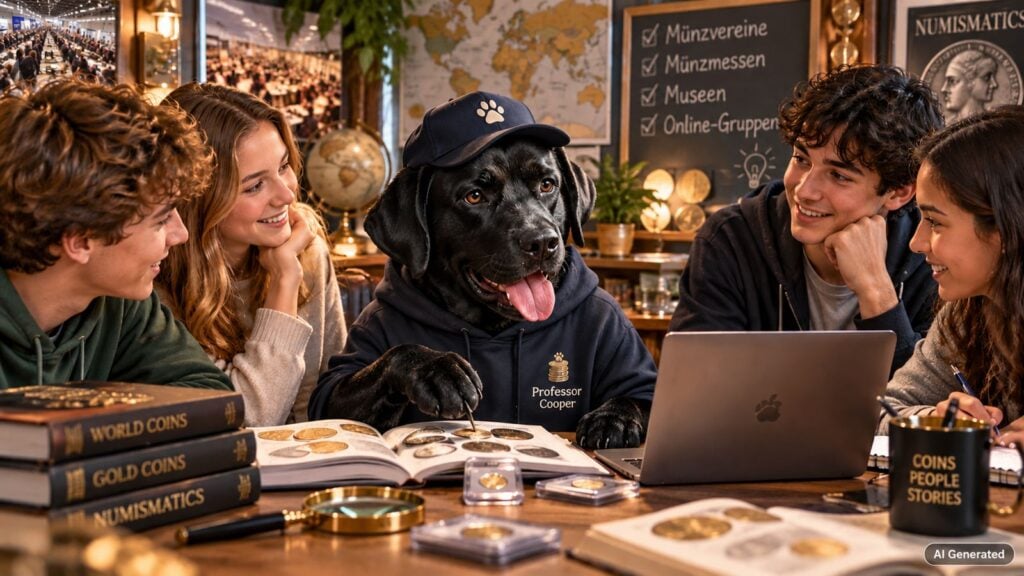
Young coin collectors often learn on their own, using books, websites, and videos. Professor Cooper shows where to meet other collectors: in coin clubs, at fairs, and online. He also explains where to deepen one’s knowledge and what to pay attention to.
Hi Collectors Club, Cooper here. 🐾
I’m still young myself, just a year and a half old. I learned something important at puppy school: you learn faster with others than alone. You watch, imitate, ask questions, and remember things better.
It’s the same with coins. Anyone who’s just become enthusiastic about collecting coins has many questions. Books and websites can help, but a conversation with an experienced collector can answer many questions in five minutes.
Collector’s question with Cooper
“Where can young coin collectors find like-minded people?”
My answer: Young coin collectors can find like-minded individuals primarily in coin clubs, at coin fairs, and in well-moderated online groups. Coin cabinets and numismatic museums are good places to deepen one’s knowledge. There are also special programs for students, such as the Young Numismatists programs offered by the American Numismatic Association.
Coin clubs: Meetings with experienced collectors
Many German cities have numismatic societies. Their umbrella organization is the German Numismatic Society (DNG). Founded in 1951, it publishes the “Numismatic News” and organizes coin collector meetings. Anyone looking for a coin club nearby can find a map of clubs by city on the DNG website.
The Numismatic Society of Berlin was founded in 1843 and is the oldest numismatic association in Germany. It regularly organizes lectures and events, to which guests are also welcome.
The German Coin Collectors’ Association (DNG) itself acknowledges the difficulty of attracting young people to clubs. I see this as an opportunity. Many clubs welcome new members, especially younger ones. Many experienced collectors are happy to share their knowledge and show off their coins.
My tip: Before your first visit, briefly check with the club to find out when the next meeting is and whether guests are welcome. Bringing a notebook also helps.
Coin fairs: Dealers, collectors and coins all in one place
Coin fairs are a meeting place for collectors, dealers, and experts. Visitors can view coins, ask questions, and compare prices. Information on which fairs will take place in 2026 can be found in “Coin Fairs 2026: A Paradise for Collectors .” Tips for visiting the fair are available in “3 Reasons to Visit a Coin Fair .”
For your first visit to a trade fair, I recommend: look and ask questions first, buy later.
International offers for young coin collectors
The American Numismatic Association (ANA) in the USA offers educational programs for its members, aimed at students of various grade levels. These include the online programs Coin Explorers, Money Study Buddies, and Currency Connectors ( ANA Young Numismatists ).
For those seeking like-minded individuals, the Young Numismatists of America (YNA) is particularly interesting. Founded in 2025, the club is run exclusively by young numismatists. It meets online once a month and publishes the magazine “The Young Numismatist.” ANA members from sixth grade onward, or from age 11, are eligible to join. The ANA can answer questions about participation for members outside the USA directly.
Wasserthal RareCoin.Store is itself a member of the American Numismatic Association.
Museums: Deepen your knowledge before you buy
For young coin collectors, a coin cabinet is primarily a place of learning. Those who want to see many different coins will find an enormous selection in large collections.
- Berlin Coin Cabinet: With around 500,000 objects, it is one of the largest numismatic collections. Most of the exhibited pieces are on display in the Bode Museum. Since 2011, the Coin Cabinet has also presented a permanent exhibition of ancient coins in the Altes Museum ( National Museums in Berlin ).
- Munich State Coin Collection: It is located in the Munich Residence and contains more than 300,000 objects ( Munich State Coin Collection ).
A museum visit is good exercise for the eye. You can see how different embossing, surfaces and motifs can be, all without any pressure to buy.
Online groups: practical, but with caution
For young coin collectors, forums and groups on social networks are practical because you can ask questions there at any time. However, caution is important here:
- Not every answer comes from an expert. A statement doesn’t become more correct just because many people agree with it.
- Private group buy offers can be risky because you don’t know the seller or the coin.
- Photos alone do not always allow for a reliable assessment of a coin’s condition, surface finish, and potential problems. Those wishing to buy should look for certified coins and verifiable information.
Online groups are a good place to collect questions. I would then check the answers against a second source, for example, a club or a specialist book.
Cooper’s opinion: Learn first, then buy
I believe young coin collectors benefit most from spending more time learning than buying in their first year. Joining a club, attending a fair, or visiting a museum costs little and provides a wealth of knowledge. Those who first understand what makes a coin rare and desirable will later make more informed purchases.
What suits you best also depends on how you want to collect. The quiz “What Type of Coin Collector Are You?” can help with that. What distinguishes a numismatist from a coin collector is explained in “Numismatists and Coin Collectors: Differences and Similarities .” And if you’d like to continue learning with me, you can find all the lessons in Cooper’s Coin Academy .
My advice for young coin collectors
- Use the DNG map to find a numismatic club near you.
- Go to a coin fair and ask questions before you buy.
- Visit a coin cabinet and take your time to look at the coins.
- Use online groups for learning, but check the answers.
- Only buy when you know what you want to collect.
Learning is faster when done together. This applies to puppies and collectors alike.
Until the next collector’s question.
Professor Cooper ⭐
Do you also have a question for collectors?
Write to us with your question about gold coins, grading, proof issues, or rare years. All previous answers can be found in the collector questions about gold coins featuring Cooper .
Sources
- German Numismatic Society: About the Society
- German Numismatic Society: Associations
- Numismatic Society of Berlin
- American Numismatic Association: Young Numismatists
- American Numismatic Association: Young Numismatists of America
- State Museums of Berlin: Coin Cabinet Collection
- Munich State Coin Collection: Collection
About the author
Professor Cooper is a Labrador and Chief Numismatic Officer of Wasserthal RareCoin.Store. He is involved in everything that happens in the office and explains what he learns about gold coins in the collectors’ questions.
The technical basis comes from the daily work of Wasserthal RareCoin.Store, an authorized dealer of NGC and PCGS specializing in certified gold coins.
Editorial and technical review: Larissa Wasserthal
Content and sources last checked: October 17, 2026