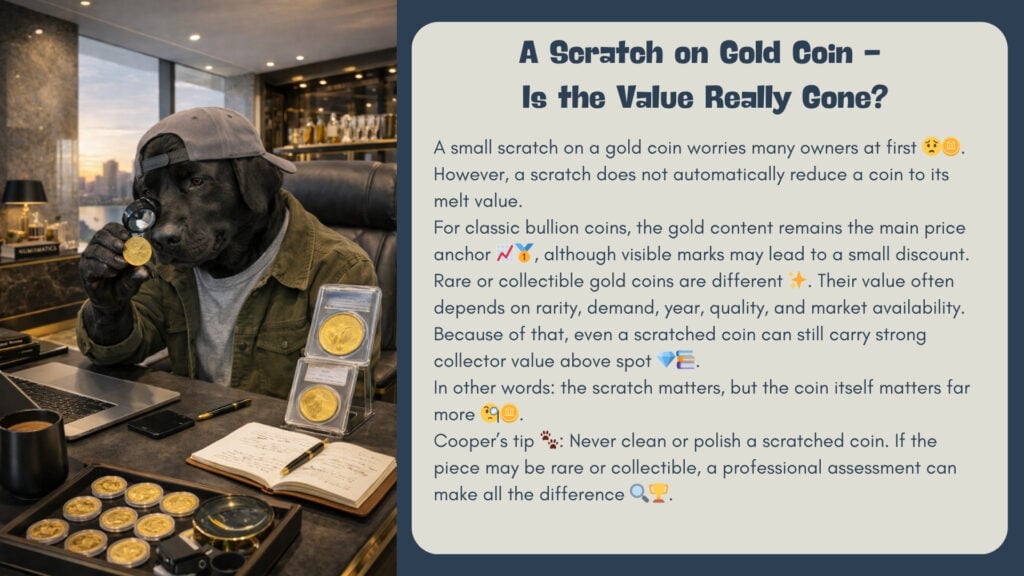
A gold coin with a scratch: Many owners immediately wonder if the piece is now worthless. But a small flaw doesn’t automatically mean that only the pure gold value counts.
The answer depends on several factors: the type of coin, the severity of the blemish, and market valuation determine whether a scratch actually affects the value. While classic investment coins are usually traded close to their precious metal value , rare collector coins can retain a higher value than the spot price even with minor scratches.
The question from Jean-Paul from Luxembourg
“Moien Cooper! Meng Goldmënz huet e klenge Kratzer um Rand. Ass si elo wäertlos?” (Or in German: “Hello Cooper! My gold coin has a small scratch on the edge. Is it worthless now?”)
Cooper’s answer
Cooper here! 🐾 No, a gold coin isn’t automatically worthless because of a small scratch. The crucial factor is whether it’s primarily considered an investment coin or a collector’s item . This determines how much damage actually affects its value.
When the value of gold is particularly crucial
For typical bullion coins like the Krugerrand , Maple Leaf , or Vienna Philharmonic, the gold content is the primary factor. Therefore, their trading value is usually close to the current gold price (spot price), plus or minus a typical trading margin.
Scratches, edge marks, or minor contact marks hardly alter the character of such coins – they remain investment objects. However, dealers often deduct small discounts when buying them back, as damaged pieces can no longer be resold as “new”.
In short: A damaged bullion coin retains its full value, but its price is even more strongly based on the pure metal value – so it is not automatically only worth spot, but the gold price remains the most important price anchor.
When collector value remains despite scratches
For numismatically sought-after coins , far more than the gold content matters. Rarity, year of issue, minting quality, demand , and market availability determine the price much more significantly. A small scratch can slightly lower the market value, but often doesn’t destroy the collector’s value – especially with rare years or limited editions.
Key influencing factors:
- Print run and actual market availability
- Collector demand by year or motif
- Conservation status and certification (e.g. NGC or PCGS)
- Historical or thematic significance
Collectors are therefore not just buying gold, but rarity and history – and these qualities remain even with slight scratches.
Overview of preservation levels
“Very nice” and “mint condition”
- Very fine (ss): Clear signs of wear, but main details are clearly recognizable.
- Uncirculated (stgl): No signs of wear, only minimal contact points possible.
Important: “Uncirculated” is a traditional German term and cannot be directly equated with the US grading scale. Such pieces roughly correspond to the MS63–MS65 range – that is, uncirculated, but not flawless.
International scale: MS, PF and PR
MS = Mint State . Designates uncirculated standard coins (not proofs). Scale from MS60 to MS70:
- MS60: Uncirculated, but significantly impaired
- MS63–MS64: Appealing, with visible traces
- MS65–MS66: Received above average
- MS67–MS69: Very high quality, almost flawless
- MS70: Perfect condition
A coin can still be considered “unused” despite minor contact marks – the tolerance here is greater than many people think.
PF/PR = Proof (Polished Plate). This designates particularly carefully produced collector coins, often with a mirror finish and matte relief. Proof therefore describes the manufacturing process, not automatically a perfect condition. Proof coins are valued more sensitively – hairlines or smudges are more significant. Nevertheless, a rare Proof gold coin, even with flaws, can be traded for well above its pure gold value.
Why Proof Coins Are More Sensitive
Proof coins may show minimal contact marks from storage or transport. Proof coins, on the other hand, should have a flawless surface, clear reflections, and clean frosting. A scratch has a greater impact on the grade (e.g., from PF70 to PF68) and thus also on the market value. Nevertheless, rare proof coins often retain considerable collector value – even with minor flaws.
Practical classification: Three questions will help.
- Investment or collector’s coin? With bullion coins, the gold value is paramount. For collector coins, rarity, demand, and condition are also important.
- MS or Proof ? Small traces are usually acceptable with MS coins, but significantly more critical with Proof coins.
- How rare is this piece really? The lower the market availability, the more likely it is that an independent collector’s value will remain.
Conclusion
A scratched gold coin is neither worthless nor automatically worth only its gold value.
- Bullion coins: their price is linked to the gold price; minor scratches usually only result in small discounts.
- Collector coins: their value depends on rarity, demand and condition – proof coins are rated more strictly, but can remain valuable despite scratches.
In the end, it’s not just the scratch that counts, but the coin itself – and what it represents in the collectors’ market.
Cooper’s tip
If you’re unsure, don’t judge a coin solely by its gold weight. Especially with rare or certified pieces, it’s worth seeking an expert appraisal from an experienced coin dealer or a recognized grading agency like PCGS or NGC . This way, you can reliably determine whether it has only the metal value or also genuine collector value.
Mini-FAQ – Frequently Asked Questions
What should I do if my gold coin is scratched? Do not attempt to clean or polish it yourself! This can further reduce its value. It’s best to have it professionally inspected.
Is the gold price the only factor that matters when it comes to investment coins? Usually yes – if there are visible flaws, the price is reduced somewhat, but remains close to the spot price.
Can a proof coin with scratches still be valuable? Yes, especially if it is rare or difficult to find on the market.
🐾 “Villmools Merci, Jean-Paul. Äddi a bis geschwënn!” (Or, in German: “Thank you very much for your question, Jean-Paul. Take care and see you soon!”)
Further collector questions with Cooper
You can find more answers about care, preservation and possible damage in the Collector Questions with Cooper .
Related to this topic: Cleaning a Krugerrand: Sensible care or guaranteed loss of value? · Scratches on the slab: 5 important facts about damage and loss of value