
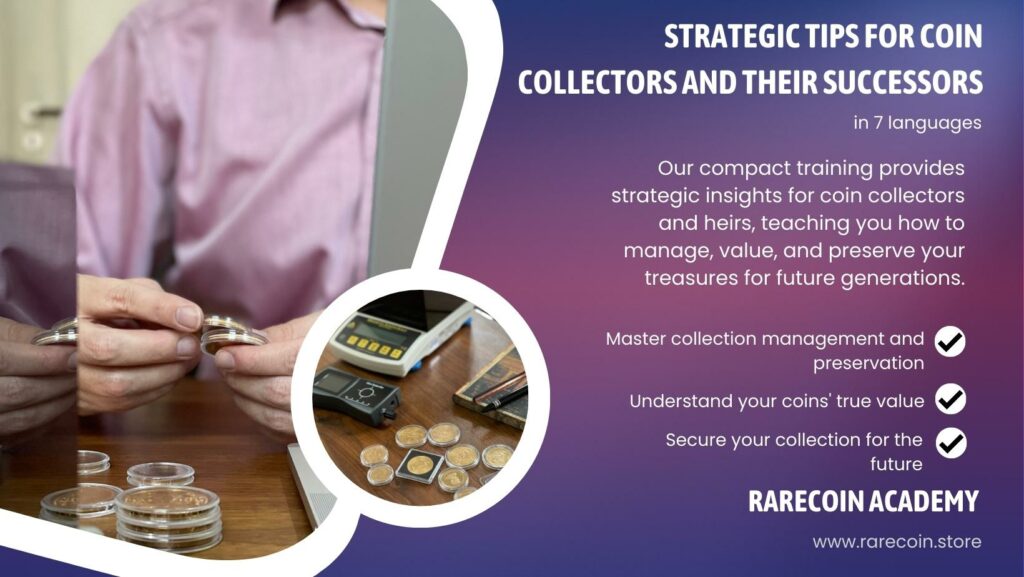
Assessing the value of a coin collection is rarely a simple calculation. Metal value, rarity, condition, and demand all play a role, and different factors may be more important depending on the collection. Here are the questions we most frequently receive on this topic.
How do I begin evaluating my collection?
With a complete inventory. Record the country, issue, face value, year of minting, mint mark, condition, and – for certified coins – the certificate number for each piece.
Only then does the actual valuation begin: researching comparable prices, checking population data, and, if necessary, consulting experts. The individual steps are described under “Steps to an accurate valuation of your coins” .
Do I need a professional appraiser?
It depends on the value. For a collection in the low four-figure range, auction results and population lists will suffice. For high-value individual pieces or larger collections, a professional appraisal is worthwhile – especially if a sale or inheritance dispute is pending.
Independence is important: Whoever evaluates the collection should not have any personal interest in buying it.
How often should I reassess?
Once a year, and whenever the collection has changed significantly. This is particularly important for insured collections – an outdated valuation leads to underinsurance in the event of a claim.
What factors determine the value of a coin?
Rarity, condition, certification, population, demand, metal content, and historical significance. None of these factors acts alone – they are discussed in detail in the chapter on value drivers in numismatics .
Is the metal content the most important factor?
Only for bullion coins. There, the price closely follows the precious metal market. For collector coins, the metal value merely forms the lower limit; above that, the mintage, condition, and demand determine the price. A rare proof coin can fetch many times its gold value.
Are older coins always more valuable?
No. Age alone is not a value driver. A hundred-year-old circulating coin in fair condition is often worth less than a modern proof issue with a mintage of 200. The decisive factor remains the combination of rarity, condition, and demand.
How can I identify features that increase value?
Examine each coin under magnification for minting errors, unusual markings, and design variations. Compare with catalog illustrations of the same issue.
The documentation is crucial: A special feature only becomes relevant to the price if NGC or PCGS indicate it on the certificate.
Do coins from different mints have different values?
Yes. Two coins with the same year of issue and face value can have different values if they come from different mints. Some mints produce smaller quantities, which increases their rarity. The mint mark on the coin provides information about its origin – our coin encyclopedia explains the common abbreviations.
What does “population” mean, and where can I find these figures?
The population indicates how many copies of an issue were assessed at a specific preservation grade. NGC and PCGS publish this data freely.
They are the only reliable proof of rarity. Of an issue with 10,000 coins minted, only a few dozen can have reached the PF70 grade – and this is precisely where the price difference arises. Examples can be found under Top Pop coins .
Where can I have my collection appraised?
Numismatists, specialized dealers , and publicly appointed experts are the best people to consult. Jewelers and bullion dealers are less suitable, as they usually only assess the metal value.
Information about our process can be found under “Coin Appraisal .” If you would like to compare prices, a look in our shop will help: There, the condition, population, and mintage of each piece are listed.
We explain in detail why gold value and collector value are two completely different calculations in From purchase to collection: How we examine a rare gold coin .
Other interesting blogs:
A brief guide – Uncovering the secrets of coin valuation and pricing