
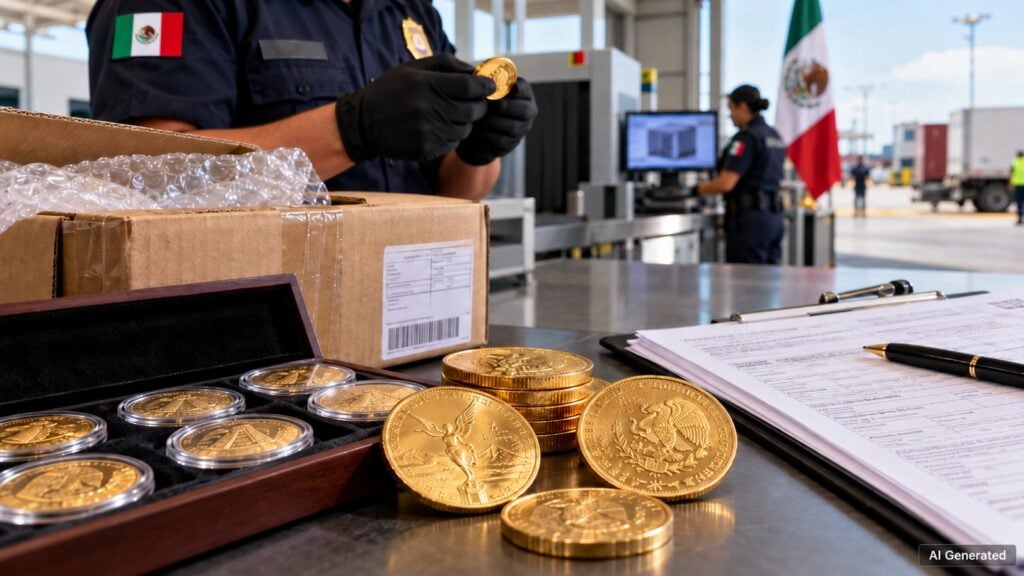
Customs duties and import taxes on coin shipments to Mexico depend on the coin and the customs procedure. A gold coin and a platinum coin can incur very different charges even when both are shipped from Germany.
Under a formal import procedure, customs duty and Mexican value-added tax (IVA, Impuesto al Valor Agregado) may not be payable if the relevant requirements are met. The rules differ for gold and platinum. Under the simplified courier procedure, a general rate of 33.5% of the customs value normally applies to a shipment from Germany. Whether UPS or FedEx carries the parcel does not by itself determine which customs procedure is used.
This overview concerns commercial shipments of gold and platinum coins from Germany to private collectors in Mexico. It primarily covers modern collector coins and occasional older issues from the twentieth century. Ancient coins and objects of cultural or historical significance are outside its scope. Different rules apply to coins carried in travellers’ baggage.
Why customs duties and import taxes on coin shipments to Mexico can differ
Formal import: The coin is classified under the appropriate tariff code. Code 7118.90.99 may apply to many coins; the standard import duty in the Mexican tariff is shown there as “Ex.”, meaning exempt. A platinum coin without legal-tender status may instead fall under code 7118.10.01. The April 2026 tariff amendment sets a standard import duty of 35% for that code. Particularly rare numismatic pieces may be classified differently. IVA has separate rules, explained below for gold and platinum. Even if duty and IVA do not apply, a government customs processing charge (Derecho de Trámite Aduanero, DTA) and customs broker fees may still be payable.
Simplified courier clearance: Among other conditions, the customs value must not exceed USD 2,500 per recipient. Rule 3.7.5 of Mexico’s 2026 Foreign Trade Rules expressly refers to US dollars or the equivalent in pesos or another currency. If an authorised courier uses this procedure, the general rate for a shipment from Germany is normally 33.5% under rule 3.7.35. The charges are then not calculated according to that particular coin’s individual duty and IVA treatment. A coin that might be exempt from both charges under formal import can therefore cost considerably more under the simplified procedure. Registration of the recipient in Mexico’s importers’ register is generally not required for this procedure.
If the customs value exceeds USD 2,500, the simplified procedure is unavailable and a formal declaration is required. UPS and FedEx offer customs clearance; FedEx expressly describes a formal import service with a customs broker in Mexico. Whether that service is available for the particular coin, and which documents the recipient will need, should be established before shipment.
Examples of gold content and monetary status
Mexico’s central bank, Banco de México, gives a gold content of 99.9% for the Gold Libertad. The South African Mintgives 91.67% for the Krugerrand. The Mexican Centenario contains 90% gold. All three examples exceed the 80% threshold in Mexico’s IVA law.
The import exemption appears in Article 25(VII) of the Mexican IVA law. It refers to gold but does not name gold coins separately. A Mexican customs broker should therefore confirm before shipment whether the exemption can be claimed for the particular coin under formal import.
There is a second possible basis for a Gold Libertad: it belongs to the precious-metal coins in Mexico’s monetary system. The Monetary Law gives these coins legal-tender status even without a face value. Article 9(VI) of the IVA law exempts domestic currency, and Article 25(III) may extend that exemption to imports. Banco de México describes the original Centenario as a coin that was formerly in circulation; Article 9(VI) also expressly mentions former gold and silver coins. Later restrikes and particular collector issues require a separate assessment.
What about platinum coins?
The 80% gold rule does not apply to platinum coins. Whether IVA is due on a formal import depends, among other things, on the coin’s legal status. Article 9(VI) of Mexico’s IVA law exempts sales of domestic and foreign currency. Article 25(III) may extend this treatment to imports. Whether a particular platinum coin, possibly sold as a collector piece, qualifies as currency must be established for that coin in Mexico. A face value alone does not settle the question. Conversely, a coin without an inscribed face value can have legal-tender status: the Mexican Monetary Law expressly provides for this in the case of certain precious-metal coins.
A platinum issue without legal-tender status may also fall under tariff code 7118.10.01. The decree of 23 April 2026 sets its general import duty at 35%; any preferential tariff based on proven origin requires separate examination. If no IVA exemption applies, the general 16% value-added tax may also be due. A platinum coin with legal-tender status may be classified and taxed differently. Particularly rare pieces may also require different tariff treatment. The coin’s monetary status, tariff code and IVA treatment should therefore be clarified with a Mexican customs broker before import.
Which pieces need individual examination?
Historical rarities, particularly rare numismatic pieces, medals and restrikes require their own tariff classification. Gold content alone does not determine the tariff code. This overview does not cover silver coins.
Are there sanctions or import bans?
Mexico has embargo rules covering certain countries, goods and parties. North Korea and Iran are among the countries named, although the lists of covered goods differ. For shipments from or to North Korea, the Mexican list includes all of tariff chapter 71, which also covers coins. The country in which a coin was minted does not by itself make a shipment from another country prohibited. The particular goods, shipping route and people or businesses involved matter; Mexico also maintains lists of designated parties. A list of countries alone therefore cannot establish either a ban or clearance for every coin shipped from Germany to Mexico.
Which value does customs use?
Under Articles 64 and 65 of Mexico’s Customs Law, the price actually paid is generally the starting point. For a rare collector coin, this includes the premium above its metal value. The coin’s face value is not the basis for calculating customs charges. Shipping and insurance costs up to the relevant place of import are taken into account insofar as they are not already included in the price.
The invoice should clearly identify the coin, its issuing country and year of issue, fineness, quantity, purchase price, shipping costs and insurance costs. Shipment from Germany does not change the coin’s origin. A sold coin must not be declared as a “gift”. Such a generic description excludes simplified clearance under rule 3.7.5.
What should be clarified before ordering?
Three points should be clarified before an order is placed:
- Who will transport and insure the coin? Not every standard service accepts collector coins or precious metals. UPS Mexico lists bank-issued coins as prohibited items; it separately mentions the possible acceptance of gold and other precious metals subject to contractual conditions. That precious-metal provision does not amount to acceptance of a coin such as a Libertad. FedEx also applies special conditions to collector coins. Acceptance and insurance must be clarified expressly with the carrier for the particular coin and route.
- Which customs procedure is planned? Formal clearance through UPS or FedEx may be possible. The chosen provider should explain how the shipment will be declared and which documents the recipient needs to supply. “Express shipping” alone says nothing about the applicable rate.
- What does the recipient need? Formal import may require registration in Mexico’s importers’ register. Under certain conditions, an unregistered private individual can apply for authorisation for a one-off import for personal use. Authorisation must be obtained before import; Mexico’s tax authority (Servicio de Administración Tributaria, SAT) states that a decision can take up to three months.
For formal imports, the amendment to the Foreign Trade Rules of 22 September 2026 generally adds an electronic declaration of value (Manifestación de Valor) from 1 October 2026. The purchase and shipping documents required, and who will submit the declaration, should be discussed with the customs broker in good time.
The DTA and fees charged by the customs broker or carrier may be payable in addition to any import duties and taxes.
Frequently asked questions
Is a Gold Libertad tax-free on import into Mexico?
Under formal import, the wording of the IVA law provides a possible exemption: the Gold Libertad meets the 80% gold threshold. It also has legal-tender status under Mexican Monetary Law, so the exemption for domestic currency may be relevant. Import duty may be waived if classification under 7118.90.99 is correct. Whether these provisions are applied to the particular collector coin must be clarified before declaration. For simplified courier clearance of a shipment from Germany, the general 33.5% rate normally applies.
Does the same apply to a Krugerrand?
The Krugerrand’s 91.67% gold content supports the exemption under Article 25(VII) of the IVA law if it is applied to that gold coin under formal import. Import duty may also be waived if classification under 7118.90.99 is correct. Whether the exemption for foreign currency also applies depends on how the particular Krugerrand is classified and should not be assumed. The general 33.5% rate normally applies under simplified courier clearance.
Are platinum coins exempt from customs duty and tax on import into Mexico?
There is no general answer. A coin with legal-tender status may be subject to different tariff and IVA rules from an issue without that status. For the latter, Mexico’s April 2026 decree specifies a general 35% duty if the coin is classified under 7118.10.01. Any IVA exemption and preferential tariff must also be assessed for the particular piece. The general 33.5% rate may apply instead under simplified courier clearance.
Can UPS or FedEx arrange formal customs clearance in Mexico?
In principle, yes. Both companies offer customs clearance. FedEx also describes a formal import service with a customs broker in Mexico. This does not establish whether a particular coin will be accepted and insured under the relevant shipping agreement.
Orders from Wasserthal RareCoin.Store
Wasserthal RareCoin.Store deals in gold and platinum collector coins and ships coins in both metals outside the European Union (EU). Whether a particular shipment to Mexico is possible depends on the coin, the shipping route and import requirements. Under the shipping terms, the buyer bears import duties, taxes and clearance charges in the destination country. It is advisable to enquire about the particular coin before ordering. Mexico’s customs rules also apply to purchases from other dealers in Germany.
Further articles cover Mexico’s coinage tradition, the minting periods and restrikes of the Centenario and platinum coins for collectors. Those articles discuss the coins themselves; Mexico’s import rules are covered here.
Transparency statement
Wasserthal RareCoin.Store is operated by TriaPrima GmbH and deals in numismatic gold and platinum collector coins. It therefore has a commercial interest in this subject. This information offers general guidance on potential costs before a purchase. Official sources are linked throughout the text.
Disclaimer
This overview is not a binding customs or tax assessment for a particular shipment. Nor does it guarantee that any coin can be accepted, transported, insured or imported on the terms described. Rules, tariffs and carriage conditions can change. Mexican authorities decide the actual classification and charges. The customs procedure, shipping route and costs for a particular coin should be clarified separately before purchase.
About the author
Author: Dirk Wasserthal
Dirk Wasserthal is managing director of TriaPrima GmbH, which operates Wasserthal RareCoin.Store. He specialises in modern numismatic gold and platinum coins, including certified collector pieces. Wasserthal RareCoin.Store has served collectors in 40 countries. TriaPrima GmbH is an authorised PCGS dealer and is listed in NGC’s dealer directory. It belongs to the German professional coin dealers’ association and the American Numismatic Association.
Official sources and other supporting documents
- Mexican Foreign Trade Rules 2026, rules 3.7.5 and 3.7.35: simplified courier clearance, value threshold and general rate.
- Ley del Impuesto al Valor Agregado, Articles 1, 9(VI) and 25(III), (VII): general IVA rate and exemptions for currency and imports of gold containing at least 80% gold.
- Ley Monetaria, Article 2 bis: legal-tender status of certain precious-metal coins without a face value.
- Mexican tariff and 23 April 2026 tariff amendment in the official gazette: in particular, 7118.90.99 and the general 35% import duty for 7118.10.01. Classification of a particular coin requires individual assessment.
- Ley Aduanera, Articles 64 and 65: customs value and costs added to it.
- Mexican Federal Fees Law, Article 49: customs processing charge (DTA), including for certain duty-free imports.
- Second amendment to the 2026 Foreign Trade Rules, 22 September: transition period for electronic value declarations until 30 September 2026.
- SAT: one-off import without registration in the importers’ register: conditions and processing time.
- Banco de México: Gold Libertad, Centenario and South African Mint: Krugerrand: gold content.
- Mexican embargo rules, Annex I as amended on 11 October 2022: countries and goods covered, including chapter 71 for shipments from or to North Korea.
- Mexican financial intelligence authority: international lists of designated parties: lists of affected people and businesses.
- UPS Mexico: prohibited and restricted items and FedEx Germany: conditions of carriage: carriage conditions for coins and precious metals.
- FedEx Import Solution, Mexico and UPS Customs Brokerage: formal customs clearance services.
Content and sources last checked: 27 September 2026