
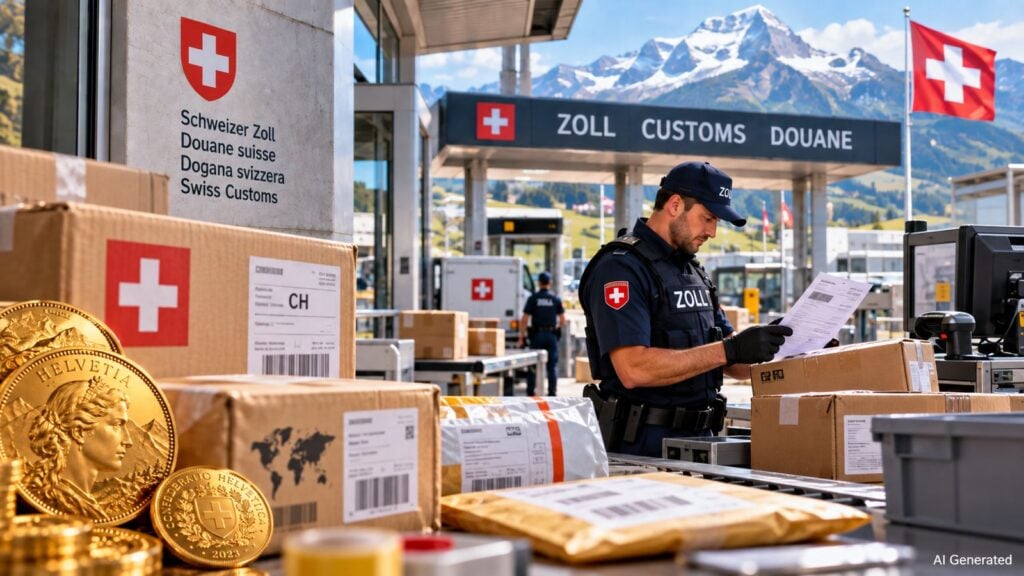
Customs duties and import taxes for coin shipments to Switzerland depend above all on whether the shipment contains a gold coin or a platinum coin. The regular Swiss import duty on coins is generally zero, because Switzerland abolished industrial tariffs for goods in tariff chapters 25 to 97 on 1 January 2024. The shipment must still be declared correctly. The main issue after that is Swiss VAT: state-minted gold coins may be exempt from import tax, while platinum coins are not.
This guide is intended for private collectors in Switzerland who buy coins from a dealer in Germany and have them shipped, for example, by UPS or FedEx. Different procedures may apply to travellers carrying coins personally in their luggage.
Customs duties and import taxes for coin shipments to Switzerland at a glance
| Item | What collectors should know |
|---|---|
| Regular Swiss customs duty | Generally CHF 0 for coins as industrial goods. The shipment must still be declared and classified correctly. |
| Import tax on gold coins | State-minted gold coins in certain tariff classifications are exempt from Swiss VAT. |
| Import tax on platinum coins | Platinum coins are expressly not covered by the exemption for coins and fine gold. The standard rate of 8.1% generally applies. |
| Taxable amount | For taxable coins, the actual price paid generally applies, plus certain costs up to the destination in Switzerland. |
| Courier and clearance fees | Fees charged by UPS, FedEx or other service providers are separate from government duties and taxes and may be added. |
Why there is no regular customs duty on gold and platinum coins
Since 1 January 2024, Switzerland has no longer levied import duties on industrial goods in tariff chapters 25 to 97. This applies regardless of the origin of the goods or the shipping route. Coins fall within these chapters. The abolition of customs duty does not, however, remove the requirement to declare the shipment correctly and classify it under the Swiss customs tariff.
The details of the classification can be checked in the Swiss Tares customs tariff. For collectors, the important point is this: duty-free does not automatically mean tax-free. Swiss import VAT can still apply, especially to platinum coins.
Gold coins: when is no Swiss import tax due?
The current guideline of the Swiss Federal Office for Customs and Border Security provides a clear exemption for state-minted gold coins. It covers gold coins under tariff number 7118.9000 and numismatic collectors’ items classified under 9705.3100 and 9705.3900.
This is an important difference from many other countries: Swiss law does not require a minimum fineness of 99.5%for the tax exemption on a state-minted gold coin. A 22-carat state-minted gold coin can therefore qualify for the exemption just like a 999.9 fine gold coin, provided the specific coin is correctly classified under one of the eligible tariff positions.
This matters, for example, with the Krugerrand. Its gold content of around 91.67% does not by itself prevent the Swiss tax exemption. Canada is different, for example, because a minimum fineness can be decisive for the precious-metals exemption there.
A Proof finish, a high numismatic premium or NGC or PCGS certification also do not automatically change this basic rule. What matters is the specific coin and its correct customs classification. Gold medals, by contrast, do not fall under this specific exemption for state-minted gold coins.
Platinum coins: why 8.1% import tax may apply
Platinum coins are treated differently. The current FOCBS guideline expressly states that platinum coins are not covered by the tax exemption for coins and fine gold.
For a platinum coin shipped from Germany to Switzerland, the Swiss standard import tax rate of 8.1% therefore generally applies. The fact that the coin was issued by a government, has a face value or was issued as legal tender does not create the same tax exemption that applies to qualifying gold coins.
This also applies to rare numismatic platinum coins. With an expensive Proof, Reverse Proof or Top Pop issue, it is therefore not only the pure platinum value that matters. For import tax purposes, the amount paid in the actual transaction is generally decisive.
What value is taxed on a taxable platinum coin?
For a purchase, Swiss import tax is generally based on the price actually paid or payable. For a rare collector coin, this means that the relevant amount is not merely the metal value, but the actual purchase price including the numismatic premium.
Certain costs up to the destination in Switzerland are also included if they are not already part of the purchase price. The Federal Office for Customs and Border Security specifically mentions packaging, transport, insurance and customs clearance costs.
A simple example: if a rare platinum coin is sold well above its metal value, the tax is generally not calculated on the pure platinum value. The starting point is the actual purchase price, plus any additional costs that must be included.
Amounts in euros or other foreign currencies are converted into Swiss francs for the import assessment. The exchange rate used by the Swiss customs authorities is decisive.
Is there a low-value exemption for small shipments?
For normal commercial shipments, there is no general value threshold comparable with the low-value exemptions found in some other countries. Small tax amounts are, however, not collected: import tax amounts of CHF 5 or less are not charged.
At the standard rate of 8.1%, the FOCBS states that this corresponds to a taxable amount of around CHF 62. In practice, this threshold is rarely relevant for high-value collector coins.
The separate CHF 100 gift allowance applies only to gifts sent by a private individual abroad to a private individual in Switzerland. A purchase from a dealer does not qualify.
What role do UPS, FedEx and customs clearance fees play?
Even if no customs duty or import tax is due on a gold coin, the carrier may still charge its own customs clearance or service fees. These private charges are separate from government duties and taxes.
For a taxable platinum coin, the courier may initially advance the import tax on behalf of the recipient and later invoice it together with its own clearance or disbursement fees. The amount of these charges depends on the carrier and the customs procedure used.
A clear commercial invoice makes customs clearance easier. It should identify the exact coin, the precious metal, the purchase price, the weight and, where applicable, the certification number.
Can origin and sanctions still matter even when customs duty is zero?
Yes. Even after the abolition of industrial tariffs, the origin of a gold coin can still be relevant. Certain sanctions specifically depend on the origin of the goods and on when they were exported from the country of origin.
Gold coins of Russian origin
Swiss measures relating to the situation in Ukraine prohibit, among other things, the purchase and import of gold of Russian origin listed in Annex 26 if it was exported from Russia after 4 August 2022.
A Russian gold coin is therefore not automatically unproblematic simply because it is now shipped from Germany. Its origin and documented export history may still be decisive.
Gold from Sudan
Since 10 September 2026, Switzerland has also applied new restrictions to gold of Sudanese origin. SECO expressly refers to a prohibition on the purchase, import and transit of gold covered by the measure.
For a gold coin of Sudanese origin, the current Swiss sanctions rules should therefore be checked before purchase to determine whether that particular coin is covered.
Three typical purchases, three different outcomes
| Purchase from Germany, delivery to Switzerland | Typical treatment |
|---|---|
| State-minted gold coin, such as a Krugerrand or Gold Maple Leaf | Regular customs duty CHF 0. If correctly classified as an eligible state-minted gold coin, generally no Swiss import tax. |
| Rare certified Gold Proof coin with a high numismatic premium | The numismatic premium alone does not remove the tax exemption. The type of coin and correct customs classification remain decisive. |
| Rare platinum coin, such as a Platinum Maple Leaf | Regular customs duty CHF 0, but generally 8.1% import tax on the relevant taxable amount, plus possible clearance fees. |
Frequently asked questions
Do I have to pay Swiss import tax on a gold coin from Germany?
Not necessarily. State-minted gold coins in the eligible tariff classifications are exempt from Swiss import tax. The decisive factor is the correct classification of the specific coin.
Is a Krugerrand taxable because it contains only 91.67% gold?
Not for that reason alone. The Swiss exemption for state-minted gold coins does not specify a minimum fineness of 99.5% for coins. The specific coin must, however, fall under an eligible tariff classification.
Do I have to pay Swiss VAT on a platinum coin?
Generally yes. The current FOCBS guideline expressly lists platinum coins as not tax-exempt. For a taxable import, the standard rate of 8.1% generally applies.
Is only the metal value taxed on a rare platinum coin?
No. In a purchase transaction, the price actually paid or payable is generally decisive. For a numismatic platinum coin, the collector premium therefore forms part of the amount paid. Additional costs up to the destination may also be included in the taxable amount.
Does the CHF 100 gift allowance apply to an online-shop purchase?
No. It applies to gifts sent by private individuals abroad to private individuals in Switzerland. An invoice from a dealer is not a gift shipment.
If you order from Wasserthal RareCoin.Store
Wasserthal RareCoin.Store ships collector coins fully insured and with clear commercial documentation. Under our payment and shipping terms, the buyer is responsible for import duties, taxes and other charges that arise in the destination country.
For collectors in Switzerland, the distinction between gold and platinum coins is especially important. Even where the coins have a similar numismatic character, their Swiss import tax treatment can be completely different.
Further information is available on our pages for gold coins and platinum coins.
Transparency note
Wasserthal RareCoin.Store trades in rare modern gold and platinum coins and therefore has a commercial interest in this market. This guide applies regardless of which dealer the coin is purchased from. It does not recommend any particular coin. The relevant official sources are linked directly in the text.
Disclaimer
This article provides general information for collectors and does not constitute individual customs, tax or legal advice. The decisive factors for a specific shipment include the coin itself, its correct customs classification, the commercial invoice, the Swiss rules in force on the date of import and, where relevant, origin and sanctions rules. The competent Swiss authorities make the final assessment.
About the author
Author: Dirk Wasserthal
Dirk Wasserthal is Managing Director of TriaPrima GmbH, the company operating Wasserthal RareCoin.Store. He specialises in modern numismatic gold and platinum coins, including certified collector pieces. Wasserthal RareCoin.Store has already delivered coins to collectors in 40 countries. TriaPrima GmbH is an authorised dealer with the coin grading service PCGS and is listed as a dealer with the coin grading service NGC. It is a member of the German Professional Association of Coin Dealers and the American Numismatic Association.
Sources and scope
The following official sources were used in particular:
- Duty-free industrial goods: SECO on the abolition of industrial tariffs from 1 January 2024 and FOCBS on the Swiss Tares customs tariff.
- Gold and platinum coins: FOCBS Guideline R-69-02 on tax exemptions, section on coins and fine gold.
- Import tax and taxable amount: FOCBS on tax rates for imported goods, FOCBS on the taxable amount for import tax and FOCBS on online purchases and postal or courier shipments.
- Russia: SECO on measures in connection with the situation in Ukraine.
- Sudan: SECO on the Swiss prohibition on trade in gold of Sudanese origin from 10 September 2026.
Content and sources last reviewed: 27 September 2026