
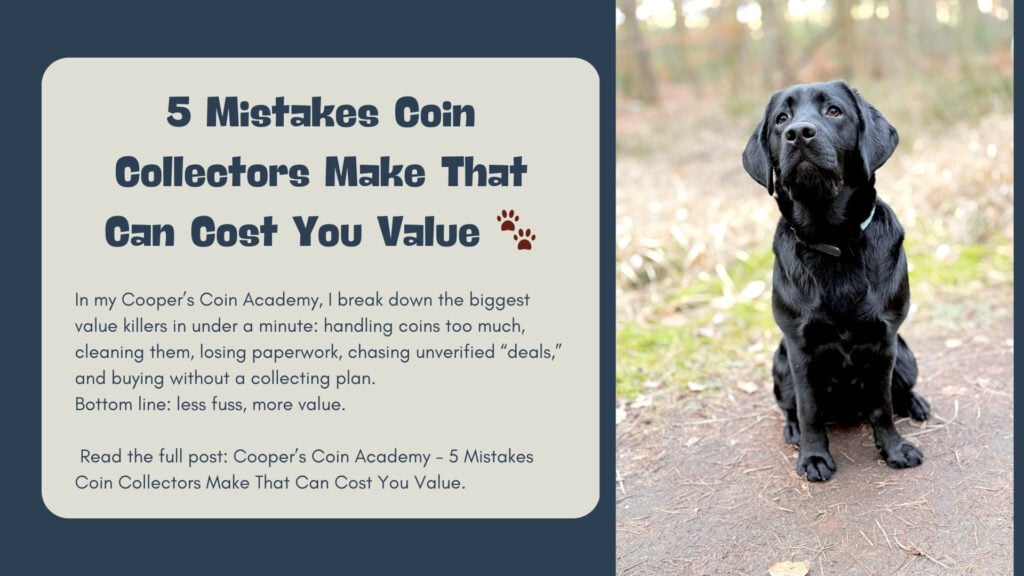
Hello. It’s me, Cooper. I’m almost 9 months old. And I’m an expert at two things: finding treats 🧀 and spotting mistakes immediately 👀.
Many people who collect coins first think of rare years, high grades, or perfect sets. That’s all important ✅. But the biggest loss in value often doesn’t happen at the time of purchase, but afterward, due to perfectly normal collector mistakes in everyday life. It’s a bit like me: it’s not the big adventure that’s dangerous, but the small lapses in attention when you think nothing bad will happen 🐶.
To prevent this from happening to you, here’s my rulebook. Short, clear, and consistent 🎯.
Mistake 1: Touching coins too often and holding them incorrectly ✋
Coins aren’t meant to be tactile. Coins are collector’s items. And collector’s items don’t like fingerprints ❌.
What many people underestimate: skin oils, sweat, and pressure leave marks. This is especially noticeable on proof coins and reflective surfaces, often becoming permanently visible later. It’s like a freshly cleaned window: one touch with your paw 🐾, and you’ll see it immediately in the light ✨.
Here’s how to hold coins correctly:
-
Hold coins only by the edge, never touch the surfaces with your fingers ✅
-
Always work over a soft surface to prevent hard impacts 🧸
-
Don’t pass around coins. If someone wants to see them, they should look with their eyes, not their hands. 👀
Cooper’s rule: If you have to handle a coin, do so as little as possible and as safely as necessary. Like with a treat: don’t crush it, just handle it cleanly 🧀🐾.
Mistake 2: Cleaning or “sprucing up” coins 🧼
Many collectors want to make a coin “prettier.” The problem is: cleaning almost never makes coins more beautiful, but often worse. Why? Because you’re altering the surface. And this surface is precisely part of the collector’s value 💎. If you destroy it, it’s like brushing my fur against the grain: it might look neat for a short time, but in the end, everything is irritated 😅.
Typical consequences of cleaning:
-
Micro-scratches and dull spots ⚠️
-
unnatural shine ⚠️
-
destroyed patina ⚠️
-
Visible traces that may be noticeable as a “cleaned” or “altered surface” ⚠️
The most important rule when collecting coins is:
-
If you’re thinking about cleaning, you need professional advice first 🧠
-
No polishing agents, no cloths, no rubbing, no “very carefully” 🚫
Cooper’s rule: I chew sticks 🦴. You only clean coins if a professional explicitly recommends it ✅.
Mistake 3: Not storing packaging, certificates and documents properly 🧾📦
Many collectors invest in top-quality pieces but treat the documentation like an instruction leaflet. That’s a classic mistake.
Especially with modern collector coins in proof quality, limited editions, and graded coins, documentation is an integral part of the product. Box, COA , outer packaging, invoice, grading number, provenance. This isn’t just decoration, it’s substance 🧱. It’s like my vaccination certificate and my microchip: without it, I’m still a Cooper, but suddenly everything becomes more complicated 🐶.
Here’s how to do it right:
-
A separate data record for each coin: invoice, photos, notes, certificates 🗂️
-
For NGC or PCGS: Note the certificate number and file it in a traceable manner 🔎
-
Always store the box and COA together with the coin if it’s part of the issue 📦
Why this is important: Completeness increases market acceptance. And market acceptance can increase the price 📈. Just like with me: With a collar, microchip, and dog tag, everything goes faster. In Germany, a dog tag is mandatory in many places so that I can be clearly identified 🏷️.
Cooper’s rule: A coin without clear documentation is like a dog without a collar and ID tag. Something’s missing, and when it comes down to it, things can get unnecessarily complicated 🐾.
Mistake 4: Hunting for bargains instead of assessing risks 🔍
There are two types of “cheap”:
-
Affordable price 💰
-
Cheap in the problem ⚠️
Many bad purchases happen because an offer sounds too good to be true. People buy too quickly without checking the basics. And that’s exactly where the expensive mistakes happen. It’s like when I see something on the ground that smells like sausage 🌭: I want it immediately, but smart people say “stop” ✋ first. And most of the time, they’re right.
Always check before buying:
-
Do the weight and diameter match the output? ⚖️
-
Does the embossing quality match the description ( Proof, MS, SP )? 🪙
-
Are your photos clear, sharp, and complete? 📸
-
Is the seller trustworthy and professional? 🧑💼
Especially in the high-price segment, it’s better to buy one less coin, but one that is genuine, well-documented and marketable ✅.
Cooper’s rule: If an offer is too good, then it often is exactly that: too good 😄.
Mistake 5: Buying without a collection strategy 🎯
A collection is not a matter of chance. A collection is a concept.
If you simply buy whatever catches your eye, you often end up with a hodgepodge. That can be fun, but it rarely builds systematic collector value. Value often arises where there’s a clear focus. It’s like training: if the rules are different every time, I learn nothing. If the rules stay the same, I’ll become very good very quickly 🐕🦺.
Examples of good collecting strategies:
-
a country or a mint 🌍
-
a period of time, for example 1950 to today 📅
-
a series, for example certain animal or anniversary series 🦁
-
a quality target, for example proof or certified grades 🏅
With a strategy, you buy less, but more selectively. And that’s exactly how strong collections are created. Just like me: I don’t chase every ball, I choose the best one 🎾.
Cooper’s rule: A plan is not less freedom. A plan is better choice ✅.
Cooper’s conclusion at almost 9 months 🐾
If you do too much, you can break it ⚠️.
If you touch it too often, you might regret it later 😬.
Cleaning can cause you to lose value 📉.
Collecting coins isn’t a sprint. It’s a calm, deliberate process. Just like me when I’m waiting for the treat to actually fall 🧀🐶.
FAQ: Frequently asked questions about coin collecting and value retention ❓🪙
Should coins be cleaned?
Generally, no. Cleaning can alter surfaces and significantly reduce collector value 🚫.
How do you hold coins correctly?
Only along the edges, not on the surfaces. Ideally over a soft surface and with gentle movements ✅.
Why are the box and COA important?
Because completeness builds trust. And trust is a key price factor in the collectors’ market 🤝.
How can I avoid making bad purchases?
Don’t just look at the price, but at data, quality, documentation, photos and the seller’s reliability 🔎✅.
About the author: Larissa Wasserthal
Larissa Wasserthal writes for Wasserthal RareCoin.Store about modern numismatic gold coins, grading, rarity, and collector value. In Cooper’s Coin Academy, she combines numismatic expertise with easily understandable explanations for collectors.
Who is Cooper?
Cooper is the Labrador of Wasserthal RareCoin.Store and the junior numismatist of Cooper’s Coin Academy . In his lessons, he explains the basics and connections surrounding coin collecting in an understandable and sometimes slightly unusual way. 🐾
More lessons from Cooper’s Coin Academy
Further basics and tips for consciously building and maintaining a coin collection can be found in Cooper’s Coin Academy .
Related to this lesson: Cooper’s Coin Academy – Numismatic Staircase Wisdom · Cooper’s Coin Academy: Protect, Examine, Compare, Buy · Cooper’s Coin Academy: Coin Myths Debunked