
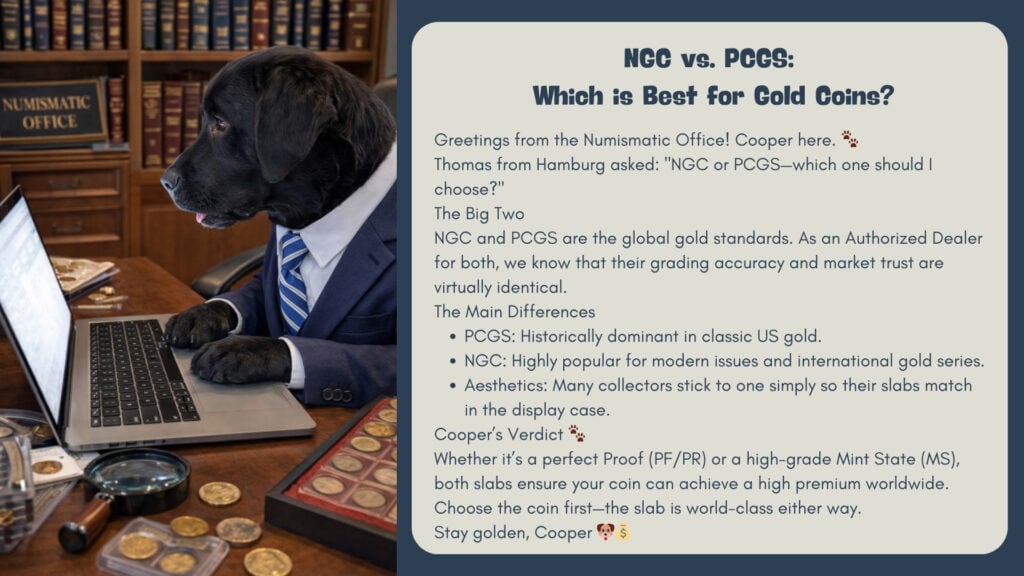
Hi Collectors Club, Cooper here. 🐾
This week, Thomas from Hamburg sent us a question that we actually hear very often – on the phone, via email or WhatsApp.
Especially in German-speaking countries, we repeatedly notice that coin grading is still a relatively new topic for many collectors. While certified coins have been an integral part of the collector market in countries like the USA for decades, many collectors in Germany have only discovered this topic in recent years.
At Wasserthal RareCoin.Store, we sell coins to collectors in more than 40 countries worldwide . This has given us extensive experience with certified coins, and over time we have increasingly specialized in highly graded collector coins . Grading has long been standard practice in many international collector markets.
Thomas has been collecting gold coins for some time and is increasingly interested in certified pieces . While browsing various offers, he noticed that many high-quality coins have been graded by either NGC or PCGS .
In his search for such coins, he eventually came across Wasserthal RareCoin.Store . He noticed that a large portion of the offered pieces had already been graded by NGC or PCGS . It was precisely this wide selection of certified coins that piqued his interest.
This led him to a fundamental question that many collectors grapple with sooner or later.
His question was therefore very direct:
Which grading company is better – NGC or PCGS?
What coin grading actually means
In the process known as grading, a coin is examined and evaluated by independent experts.
Specialists assess, among other things:
-
the state of preservation of the coin
-
the surface quality
-
possible contact marks or hairlines
-
as well as the originality of the minting
After evaluation, the coin is enclosed in a sealed holder – the so-called slab .
This protects the coin permanently and simultaneously documents the degree awarded.
This has a decisive advantage for collectors:
The condition of the coin becomes internationally comparable and verifiable .
NGC and PCGS – the best-known grading companies
In the international coin market, two companies are considered particularly established:
NGC – Numismatic Guaranty Company
PCGS – Professional Coin Grading Service
Both companies originally come from the USA , where the modern market for coin grading developed.
Today, both companies operate worldwide.
For example, NGC operates a major European office in Munich , while PCGS maintains an office in Paris . This makes it easier for collectors and dealers to submit their coins for appraisal from across Europe.
Furthermore, both companies are regularly represented at major international coin fairs , where they accept submissions and exchange information with collectors.
Wasserthal RareCoin.Store has worked closely with the most important grading institutions for many years and is an authorized dealer for NGC, PCGS, and CAC grading . This means we deal with certified coins and their evaluation on a daily basis.
How long does coin grading take?
One point that many collectors underestimate is the time required for a grading process.
After coins have been submitted to a grading company, it can often take several weeks or even months for them to be graded and returned.
For many collectors, this is not always easy – especially if you are curious about what grade a coin will ultimately receive.
However, this careful examination by several experts is one of the reasons why grading results enjoy so much trust in the international collector market .
Are there differences between NGC and PCGS?
In everyday life, the difference is smaller for many collectors than one might expect.
Both companies operate with very similar valuation standards and enjoy a high reputation worldwide among collectors, dealers and auction houses.
Some collectors still have personal preferences. Some prefer PCGS because the company has a particularly strong historical presence in the US market. Other collectors specifically collect NGC-certified coins because NGC is very prominent in many modern issues and international series.
Personal preference often plays a major role.
One point is often underestimated: the collector’s personal preference .
Some collectors prefer a uniform overall look for their collection. Those who start with coins in NGC slabs often stick with them. Other collectors prefer PCGS holders from the outset.
The reason is quite simple:
When several coins are placed side by side in a box or safe, a collection appears more harmonious if all the slabs look the same .
Especially with larger collections, this visual uniformity plays a surprisingly important role for many collectors.
Ultimately, the decision often depends not only on the grading company itself, but also on which slabs are already available in their own collection .
Cooper’s comparison from the world of dog shows 🐾
Imagine a dog participating in a large international dog show .
There, experienced judges evaluate the dogs according to clear criteria: physique, coat, movement and overall impression.
If a dog wins a title at a large international show, that title naturally carries more weight than a rating at a small local competition.
It works similarly with coins.
NGC and PCGS are, in a sense, the major international exhibitions of numismatics.
Their appraisals are accepted by collectors worldwide and create trust in the collectors’ market.
Other grading companies
Besides NGC and PCGS, there are other companies that evaluate coins.
These include, for example:
-
CAC Grading (Certified Acceptance Company)
-
as well as some smaller providers
However, in the international coin trade , NGC and PCGS enjoy the greatest recognition.
If you would like to learn more about the different valuation companies , you can find a detailed explanation here:
Cooper’s conclusion 🐾
The question “NGC or PCGS – which grading company is better?” can actually be answered quite easily.
Both companies are among the world’s leading grading firms , and their ratings are widely accepted in the international collectors market.
For many collectors, it is therefore less important whether a coin has been graded by NGC or PCGS – but rather:
-
which preservation grade was assigned
-
how rare the coin is
-
and how high the demand is in the collectors’ market
Ultimately, the most important thing is always the coin itself.
And now, please excuse me.
I think I just heard a new collector’s question land on my desk. 🐾
How we specifically check certificates and holders during the purchase process is shown in “From purchase to collection: How we check a rare gold coin” .
Further collector questions with Cooper
You can find more answers about gold coins and grading in the Collector Questions with Cooper .
Related to this topic: What does “Details Grade” mean on a gold coin? Is PF70 worth it compared to PF69?