
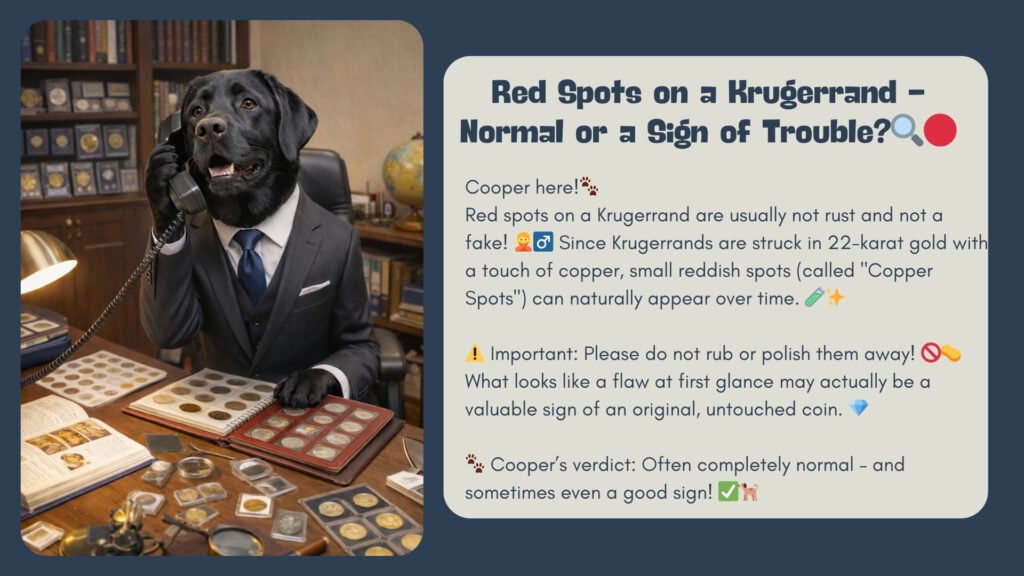
Don’t panic about supposed gold rust: Why red spots on a genuine Krugerrand are often perfectly natural copper spots.
🐾 Cooper explains
The collector’s question: Are red spots on a gold Krugerrand a warning sign?
Cooper here! 🐾
Small red spots on a gold Krugerrand immediately worry many collectors. Is the coin perhaps counterfeit? Is it rust? Or was it stored improperly?
A collector from Bern, Switzerland, approached us with precisely this question. He was unsure whether the reddish spots on his Krugerrand posed a problem or might even indicate a forgery. Many collectors share this concern.
The short answer is: No, not automatically. Red spots on a Krugerrand are often not a warning sign, but a known and natural phenomenon. In the case of a classic Krugerrand, these can be so-called copper spots , meaning reddish spots on the surface caused by copper.
Why red spots can appear on the Krugerrand
The classic gold Krugerrand is made of 22-karat gold . This also means that copper is deliberately added to the coin. This makes the Krugerrand harder, more durable, and more suitable for everyday use than a very soft pure gold coin. Furthermore, the copper gives the Krugerrand its characteristic slightly reddish-golden hue.
This copper content can cause small reddish spots or discolorations to appear in certain areas. In numismatics, these phenomena are known as copper spots or copper stains .
Are the red spots on the Krugerrand rust?
This often leads to confusion because many collectors colloquially refer to it as rust. However, this is not technically correct. Gold doesn’t rust.
The reddish spots on a Krugerrand are usually not rust, but rather copper-related discoloration or oxidation on the surface . The coin is therefore not automatically damaged, and certainly not automatically counterfeit.
Why red dots aren’t automatically bad
This is precisely where it becomes particularly interesting from a numismatic perspective. What appears to be a flaw at first glance can be viewed quite differently by experienced collectors.
Small copper spots can indicate that a coin still has its original, uncleaned surface . They are therefore not proof of authenticity, but can suggest that the coin has not been chemically treated, dipped, or artificially enhanced.
In other words, a red dot is not automatically bad. In some cases, it is rather an indication of originality instead of manipulation .
Cooper’s most important collector’s note: Please do not clean it yourself.
What you should absolutely not do: rub, polish or scrub away red stains.
This is precisely where many collectors make a costly mistake. Those who attempt to remove such marks with pressure, cloth, polish, or cleaning agents often damage exactly what is crucial for the coin’s collector value – the original surface and natural luster.
A minor cosmetic issue can very quickly lead to a real loss in value.
Are red spots normal on genuine Krugerrands?
Yes, absolutely. Red spots on a genuine Krugerrand can be perfectly normal. Precisely because of the 22-karat gold-copper alloy, such phenomena are known numismatically and are by no means unusual.
Therefore, the overall appearance of the coin remains crucial for its authenticity. These include in particular:
-
Weight
-
diameter
-
Edge notches
-
Surface image
-
conservation
-
Origin and plausibility
A red spot alone does not make a Krugerrand a counterfeit or of inferior value.
Cooper’s conclusion on red spots on the Krugerrand
Not every red dot is a problem. And certainly not every red spot is a reason to panic.
On gold Krugerrands, so-called copper spots are often a natural consequence of the alloy. They are usually not rust and not counterfeit . Furthermore, they can even indicate that a coin has retained its original, untreated surface .
What laypeople see as a flaw can therefore be a sign of genuine originality for experienced collectors.
Quick answer for those in a hurry
Red spots on a Krugerrand are usually not rust and not a counterfeit. In many cases, they are natural copper spots caused by the copper content of the 22-karat alloy. Therefore, it is important: never polish or clean them yourself , as this can damage their genuine collector value.
Do you have any questions about your Krugerrand?
If you are unsure, it is best to have your Krugerrand professionally examined before making any alterations to its surface. Especially with valuable gold coins, caution is usually the better option.


