Expert Guide 2026: This guide to coin grading and international grading standards (MS, PF, PR) was updated on October 1, 2026, to reflect current market developments and certification trends.
Coin grading is a key topic for collectors and investors. Markings like PF, PR, or MS significantly influence how a coin’s condition, minting quality, and market value are classified. This understanding is particularly important for certified gold coins from NGC or PCGS.
In this article you will learn:
-
What grading means
-
How the rating scales work (PF, MS, etc.)
-
What role do NGC, PCGS and other companies play?
-
When certification is worthwhile – and when it is not
What is grading?
Grading refers to the professional evaluation of a coin’s condition and minting quality. Leading providers include:
These companies test the coin under laboratory conditions and then seal it in a so-called slab – a protective, transparent capsule with an inspection label.
The Sheldon Scale: PF or MS?
Rating from 1 to 70
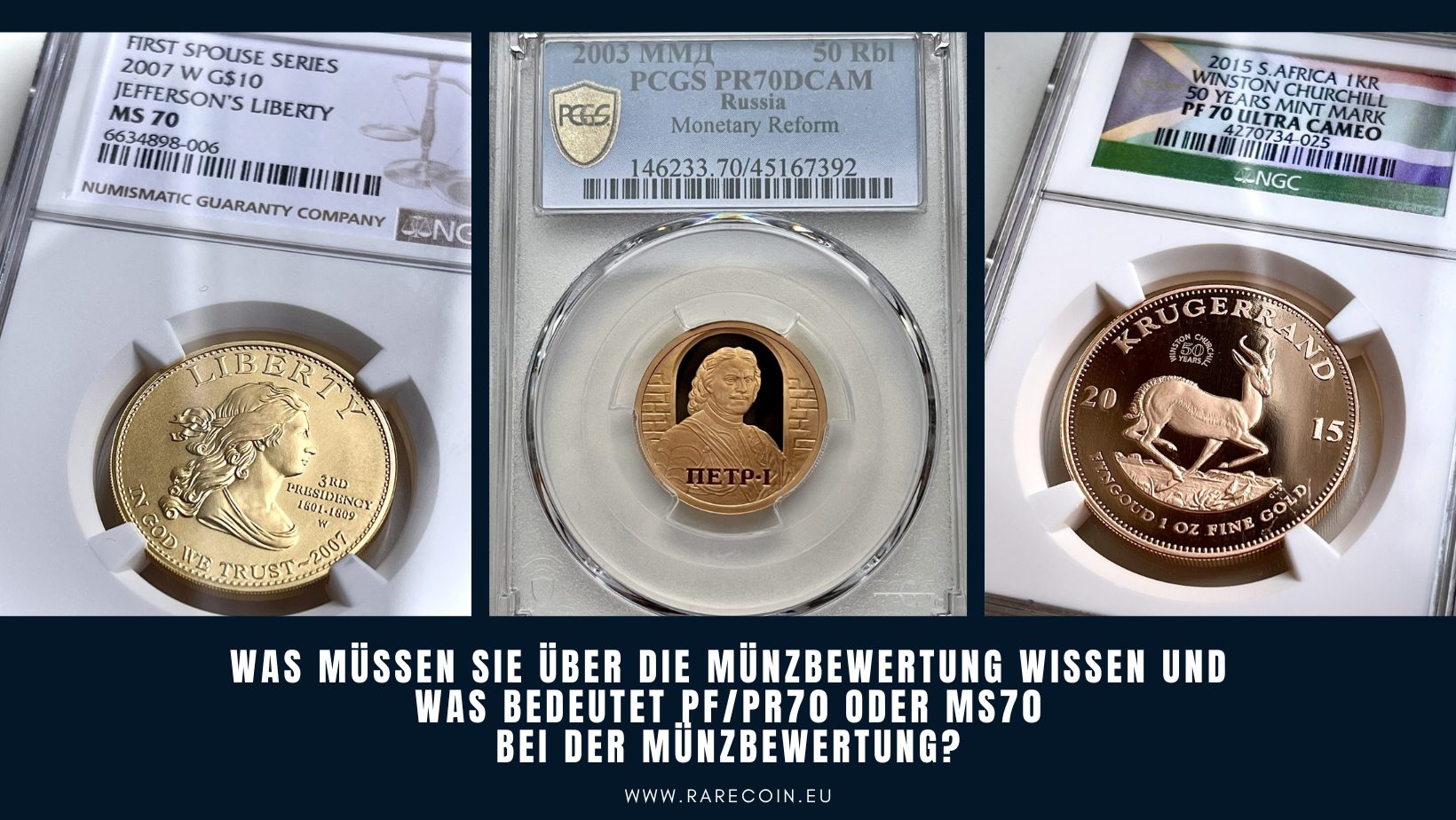
Grading is based on the Sheldon scale, which rates conditions from 1 (heavily worn) to 70 (flawless). A PF70 or MS70 coin is absolutely perfect—even under five-fold magnification.
PF, PR, MS – and what do SP, Reverse Proof & Co. mean?
Collectors encounter a variety of abbreviations when grading coins. The most important ones differ depending on the minting quality and the grading company :
-
PF (Proof): NGC uses this abbreviation for proof coins. These coins feature a mirror-like background and matte relief—typical of modern collectible coins.
-
PR (Proof): PCGS uses the abbreviation PR instead of PF, but it means the same thing: a particularly high-quality minting quality with high collector value.
-
MS (Mint State): This designation is used for coins that were not specifically minted as collector’s items but are nevertheless uncirculated – such as uncirculated or bullion coins. The scale ranges from MS60 to MS70 , with MS70 signifying flawless condition.
-
SP (Specimen): A special form, usually used for pieces that fall somewhere between circulation and collector coins. They often have a special surface or were minted in limited editions for presentation purposes.
-
Reverse Proof / Enhanced Proof: These variants are particularly visually striking. In reverse proofs , the relief is glossy, while the field is matte—the opposite of the standard proof. These mintings are usually part of special editions or anniversary series.
This variety of designations demonstrates that grading is more than just a number. The combination of abbreviation, minting quality, and condition significantly determines a coin’s market value—and how collectors or investors classify a piece.
Why is grading relevant?
Uniform standards
Grading provides consistent standards worldwide. It makes condition objectively comparable—independent of personal impressions or photos.
Counterfeit protection
Slab-graded coins are protected by seals and certification numbers. Most dealers offer online databases for authenticity verification.
Potential for value appreciation
Especially with modern gold coins, certified pieces in PF70 or MS70 fetch significantly higher prices. The quality is documented, which builds trust.
Better resale value
Investors and collectors prefer certified coins. Certification significantly facilitates international trade.
Frequently asked questions about grading
Which grading companies are relevant?
Especially NGC and PCGS. Both have an excellent reputation in the international market.
When is grading worthwhile?
For coins with a collector value above approximately €300, for modern proof coins of original quality, or for popular series (e.g., Krugerrand, Maple Leaf, Libertad, Lunar).
How much does grading cost?
Between €35 and €200, depending on the provider and service level. Shipping, customs, and insurance costs may apply.
How do you recognize fake slabs?
Be aware of design variations and check each assay number directly on the NGC or PCGS website.
Conclusion
Grading builds trust, increases collector value, and enables international comparison of quality. Those who collect or invest in high-value coins should consider graded coins – especially those in PF70 or MS70. They represent the highest quality and long-term value retention.
About the author: Larissa Wasserthal
In the world of high-end numismatics, subtle nuances often determine market value. As editor for RareCoin.Store, Larissa Wasserthal specializes in making the technical aspects of coin grading transparent and comprehensible for collectors. Her focus is on analyzing international grading standards and their impact on the value stability of gold coins. Her goal is to equip collectors with the necessary knowledge to objectively assess the quality of their pieces, thus creating the foundation for secure and lasting investments.
Learn more about the work of Larissa Wasserthal.
“Grading is no longer a luxury, but the standard for modern numismatics. Those who think long-term are not just buying gold, but documented quality.” — Larissa Wasserthal, RareCoin Team
Further content on RareCoin.Store
-
Was sind die Grundlagen des Gradings? Part 4 of our compact training shows it.