
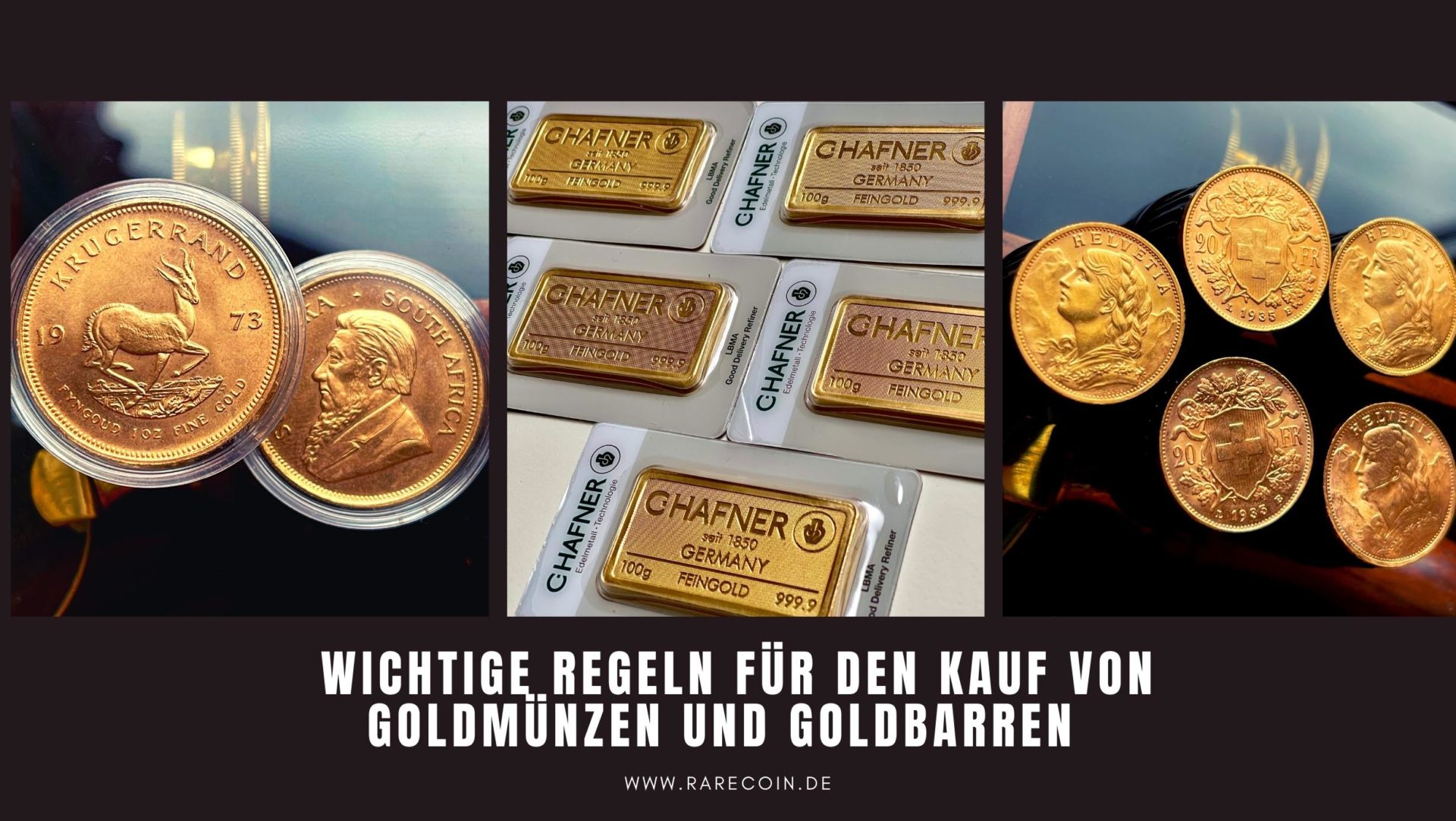
Gold coins vs. gold bars – differences, advantages and buying criteria
Buying gold coins and gold bars requires more than just looking at the current gold price. Anyone wanting to acquire physical gold should carefully examine its authenticity, dealer quality, premium, storage, and future resale value. Especially with high-quality gold coins, classic investment coins, and gold bars, a few basic rules determine whether the purchase is a sensible and secure long-term investment.
When buying gold, always consider the later sale.
Those who acquire gold as a crisis reserve or store of wealth should consider not only the purchase price but also a potential later sale . An example illustrates this:
Anyone who buys a 1kg gold bar owns a cost-efficient unit (low price per gram), but faces a problem if needed:
If only a partial amount is needed, the bar cannot be sold “proportionally”. It must be sold in its entirety – often at a time that may be unfavorable from a market perspective.
Practical recommendation:
Gold positions should be structured so that they can be liquidated gradually and flexibly over time . This suggests a combination of several smaller units rather than one large single position.
Price per gram – and why smaller denominations can still be useful
The following generally applies:
The larger the unit, the lower the price per gram, as dealer markups on larger pieces are proportionally smaller.
However, this logic has a second side:
-
Larger units = cheaper per gram, but harder to resell.
-
Smaller units = higher surcharge, but more flexibility and liquidity
Especially during uncertain market phases, smaller gold coins are often traded faster and more easily than large bars or rare special sizes.
Best practice approach:
A mixture of several denominations, e.g.
-
1 oz as a standard investment size
-
supplemented by 1/2 oz, 1/4 oz or 1/10 oz for flexible partial sales
This ensures that the position remains stable, tradable and divisible as needed .
Which gold coins are particularly suitable for investment?
For investors, internationally circulated bullion coins are particularly worthwhile. These coins have:
-
high market acceptance
-
transparent pricing close to the spot price
-
global tradability
Typical examples:
-
Krugerrand (South Africa)
-
Maple Leaf (Canada)
-
Vienna Philharmonic Orchestra (Austria)
-
American Eagle (USA)
-
Britannia (United Kingdom)
-
China Panda
These coins are usually available in 1 oz , but also in smaller denominations, and are considered to be particularly liquid .
What influences the price of gold coins and gold bars?
Besides the price of gold, several other factors play a role:
-
Type of provider
Specialized precious metal and numismatic dealers usually offer
Professional advice, competitive prices and stable availability. -
Coin type
Part of the portfolio should consist of classic investment coins .
Proof or collector’s editions are a separate segment and follow different market mechanisms. -
Condition and handling
Gold is soft and delicate.
Scratches, stains or contact marks can reduce the resale value.
Proof coins should generally only be handled in a capsule and with gloves. -
Unit of weight
While a higher weight lowers the price per gram, it also reduces the divisibility for sale – an important aspect for crisis or liquidity planning.
Collector coins as an addition to your mix: consider additional risks
The pricing of rare collector coins follows different rules than that of classic bullion coins. Besides the gold value, the numismatic premium is primarily determined by documented rarity, condition, population, demand, and actual market availability. A low mintage alone, therefore, guarantees neither an increase in value nor a smooth resale.
Certification by NGC or PCGS improves international comparability and documents authenticity and condition according to the respective standards. However, it does not guarantee a specific market price or immediate liquidity. Therefore, before purchasing, one should check the population, available comparable offers, verifiable sales results, and demand within the respective series.
Furthermore, collectors should avoid emotional purchases and artificial time pressure. Rare coins may be unavailable for extended periods, but scarcity is no substitute for a well-informed purchasing decision. Those needing short-term liquidity are usually better off with internationally circulated bullion coins. Rare modern collector coins, on the other hand, are more suitable as a targeted, long-term addition to a collection.
Storage – at home, in a safe or in a bank safe deposit box?
Gold can, in principle:
-
at home in a high-quality safe or
-
in a bank safe deposit box
They must be stored securely. Security, discretion, and insurance coverage are crucial.
For larger inventories, separate storage of several units makes sense – again with a view to future liquidity.
Where can you buy gold coins and gold bars?
Basically, there are three sources:
-
Banks – often limited product range and fluctuating availability
-
Precious metals and numismatics dealers – largest selection, market-based prices, expertise
-
Private purchases – only with great caution, as there is a risk of counterfeiting and fraud.
For high-quality coins and professional handling, a reputable specialist dealer is usually the best choice.
Gold coins or gold bars – which is better?
There is no universally valid answer – a strategic combination makes sense:
-
Bars are suitable for larger individual amounts.
-
Gold coins offer flexibility, tradability, and a variety of denominations.
For many investors, a coin-centric approach is therefore proving successful.
with additional bars only where larger sums are to be tied up long-term.
Tax information for Germany
In Germany, the purchase of investment gold is exempt from value added tax.
This includes:
-
commercially available gold bullion coins
-
Gold bars with defined fineness
Numismatic collector coins may be subject to different tax regulations – in case of doubt, professional advice is recommended.
Conclusion
Those who invest in gold should not only pay attention to the purchase price, but above all to:
-
Liquidity and denomination structure
-
tradable, recognized coin types
-
safe condition and proper storage
-
reputable sources
If structured correctly, a gold portfolio can combine long-term stability, flexibility and value preservation.
If you have any questions about gold coins, portfolio structure or suitable denominations, we would be happy to advise you personally.
About the author
Larissa Wasserthal, at Wasserthal RareCoin.Store, focuses on modern gold coins, certified collector coins, and the most important quality criteria when buying high-quality precious metals. In her articles, she combines practical market experience, numismatic classification, and clear advice for making informed purchasing decisions, enabling collectors and investors to better assess gold coins and bars.
This article was updated for you in April 2026. The information on the safe purchase of gold coins and gold bars, authentication, dealer selection, and typical mistakes was editorially revised.