
Updated April 2026 – Exonumia offers a fascinating extension to classic numismatics. In this update, we examine the unique features of tokens, medals, and other items in 2026 and explain the key differences for collectors looking to add exceptional pieces to their portfolios.
The term exonumia refers to a specific area of collecting within numismatics. It encompasses all coin-like or money-related objects that are not official legal tender but may be of interest from a historical, cultural, or collector’s perspective. For many collectors, exonumia represents a deliberate complement to or alternative to traditional coin collecting.
The term is derived from Greek:
“Exo” means “outside,” and “nummus” stands for “coin.” Thus, it refers to objects that exist outside the regular monetary system .
What is included in the Exonumia?
Exonumia encompasses a wide range of very different objects. What they have in common is that they were not intended as legal tender, but were often used in an economic or social context.
Typical forms of exonumia
Tokens
These coin-like objects were historically used as a substitute for money, for example in public transport, factories, arcades or on company premises.
medals
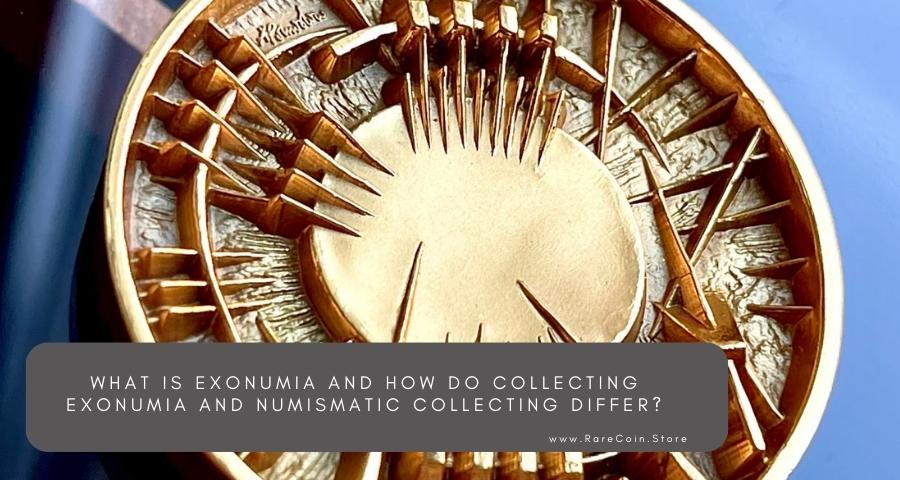
Medals are issued to honor individuals, events, or anniversaries. They have no face value but are often made of precious metals and feature sophisticated artistic designs.
Badges and pins
These pieces are often associated with organizations, political movements or special occasions and reflect social trends of their time.
Commemorative items and plaques
This includes objects created to commemorate historical events, exhibitions, or anniversaries, often in very limited editions.
Vouchers and Scrip
Alternative currencies issued by companies to employees, particularly in industrialized regions. Today, they are important historical records of social and economic structures.
Love Tokens
These are usually smoothed coins that have been individually engraved, for example with initials or dedications, and thus possess a strong personal character.
Souvenir coins (elongated coins)
Machine-deformed coins produced as souvenirs in tourist areas. These also clearly belong to the category of exonumia.
Historical tickets
Old train, tram or subway tickets can also be considered exonumia, provided they are collectible or historically relevant.
Exonumia vs. classic numismatic coins – the most important differences
Although exonumia belongs to the broader numismatic field, collecting it differs fundamentally from classic coin collecting.
Monetary value
Traditional coins either have a legal face value or an intrinsic material value , such as gold or silver. Exonumia, on the other hand, generally have no guaranteed monetary value and are not subject to fixed precious metal standards.
Collecting motivation
While coin collecting is often driven by value appreciation, rarity, and condition, exonumia is usually driven by historical, cultural, or personal interest . The financial aspect is often secondary.
Market and comparability
Numismatic coins can often be compared using catalogs, mintages, and market prices. This standardization is frequently lacking for exonumia. Instead, their value arises from context, provenance, and demand within small collector circles.
Why Exonumia is so appealing to collectors
Exonumia offers insights into areas of history that traditional coins often don’t depict. It documents everyday life, industrial history, social structures, and cultural events. Many collectors also appreciate the detective work required to research the origin, purpose, and meaning of individual pieces.
It is precisely this openness that makes Exonumia a very individual collecting field, which is less regulated than classical numismatics and therefore offers great creative freedom.
Conclusion
Exonumia adds a fascinating dimension to numismatics. It encompasses objects resembling money but lacking official legal tender status, whose value lies less in the material itself than in their history, context, and significance. While classic coins are often valued according to fixed criteria, exonumia thrives on diversity, individuality, and the joy of discovery. For collectors who wish to look beyond the mere concept of money, it represents a unique and challenging field of collecting.
About the author
Larissa Wasserthal is an expert in numismatics and is passionate about explaining complex topics in a simple and understandable way. Her focus is on presenting the historical relevance and the special fascination behind rare pieces in a way that makes them accessible to every collector. Learn more about Larissa Wasserthal.


