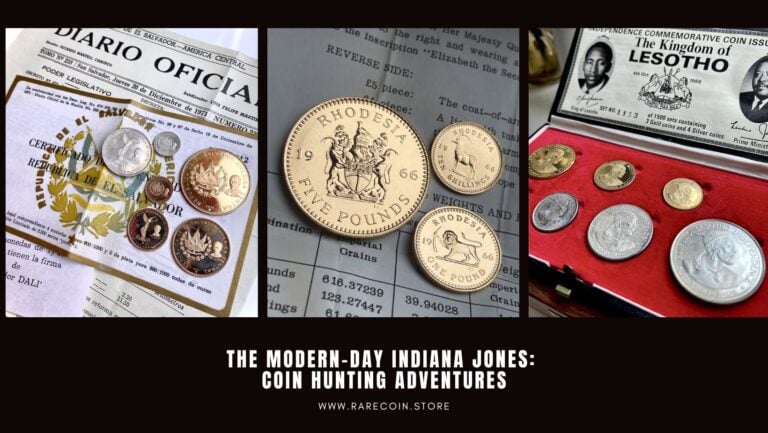

Comparing prices of rare coins: Why the cheapest price isn’t automatically the best
Comparing prices of rare coins is significantly more complex than comparing prices of ordinary goods. Two coins can appear identical at first glance and yet have different market values. Year of issue, variant, minting quality, condition, certification, population, original accessories, and current market availability all significantly influence the price.
Therefore, neither a high dealer price is automatically overpriced, nor is a low price necessarily a good deal. The crucial factor is whether the same coin, of comparable quality and with identical contents, is actually being compared.
1. Compare the exact coin.
A meaningful price comparison begins with clearly identifying the issue. Even small differences can turn a common coin into a rare variant.
Therefore, check:
- Country and year of issue
- Nominal value and denomination
- Metal, fineness and fine weight
- Bullion, Proof, Reverse Proof or other minting quality
- Motif and specific variant
- Privy Mark, Mint Mark or Special Marking
- Single coin or part of a set
- Original edition or later reissue
A one-ounce gold coin from the same country and year is not automatically comparable to every other one-ounce issue. Proof and bullion coins, for example, follow different pricing and collector logics.
You can find out more under Collector coins and investment coins – the crucial differences .
2. Separate the gold value and the numismatic premium.
The intrinsic value of every gold coin is its gold content. However, rare collector coins also have a numismatic premium.
The market price can therefore be simplified to consist of two components:
- current value of the gold contained
- Premium for rarity, quality and collector demand
A price comparison based solely on gold weight is insufficient for rare coins. Conversely, a high premium should be demonstrably justified by specific numismatic characteristics.
You can find a detailed explanation in the article “What is the right price for your gold collector coin?” .
3. Correctly classifying conservation and grading
The condition of a coin can significantly influence its market value. Collectors are particularly sensitive to hairlines, scratches, fingerprints, stains, or other surface defects, especially in modern proof gold coins.
Therefore, you should compare certified coins:
- Grading company
- numerical degree
- Additional designations such as Ultra Cameo or Deep Cameo
- Certification number
- Holder and Label
- possibly origin or special signature
- Population at the respective level
NGC PF70 and NGC PF69 are not automatically interchangeable. Likewise, a coin in PF69 may be rarer and more sought after on the market than a more commonly available issue in PF70.
The certification number should be verified directly with NGC or PCGS. This will ensure that the coin, grade, and holder match the information provided in the offer.
4th edition, population and market availability must be checked.
A low print run is an important indicator, but not a guarantee of high collector value. What matters is how many copies are actually available on the market and how high the demand for the issue is.
Three values must be distinguished:
- original mintage
- certified population at NGC or PCGS
- Currently available copies in stores and at auctions
A coin may have a relatively high total mintage, but be extremely rare in a particular condition. Conversely, a coin with a low mintage may generate little demand and therefore be difficult to sell despite its rarity.
For Top Pop coins, it should also be checked whether a higher-rated specimen actually exists and how many pieces share the highest grade.
5. Correctly compare historical auction results
Auction results are valuable points of reference. However, they should not be accepted as the current market price without verification.
Please note:
- Auction date
- gold price at that time
- Surcharge price or total price
- Buyer’s premium
- Shipping, insurance and import costs
- population at that time
- current market availability
- Development of international demand
The relationship to the gold price is particularly important. An auction result from a time with a significantly lower gold price must be interpreted accordingly.
To do this, one should first consider how high the premium was above the gold value at that time. Then, one can examine how this numismatic premium relates to the current gold value and the current market situation.
An old winning bid without buyer’s premium is therefore not directly comparable to today’s final price of a dealer offer.
6. Asking prices and actual prices achieved differ.
An online dealer price or a private sales offer only confirms the price a seller is asking. It does not show whether the coin was actually sold at that price.
Therefore, the following are particularly relevant for a reliable comparison:
- documented auction results
- Verifiably sold dealer offers
- several current comparison offers
- Duration of market availability
- actual scarcity of the issue
For very rare coins, there are often no recent comparable sales. In such cases, an exact price determination is more difficult and must be based on the gold value, rarity, population, previous results, and international demand.
The absence of cheaper comparable offers does not automatically mean that an existing offer is in line with the market. However, it can indicate that the coin is indeed rare.
7. Consider the box, certificate, and provenance.
The original box, certificate of authenticity, numbered COA, outer packaging, or other documents may be included with a collector’s coin. Especially with limited proof issues and coin sets, complete original accessories can influence the market value.
When comparing prices, the following should therefore be checked:
- Is the original box included?
- Does the issue include a numbered certificate?
- Do the coin and certificate numbers match?
- Is the set complete?
- Is there a verifiable provenance?
- Are the original invoices or other documents available?
A single coin without accessories is not always comparable to a complete original set. Likewise, a professionally certified single coin may be more attractive to certain collectors than an ungraded coin in its original box.
8. Include dealer services in the total price
The price charged by a specialized coin dealer includes more than just the coin’s material value. Depending on the dealer’s offerings, additional services may be included:
- Examination and correct determination of the output
- Authenticity and condition check
- professional product photography
- verifiable information on grading and population
- secure payment processing
- Insured shipping
- professional packaging
- Warranty and available contact person
- Sourcing rare pieces on international markets
These services do not justify any arbitrary surcharge. However, they have real value and must be taken into account when comparing them with private offers, foreign auctions, or uninsured sales.
When is a coin offer actually too expensive?
A high price can be critical if:
- Rarity or edition size may be misrepresented.
- a top pop status is not demonstrable,
- Certification data is missing or incorrect,
- a common bullion coin is offered as a numismatic rarity,
- The premium price bears no comprehensible relation to market availability.
- Significantly cheaper identical copies are available at the same time,
- The condition or scope of delivery is not described transparently.
A dealer should be able to explain why a coin is priced above its gold value or above comparable offers.
When should an unusually low price raise suspicion?
Even a strikingly cheap offer can conceal risks:
- counterfeit or manipulated coin
- counterfeit or altered slab
- incorrect variant determination
- hidden surface damage
- missing box or missing certificate
- uninsured shipping
- unclear origin
- misleading photos
- fees, taxes, or import costs not included
Especially with rare gold coins, an exceptionally low price should not replace checking authenticity, condition and seller.
Further information can be found under Counterfeit protection for modern gold coins .
How to compare coin offers step by step
- Specify the exact edition and variant.
- Check the gold weight and current metal value.
- Compare the minting quality and the degree of preservation.
- Verify NGC or PCGS certification data .
- Check circulation, population, and top-pop status.
- Look for actual sales prices achieved.
- Compare historical prices to the gold price at that time.
- Consider the box, certificate, and scope of delivery.
- Add buyer’s premium, shipping and import costs.
- Rate dealer services, security, and warranty.
Only then can one assess whether an offer is expensive, cheap, or in line with the market.
Transparent pricing at Wasserthal RareCoin.Store
Wasserthal RareCoin.Store specializes in rare modern gold and platinum coins, proof issues, low mintages, and NGC, PCGS, and CAC certified pieces.
Many of these coins are rarely offered worldwide. Therefore, when determining the price, we consider not only the gold value, but also:
- actual market availability
- historical auction results
- then and now gold price
- certified conservation status
- Population and Top Pop Status
- international collector demand
- Box, certificate and provenance
- Procurement, insurance and shipping costs
The aim is not merely to state a price, but to be able to classify it comprehensibly based on the specific coin.
You can find a current selection in our Gold Coins section.
Frequently asked questions about comparing coin prices
Why does the same gold coin cost different amounts at two dealers?
The coins are often not completely identical. Differences in condition, grading, variant, population, accessories, provenance, and dealer services can explain the different prices.
Is the cheapest coin dealer automatically the best choice?
No. In addition to price, authenticity, condition, scope of delivery, insurance, warranty and expertise should be taken into account.
Are auction results more reliable than dealer prices?
Auction results show actual prices achieved. However, buyer’s premium, the gold price at the time, shipping costs, and the market situation at the time must be taken into account.
How can I recognize an inflated price?
Compare the exact issue, condition, population, gold value, current offers, and documented sales results. A high premium should be clearly justified.
Why are Top Pop coins often more expensive?
Top Pop refers to the highest grade awarded by a grading company for a particular release. If the population is small and demand is high, this can result in an additional premium.
Are rare coins always expensive?
No. Rarity alone does not create a high market value. There must also be corresponding collector demand.
How do I compare a foreign auction offer with a German dealer price?
Add buyer’s premium, currency conversion, shipping, insurance, possible import costs and the risk of international transaction to the winning bid price.
Conclusion: Price and value are not the same for rare coins.
Comparing prices of rare coins requires more than simply finding the lowest offer. A proper comparison considers gold value, mintage, variant, condition, certification, population, accessories, market availability, and all associated costs.
A high price is not automatically overpriced. Likewise, a low price is not necessarily a good deal. The crucial factor is whether the total price offered is appropriate for the specific coin, its rarity, and the features it includes.
Those who systematically check offers and compare identical features can better understand price differences and make more informed purchasing decisions.
Author box
Larissa Wasserthal is co-founder of Wasserthal RareCoin.Store and deals with modern numismatic gold coins, international collector markets, and the question of how gold value, rarity, condition, population, and demand influence the price of a collector coin.
Updated in June 2026: This article has been completely revised and supplemented with information on grading, population, auction results, gold price comparison, incidental costs and dealer services.
We hope this information will help you navigate the numismatic market with confidence!
Immerse yourself in the world of coins and let these blogs inspire you:
The true rarity of a coin: More than just a number!
A concise guide to documenting your coin collection