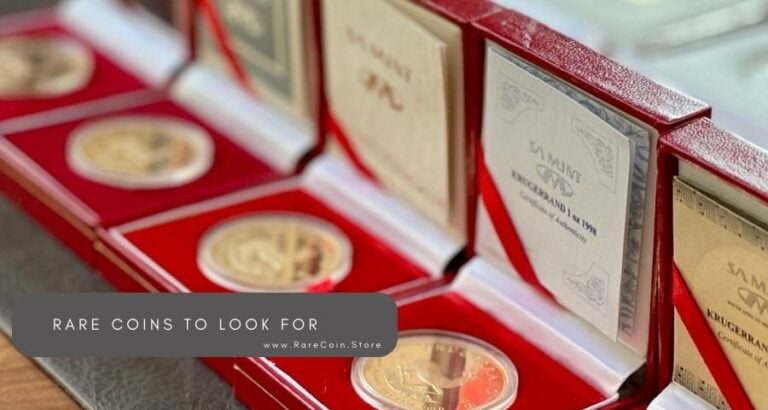

Krugerrand Privy Mark or Mint Mark – this question is more important for rare Krugerrand proof coins than it might initially seem. Additional markings on special Krugerrand issues can indicate anniversaries, historical occasions, or limited editions, without necessarily being a classic mint mark.
The Krugerrand is one of the world’s most famous gold coins. However, it is not only a classic bullion coin, but also an interesting collector’s item with numerous proof issues, anniversary editions, sets, and special editions.
Especially with rare Krugerrand Proof coins, additional markings frequently appear. This raises an important technical question: Is such a marking a Mint Mark or a Privy Mark ?
This distinction is not only linguistically relevant. It helps collectors to precisely understand the nature of a special Krugerrand issue and to clearly differentiate it from regular Krugerrand issues.
This article was published in May 2026 and classifies Krugerrand special editions with Privy Mark and Mint Mark from a numismatic point of view.
Why this question is particularly important with the Krugerrand
The Krugerrand has a clear basic design: Paul Kruger on the front, springbok antelope on the back, a gold alloy with a fineness of 916.7/1000 and a globally recognized coin type that has been minted since 1967.
However, numerous issues exist that go far beyond the normal bullion character. These include, in particular, proof issues, prestige sets, anniversary issues, and variants with additional markings.
Such markings can be very important for collectors because they clearly define an issue. A regular Krugerrand gold coin, a proof Krugerrand, and a limited proof edition with an additional special mark are not numismatically identical.
Therefore, the question of what function such a symbol actually fulfills is important.
Mint Mark and Privy Mark on the Krugerrand explained briefly
A mint mark, in the classic sense, is a mint mark. It indicates the mint or place where a coin was produced. The term therefore primarily answers the question: Where was the coin minted?
A privy mark, on the other hand, is an additional marking that often indicates a special occasion, an anniversary, a special edition, or a limited version. It answers the question: Why was this particular edition minted?
This distinction is particularly important with the Krugerrand. Not every additional mark on a special Krugerrand issue automatically indicates a different mint. In many cases, the mark instead signifies an occasion or a special edition.
Official name and numismatic function
When dealing with special Krugerrand issues, one should distinguish between the official or market-standard designation and the numismatic function of a symbol.
If a certificate, product documentation, or issuing context uses the term “Mint Mark ,” this designation should first be documented and respected. It is part of the specific issue and can be relevant for collectors, dealers, and certification bodies.
At the same time, the use of this term does not automatically mean that the mark designates a mint in the classical sense. The decisive factor remains the function of the specific mark on the coin.
If the mark indicates a minting location, it strongly suggests it is a mint mark. However, if it refers to an anniversary, an occasion, or a special edition, it is more likely, from a numismatic perspective, to be classified as a privy mark.
This distinction is particularly important because it does not evaluate why a particular term is used in documents. Rather, it objectively asks what function the symbol on the coin fulfills.
Example: Krugerrand 2016 QEII 90
A particularly good example is the 2016 Krugerrand Queen Elizabeth II 90th Birthday 1 oz Gold Proof .
This issue bears the additional mark “QEII 90” . This mark refers to the 90th birthday of Queen Elizabeth II. It does not indicate an alternative mint and therefore does not represent a different minting location.
From a numismatic perspective, there is therefore much to suggest that the mark “QEII 90” should be classified functionally as a privy mark . The occasion of the issue is paramount, not the place of minting.
This particular issue clearly demonstrates why precise terminology is important when it comes to the Krugerrand. The 2016 Krugerrand QEII 90 is not an ordinary 1-oz gold coin, but a special proof edition with a historical context, a very limited mintage, and exceptional collector appeal.
Why the Krugerrand QEII 90 is interesting for collectors
The appeal of this edition lies not solely in its gold content. Crucially, it is the combination of several features that together create a unique collector’s profile.
These include in particular the 1 oz gold edition in the classic Krugerrand format, the Proof or Polished Plate minting quality, the special mark “QEII 90” , the reference to the 90th birthday of Queen Elizabeth II, the small mintage and the original packaging with box and COA.
This distinguishes this issue significantly from regular bullion Krugerrands. While the gold value remains the material basis, the numismatic collector value also arises from the occasion, the limited edition, the condition, the completeness, and the actual market availability.
Especially with modern Krugerrand proof coins, such factors can be crucial. A coin can remain outwardly very close to the familiar Krugerrand type and yet acquire a significantly different collector’s character through a special mark, a certificate, a limited edition, or a particular historical classification.
When “Mint Mark” is used in the product environment
The term “Mint Mark” may appear in certificates, product documentation, or dealer descriptions for special Krugerrand issues. This designation is part of the specific issue context and should therefore be documented.
For numismatic classification, however, the crucial factor is the function of the specific mark on the coin. If it designates a mint, it corresponds to the classic understanding of a mint mark. If, on the other hand, it refers to an occasion, an anniversary, or a special edition, the classification as a privy mark is more technically precise.
The function of the mark “QEII 90” lies in its connection to the occasion. It refers to Queen Elizabeth II and her 90th birthday. It does not indicate an alternative mint. Therefore, from a numismatic perspective, this Krugerrand issue can be appropriately described as a special edition with the privy mark “QEII 90” .
What does this mean for the valuation of such Krugerrand issues?
To assess the value of a Krugerrand with special markings, it is not sufficient to simply look at the gold price. Likewise, the designation “Mint Mark” or “Privy Mark” alone does not determine its value.
More important is the overall assessment of the issue. Key factors include the year, minting quality, print run, condition, certificate, original packaging, market availability, and collector demand.
For proof issues with a privy mark, the collector value can deviate significantly from the normal bullion logic. While bullion Krugerrands are usually closely tied to the gold price, rare proof variants are valued more strongly according to numismatic relevance, condition, completeness, and actual rarity.
Therefore, Krugerrand special editions should always be precisely described. Only in this way can it be determined whether it is a regular gold coin, a proof edition, an anniversary variant, or a particularly limited collector’s edition.
Krugerrand special coins as part of modern collector history
The Krugerrand holds a special position because, on the one hand, it is world-renowned as an investment coin, and on the other hand, it has also been minted as a proof and collector’s coin for decades. This dual role often leads to misunderstandings.
Those who only consider the bullion market primarily focus on weight, gold content, and the daily price. Collectors of rare Krugerrand Proof coins also consider minting quality, mintage, certificate, slab, population, box, COA, design details, and special variants.
Special characters like “QEII 90” belong precisely in this second category of analysis. They don’t automatically make a coin more valuable, but they can clearly define an issue and make it significantly more interesting for specialized collectors.
Therefore, when discussing such coins, it’s not enough to simply mention that a symbol is present. It’s also important to explain the function of that symbol and how it fits into the history of the Krugerrand.
Conclusion: With the Krugerrand, the function of the symbol is what counts.
With Krugerrand special editions, the distinction between Mint Mark and Privy Mark is particularly important. Not every designation in product documentation automatically answers the numismatic question of function.
A mint mark, in the traditional sense, refers to a mint. A privy mark, on the other hand, often refers to an occasion, an anniversary, or a special edition.
In the case of the 2016 Krugerrand QEII 90 , the function of the mark clearly indicates its classification as a privy mark. The mark “QEII 90” refers to the 90th birthday of Queen Elizabeth II and not to any other mint.
For collectors, this precision is crucial. It helps to correctly distinguish rare Krugerrand Proof issues from regular bullion coins and to properly understand their numismatic character.
Wasserthal RareCoin.Store places particular emphasis on this precise classification for rare Krugerrand issues, proof coins, certified collectibles, and modern South African gold coins. Especially with limited editions, a precise description is crucial for a coin to be truly understood.
Frequently asked questions about Krugerrand Privy Mark and Mint Mark
What is a Krugerrand Privy Mark?
A Krugerrand privy mark is an additional mark on a special edition Krugerrand. It often commemorates a special occasion, anniversary, or limited edition. It typically does not indicate the minting location, but rather the special significance of the issue.
What is the difference between the Privy Mark and the Mint Mark on a Krugerrand?
A mint mark traditionally designates a mint . A privy mark, on the other hand, refers to an occasion, an anniversary, or a special edition. This distinction is important with the Krugerrand because additional marks do not automatically indicate a different mint.
Is “QEII 90” a privy mark on the Krugerrand?
From a numismatic perspective, the classification as a privy mark is obvious. The mark “QEII 90” refers to the 90th birthday of Queen Elizabeth II and not to an alternative mint.
Why does some documents still list Mint Mark?
This could be due to the official or common product name. However, the function of the mark is crucial for its technical classification. If it doesn’t indicate a place of manufacture but rather marks an occasion, “privy mark” is the more precise description.
Is a Krugerrand with a privy mark automatically more valuable?
No. A privy mark alone does not guarantee a higher value. Decisive factors include mintage, minting quality, condition, certificate, original packaging, market availability, and collector demand. However, for very limited proof issues, a privy mark can be an important additional collector factor.
Why is the 2016 Krugerrand QEII 90 particularly interesting?
The 2016 Krugerrand QEII 90 combines a 1-oz gold proof issue with a clear commemorative reference and a visible special mark. This distinguishes it significantly from regular Krugerrand issues and makes it particularly interesting for specialized collectors of modern South African gold coins.
About Wasserthal RareCoin.Store
Wasserthal RareCoin.Store specializes in rare modern gold and platinum coins. The focus is on certified NGC and PCGS coins, proof issues, low mintages, top pop pieces , and select collector coins from South Africa, North America, Europe, and Asia.
Particular attention is paid to rare Krugerrand Proof issues, South African Natura gold coins , modern collector series, and coins with demonstrable numismatic relevance. The focus is not solely on the pure precious metal value, but also on the combination of condition, rarity, certification, series membership, and actual market availability.